
Polypropylene softens, melts and can produce flaming drips, so selecting an additive is not enough: you must match the chemistry to the PP grade, processing window and required fire test. By the end, you will have a practical screening plan covering formulation, compounding, validation, documentation and supplier qualification for industrial production in Bhiwadi.
Key takeaways
- Address burning, melt dripping, char formation, and smoke as separate design problems.
- Choose one-pack, intumescent, halogenated, or mineral systems against your PP grade and end use.
- Set drying, melt temperature, screw speed, and residence time before production trials.
- Test the finished part for fire performance, strength, impact resistance, and appearance.
Why polypropylene needs more than a basic flame-retardant additive
Unmodified polypropylene has a limiting oxygen index of only about 17–18%, so it supports burning in ordinary air. It also softens, melts and forms flaming drips. Effective polypropylene flame retardancy must therefore address four separate behaviours: gas-phase burning, melt dripping, char formation and smoke generation.
A chemical that suppresses flames can still produce unacceptable drips or dense smoke.
UL 94 V-0 V-1 V-2 are specimen-specific classifications, not generic PP resin grades. Results depend on thickness, conditioning, specimen orientation, afterflame time, afterglow and whether flaming drips ignite cotton below the specimen.
| Test or output | What it measures | What it does not prove |
|---|---|---|
| ASTM D2863 LOI test | Minimum oxygen concentration supporting candle-like downward burning | A pass in vertical, horizontal, heat-release or end-use testing |
| UL 94 vertical burning | Afterflame, afterglow and flaming-drip behaviour | Performance at another thickness or conditioning state |
| IEC 60695 glow-wire test | Ignition and glowing behaviour under a specified electrical-product challenge | General flame-retardant performance |
| ASTM E662 and cone calorimetry | Flaming/non-flaming smoke density and heat-release rate | Smoke toxicity, corrosivity or end-use acceptability |
Define the application target before choosing a chemical. Specify the required UL 94 class, actual wall thickness and conditioning protocol; add the IEC 60695 glow-wire requirement when the customer calls for it. Use ASTM E662 for smoke measurement and record cone-calorimeter outputs such as heat-release rate when the specification requires them.
Changing pigment, glass fibre, mineral filler, lubricant or recycled PP can alter the result at the same nominal dosage.
How to choose between one-pack, intumescent, halogenated and mineral systems
Do not choose a universal flame retardant loading for PP. Ask the supplier for polypropylene-specific data in weight percent, phr, or masterbatch let-down ratio, then test that concentration in the exact PP grade and specimen thickness.
| Option | What it means | Decision consequence |
|---|---|---|
| One-pack additive | Pre-balanced blend for PP | Simplifies dosing, but verify every component and grade |
| Halogenated plus antimony | Halogen chemistry paired with antimony compounds | Lower loading; check smoke, corrosive products, recycling and restrictions |
| Phosphorus-based system | Phosphorus chemistry promoting gas-phase action or char | Compare colour, hydrolysis, migration and melt-flow effects |
| Intumescent | Acid, carbon and blowing sources forming expanded char | An ammonium polyphosphate intumescent often needs higher loading |
| Mineral system | ATH, magnesium hydroxide or related fillers | Lower cost potential, but loading can hurt impact and flow |
A halogen-free polypropylene intumescent commonly combines ammonium polyphosphate, pentaerythritol and melamine. Coated or microencapsulated APP can improve moisture resistance, dispersion and processing stability. Zinc borate and molybdate compounds can support smoke suppression or char formation, not replace the primary flame retardant.
Aluminium hydroxide dehydrates around 180–220°C, making it risky as the sole high-performance choice near PP processing temperatures. Magnesium hydroxide decomposes around 330–350°C, but its high loading can reduce impact strength, elongation and melt flow.
Do not recommend FAM-501 for PP: it is positioned for plasticized PVC and needs PP compatibility and fire-test data. Define halogen-free by analytical limits and CAS numbers. EU RoHS limits PBB and PBDE to 0.1% each in homogeneous material; check decaBDE (CAS 1163-19-5) and HBCDD (CAS 25637-99-4) separately under the POPs framework.
Set the PP grade, drying plan and extrusion process before scaling
Select the PP grade before selecting the additive. Homopolymer PP gives stiffness; random-copolymer PP improves clarity and impact; impact-copolymer PP, PPCP and PPHP can change crystallinity, dripping and weld-line strength. Compare melt-flow rate polypropylene grades because viscosity controls wetting, dispersion, residence time and injection filling.
| Grade | Processing implication | Record before trial |
|---|---|---|
| Homopolymer PP | Higher stiffness; check dripping and impact retention | MFR, crystallinity and supplier compatibility |
| Random-copolymer PP | Lower crystallinity; check softening and weld lines | MFR, comonomer content and moulding history |
| Impact-copolymer PP, PPCP, PPHP | Rubber or high-crystallinity phases alter dispersion and fire response | MFR, impact modifier and validated loading |
Before compounding, specify particle-size distribution, surface treatment, bulk density, purity, residue, moisture and an accepted dispersion limit. Apply flame-retardant powder moisture control using the supplier’s drying data. In twin-screw extrusion, feed PP first, then compatible solid additives through a stable gravimetric sequence; use distributive and dispersive mixing without excessive shear.
Inspect for agglomerates, volatilisation and die plate-out.
Keep the PP compounding temperature near the validated formulation window and screen 190–230°C with documented residence time, screw speed, feed rate, venting and die pressure. ATH can dehydrate near this range; APP can absorb water or migrate, making coated or microencapsulated grades worth testing.
Record the effects of stabilisers, antioxidants, pigments, glass fibre, talc, calcium carbonate, impact modifiers, lubricants and recycled PP on dripping, colour, weld-line strength and dispersion.
Validate fire performance and mechanical trade-offs on the real part
A thin plaque pass is provisional: dilution, alternate wall thickness, weld lines, conditioning or production residence time can change the result. Qualify the compound on both standard specimens and the customer’s actual geometry.
1. Run a small compounder trial at several supplier-supported loadings. Record torque, melt pressure, melt-flow rate, colour and visible dispersion, then mould plaques and representative parts.
2. Keep specimen thickness, moulding history, conditioning temperature and humidity constant. Record UL 94 afterflame time, afterglow time, whether flaming drips ignite cotton, and the final V-0, V-1 or V-2 classification.
3. Pair PP flame-retardant testing with ASTM D2863 oxygen index. Add IEC 60695 glow-wire testing when specified, ASTM E662 smoke density under flaming and non-flaming conditions when smoke matters, and cone calorimetry for heat-release rate and char behaviour when design risk justifies it.
4. Measure Charpy impact and tensile retention alongside tensile strength, elongation, flexural modulus, density, shrinkage, weld-line strength, surface appearance, plate-out and colour retention. Repeat after heat aging and with the actual pigment, glass-fibre or mineral-filler package.
Smoke suppression is not flame retardancy. ASTM E662 smoke density reports optical obscuration; it does not establish smoke toxicity or corrosivity.
Treat every initial pass as conditional until the formulation survives dilution, alternate thicknesses, weld lines, conditioning and production-scale residence time. A compound that meets UL 94 but loses Charpy impact and tensile retention can still fail the part qualification.
Qualify a Bhiwadi supplier for consistent industrial production
A low price or a successful plaque does not prove supply consistency. Qualify each flame-retardant chemical supplier Bhiwadi against the same written checklist before approving routine production.
1. Request a certificate of analysis for every offered grade. It must identify the batch number, active content, moisture, particle-size distribution, purity, residue and bulk density. Also obtain the safety data sheet, technical data sheet, recommended storage temperature, packaging condition, drying instructions and shelf life.
2. Test documentation against your selected PP grade and additive package. Require written compatibility data and fire-test reports stating specimen thickness, conditioning, formulation, loading and moulding history; reject an unexplained “V-0” claim. Review REACH RoHS documentation by substance, CAS number and concentration, not as an unchecked “halogen-free” statement.
3. Record the commercial controls: sample quantity, minimum order quantity, pack size, lead time, replacement policy, batch traceability and scale-up technical support. Include Niknam Chemicals Pvt. Ltd in the comparison, but award approval only after PP-specific trials and repeat-batch results match the agreed certificate limits.
4. Check Indian requirements with the applicable State Pollution Control Board. Confirm transport papers, storage arrangements, waste-handling records and consent obligations separately from the finished part’s fire rating. Before routine powder handling, document local exhaust ventilation, dust-control measures, closed or controlled powder transfer and the required respiratory protection for the Bhiwadi plant.
A supplier that cannot explain these controls creates an operational risk beyond formulation performance.
Related products
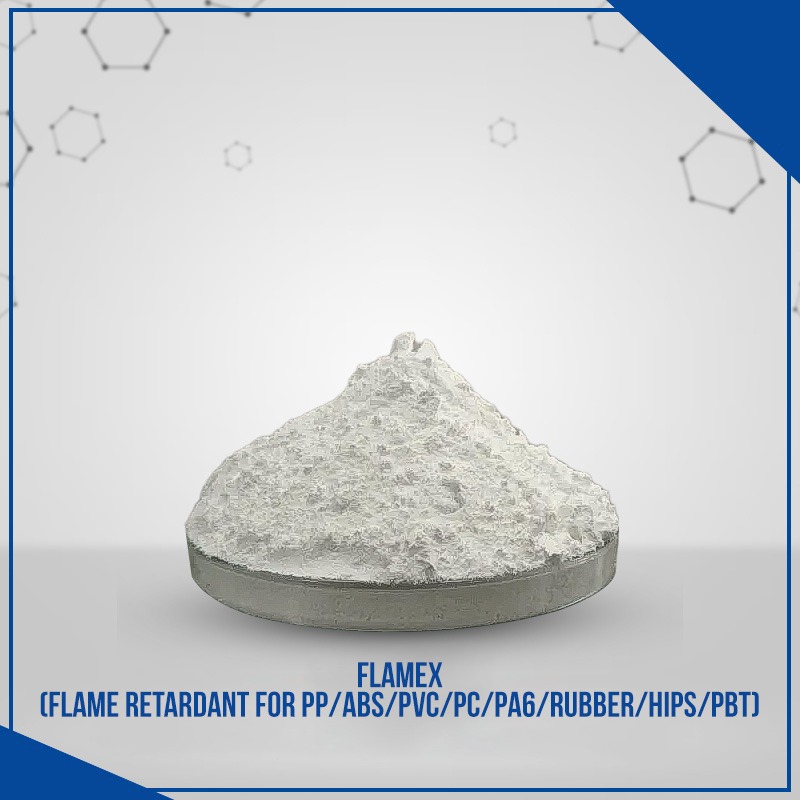 | flame retardant additives Flamex ( Flame Retardant for PP ABS PVC PC PA6 RUBBER HIPS PBT ) FLAMEX ( One Pack Flame Retardant ) manufactured by our company is widely used in PP,PA, PE,PC ,PC/ABS, PVC , Rubber ,PBT, PET, XPS, EPS, PU ,PVC,... View product → |
 | Zinc Borate ZINC BORATE is a highly effective multifunctional flame retardant synergist being used as a flame retardant and smoke suppressant in a wide range of... View product → |
Frequently asked questions
Why does polypropylene need more than a basic flame-retardant additive?
PP has a low limiting oxygen index, melts during fire exposure, forms flaming drips, and requires control of gas-phase burning, char formation, and smoke.
How do you choose between one-pack, intumescent, halogenated, and mineral flame-retardant systems for PP?
Compare the required fire rating, smoke limits, processing temperature, additive loading, mechanical properties, appearance, and regulatory requirements before selecting a system.
What should you set before scaling flame-retardant polypropylene production?
Confirm the PP grade, additive drying plan, melt-temperature window, screw configuration, feeding accuracy, residence time, and extrusion conditions.
How do you validate flame-retardant polypropylene on the real part?
Test the finished geometry for fire performance, dripping, smoke, tensile strength, impact resistance, dimensional stability, and surface appearance.
How do you qualify a Bhiwadi supplier for consistent industrial production?
Request a technical data sheet, safety data sheet, certificate of analysis, batch traceability, recommended processing range, sample material, and repeat-lot test results.
Related products
 | Aluminium Hydroxide ALUMINIUM HYDROXIDE is a Super Fine Precipitated Special ATH. View product → |
 | Aluminium Trihydrate (ATH) is a very finely grounded product having a uniform and controlled particle size distribution. View product → |
 | Molybdenum Trioxide MOLYBDENUM TRIOXIDE is a high purity free flowing powder and is the most effective Smoke Suppressant used in a variety of applications. View product → |