
ABS flame performance depends on the complete formulation, part geometry and processing history—not on a powder’s product label alone. You will be able to define a testable specification, choose a sensible development route and avoid common qualification failures in moulded and extruded ABS parts.
Key takeaways
- Match the additive to the exact ABS grade, modifiers, fillers and processing route.
- Specify thickness, orientation, flame class and smoke tests before compounding.
- Calculate loading on the correct resin-and-additive basis, then verify process stability.
- Recheck impact, flow, appearance and smoke after every formulation or process change.
Match the Flame-Retardant System to the ABS Grade and Part
A flame-retardant powder does not give every ABS formulation the same fire performance. Evaluate the exact resin grade, rubber level, impact modifier, filler, pigment and processing route before choosing the chemical; changing the ABS carrier can invalidate an existing qualification.
| ABS grade or construction | What to check | Technical applications |
|---|---|---|
| ABS injection-moulding grades | Melt flow, wall thickness, moulding temperature and cycle time | Electrical housings, appliance panels and industrial enclosures |
| ABS extrusion grades | Melt strength, die temperature, residence time and profile thickness | Sheets, ducts, covers and continuous profiles |
| High-impact ABS | Rubber content, impact retention and additive compatibility | Automotive trim, protective housings and durable equipment parts |
| PC/ABS blends | PC ratio, flow behaviour, heat resistance and blend-specific fire response | Automotive interiors, electrical connectors and electronic housings |
Specify the finished part, not only “flame-retardant ABS”: record the thinnest wall, colour, glass or mineral filler, target UL 94 class, smoke test method and mechanical-retention requirement. A V-0 result on a 3.2 mm plaque does not prove performance at a 1.5 mm wall.
Test the complete formulation at the production thickness. Include the intended regrind percentage, drying cycle and actual moulding conditions, because moisture, repeated heat history and poor dispersion can change afterflame time, dripping, impact strength and smoke. Evaluate flame and smoke separately; passing UL 94 does not establish low smoke.
Define the Fire Target with Thickness, Orientation and Smoke Tests
A passing certificate proves the tested plaque passed, not that every ABS part will pass. Specify the finished part’s wall thickness, rib and weld-line locations, gate region, colour, filler level, moulding route and mould-flow orientation, then test specimens taken from the same formulation and process.
A 1.5 mm plaque does not qualify a 1.0 mm enclosure wall.
| Class | Afterflame and afterglow limit | Flaming-drip requirement |
|---|---|---|
| UL 94 V-0 | Each specimen: 10 seconds maximum; five-specimen total: 50 seconds maximum; afterglow: 30 seconds maximum | Drips must not ignite indicator cotton |
| UL 94 V-1 | Each specimen: 30 seconds maximum; five-specimen total: 250 seconds maximum; afterglow: 60 seconds maximum | Drips must not ignite indicator cotton |
| UL 94 V-2 | Same burning-time limits as V-1 | Flaming drips may ignite indicator cotton |
Request the UL 94 report, not a powder supplier’s claim. It must identify the ABS grade, additive package, specimen thickness, conditioning, colour, filler or glass content, regrind percentage and mould-flow orientation. Test the thinnest production wall and representative ribs; thinner sections often burn more severely.
Specify smoke separately because UL 94 does not measure smoke. For an electrical cabinet, transport interior or enclosed machine, name the method—such as ASTM E662 or ISO 5659-2—and require the reported optical smoke density under the chosen flaming or non-flaming condition.
Approve the formulation only when both fire class and smoke limit are met after the intended thermal history.
Set the Loading Basis and Compound the Additive Without Losing Process Control
Set dosage against the complete formulation, not the additive sack. Record both weight percent in the finished compound and phr based on resin weight: 12 phr means 12 parts additive per 100 parts ABS resin, while 12 weight percent means 12 kg per 100 kg of finished compound. They are not interchangeable.
1. Lock the recipe before trials. Name the ABS grade, rubber content, filler, pigment, synergist, target wall thickness and regrind percentage. Screen three loadings, such as 8, 12 and 16 weight percent, only within the additive supplier’s processing and safety limits.
2. Control ABS drying before feeding. Follow the resin datasheet; many injection grades use 80–90°C for 2–4 hours. Verify pellet moisture at the hopper, because a dryer display cannot prove that the material entering the screw is dry.
3. Define the premixing and feeding sequence. Blend dried ABS pellets with the flame retardant until distribution is uniform, then feed the blend at a calibrated rate. Keep powder from segregating, bridging or entering the extruder in surges.
4. Compound at the lowest melt temperature that gives complete dispersion. Start within the ABS grade and additive supplier’s window, commonly around 210–240°C, and minimise residence time. Excess heat or hold-up can cause decomposition, colour change, plate-out and corrosive volatiles.
5. Pelletise, mould and test on the actual screw, barrel profile, mould and cycle. Regrind belongs in the qualification recipe; repeated heat history, moisture or non-FR contamination can change afterflame, dripping, smoke and impact. After a failed flame test, change one variable at a time and retest the finished thickness.
Balance Flame Resistance Against Impact, Flow, Appearance and Smoke
A V-0 result is not enough if the part loses impact strength, fills poorly, turns grey, or produces unacceptable smoke. Compare the complete ABS formulation, not the flame-retardant powder: rubber content, pigment, filler, moulding history and wall thickness can change the result.
| Option | Main benefit | Main trade-off | What to verify |
|---|---|---|---|
| One-pack | Pre-dispersed dosing reduces feeding errors and simplifies production | The fixed package may over-treat flow, colour or impact for a new ABS grade | Supplier composition, total-compound loading, viscosity and finished-part UL 94 |
| Brominated flame retardant with antimony trioxide | Gas-phase action and synergy can deliver strong flame resistance at lower total loading | Impact, colour, plate-out and regulatory status depend on the exact brominated substance | PBB/PBDE and REACH status, UL 94 at the actual thickness, impact retention and surface deposits |
| Halogen-free ABS with phosphorus chemistry or zinc borate | Avoids halogenated chemistry; zinc borate can support char, reduce afterglow and suppress smoke | Phosphorus systems can reduce impact or heat-deflection performance, alter viscosity and migrate; zinc borate can reduce flow or increase opacity | Finished-compound UL 94, HDT, impact, colour, migration, smoke method and processing stability |
Treat smoke as a separate specification. A compound can pass UL 94 V-0 and still generate substantial optical smoke, while zinc borate or another suppressant can reduce smoke without producing V-0. Test the selected formulation after the intended regrind percentage, colour change and processing history; melt-flow data alone cannot confirm equivalence.
Build a Bhiwadi Qualification Specification That Survives Production Changes
Approve a formulation against a signed, change-controlled specification, not the phrase “flame-retardant ABS, V-0.” Record the conditions that produced the result so a colour change, new mould or higher regrind content does not quietly invalidate qualification.
1. Identify the material and part: ABS grade and supplier, injection-moulding or extrusion route, high-impact or PC/ABS blend, colour, filler level, finished wall thickness and moulding orientation.
2. Set the fire target for the finished formulation and exact thickness. State the required UL 94 class—V-0, V-1 or V-2—and retain reports for the actual compound, not a rating borrowed from the additive. Record ASTM D2863 or ISO 4589-2 oxygen-index data when required.
3. Specify smoke separately from flame performance. For enclosed equipment or vehicle interiors, record ASTM E662 flaming and non-flaming optical smoke results, while recognising that E662 does not certify toxicity, corrosivity or whole-component safety.
4. Lock the production window: dryer temperature, drying time, measured pellet moisture, screw and barrel profile, melt-temperature limit, residence time, mould, cycle, injection speed and allowable regrind percentage. Requalify after changing resin grade, colour, tooling, process route or recycled content.
5. Attach the additive lot, certificate of analysis, dosage basis, batch record and test specimens. If Niknam Chemicals Pvt. Ltd supplies the additive, request compatibility and dosage guidance in weight percent of total compound or phr on resin, then document the adjustment after any failed flame test.
Bhiwadi manufacturers should also define impact retention, tensile or flexural limits, flow, appearance, plate-out and corrosion checks. These prevent a passing flame result from approving a part that cannot run reliably.
Related products
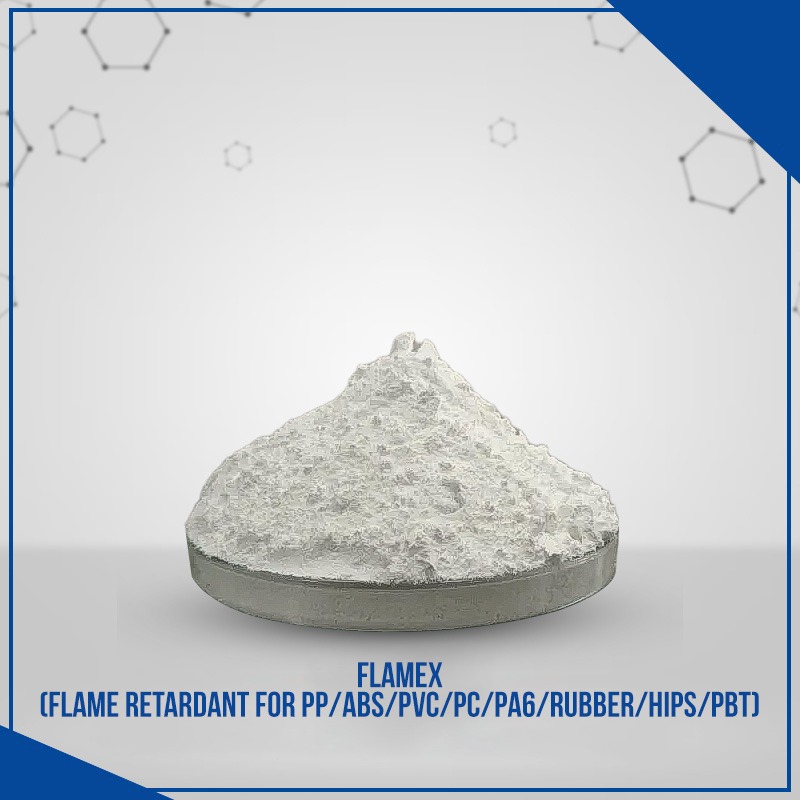 | flame retardant additives Flamex ( Flame Retardant for PP ABS PVC PC PA6 RUBBER HIPS PBT ) FLAMEX ( One Pack Flame Retardant ) manufactured by our company is widely used in PP,PA, PE,PC ,PC/ABS, PVC , Rubber ,PBT, PET, XPS, EPS, PU ,PVC,... View product → |
 | Antimony Trioxide Our range of Antimony trioxide is used mainly in flame retardant formulations for plastics, rubbers, textiles, paper and paints. View product → |
Frequently asked questions
How do you match a flame-retardant system to an ABS grade?
Review the ABS resin grade, rubber level, impact modifier, filler, pigment and processing route before selecting the additive. A carrier change can invalidate an existing fire qualification.
Which details belong in an ABS fire-performance target?
Record specimen thickness, flow orientation, target flame class, conditioning method and the exact fire and smoke test methods used for qualification.
How should additive loading be defined for ABS compounding?
State whether loading is calculated against total compound mass, resin mass or a masterbatch let-down ratio, then confirm dispersion and process stability at the selected level.
What properties must you check alongside flame resistance?
Measure impact strength, melt flow, appearance and smoke performance alongside flammability because increasing additive content can change each of them.
How can a Bhiwadi qualification specification withstand production changes?
Identify the approved ABS grade, additive, loading range, part thickness, process window, test methods and change-control triggers so substitutions require requalification.
Related product
 | Zinc Borate ZINC BORATE is a highly effective multifunctional flame retardant synergist being used as a flame retardant and smoke suppressant in a wide range of... View product → |