
ABS does not earn a fire classification from the additive name alone: resin grade, wall thickness, colour, processing history and test method all affect the result. By the end, you will be able to match an end use with the right fire test, compare additive chemistries, set a defensible trial dosage and qualify the finished compound without overlooking mechanical or processing failures.
Key takeaways
- Start with ABS grade, wall thickness and the exact failure you must prevent.
- Select UL 94, glow-wire or smoke testing before choosing additive chemistry.
- Trial additive loading against colour, impact, flow, cycle time and regrind limits.
- Compare suppliers using batch records, test data, samples and a repeatable qualification plan.
Start with the ABS grade, wall thickness and end-use failure
Start with the customer’s governing requirement, then record the minimum wall thickness, resin grade, colour, moulding cycle and regrind policy. Define the failure first: ignition, burning, dripping, glow-wire ignition, smoke, impact breakage or dimensional distortion.
Collect these before selecting an additive:
- Test standard and target classification
- Minimum production wall section, not a convenient plaque thickness
- Commercial colour, including the highest-pigment or black version
- Barrel temperature, residence time, screw speed and moulding cycle
- Virgin-to-regrind ratio, regrind source and number of heat histories
| Grade | What changes | Selection consequence |
|---|---|---|
| standard ABS | Balanced flow and impact | Establish the baseline for additive loading |
| impact-modified ABS | Better toughness, different additive tolerance | Check impact and weld-line strength after compounding |
| high-heat ABS | Higher heat resistance, harder processing | Verify flow, Vicat and moulding temperature |
| glass-filled ABS | Reinforcement changes flow and anisotropy | Test thin sections and dimensional stability |
| PC/ABS | Different heat, impact and compatibility balance | Do not transfer standard ABS data |
| flame-retardant ABS | Fire performance depends on its full formulation | Confirm grade, colour and thickness-specific results |
A thick laboratory plaque is unsafe evidence for a thin housing: flow, cooling, additive concentration and ignition behaviour change at the minimum wall thickness. Regrind can also alter dispersion and molecular weight, so qualify the controlled production stream from the first trial.
Map the failure to the application. Electrical enclosures and switchgear components usually need thin-wall vertical burning and glow-wire data; appliance housings and office equipment add appearance and dimensional limits. Automotive interior parts usually require FMVSS 302, while consumer electronics and injection-moulded industrial parts require the actual equipment standard.
Choose the fire test before choosing the flame-retardant package
Select the end-use test first: the required classification determines the additive package and the specimen thickness you must qualify.
| End use | Test and target | Why it matters |
|---|---|---|
| Electrical enclosures, switchgear, consumer electronics | UL 94 V-0 at the thinnest wall | Controls vertical burning, afterflame and flaming drips |
| Appliance housings and electrical assemblies | IEC 60695 glow-wire 650 °C, 750 °C or 850 °C | Tests ignition and self-extinguishing at a heated contact point |
| Vehicle interiors | FMVSS 302; burn rate not above 102 mm/min (4 in/min) | A horizontal-burning requirement, not a substitute for UL 94 V-0 |
| Parts with smoke limits | ASTM E662 or the specified end-product smoke method | Measures smoke optical density; UL 94 does not measure smoke or toxicity |
UL 94 is a result for one precise ABS formulation, colour, processing history and specimen thickness. It is not an intrinsic label for flame-retardant ABS. Test the thinnest production wall section, because a thick plaque can pass while the housing fails.
HB is a horizontal-burn classification. Vertical ratings distinguish severity: V-2 permits flaming drips, V-1 rejects flaming drips but allows longer burning, and V-0 limits each specimen’s afterflame to 10 seconds, all five specimens to 50 seconds, with no flaming drips.
Do not treat RoHS evidence as a halogen-free claim. Request separate declarations for PBB and PBDE, identify the brominated chemistry, and require a genuine halogen-free specification covering total halogen or formulation limits.
Compare additive chemistry and set a trial loading you can adjust
Compare additive families by chemistry, failure risk and thin-wall performance, not by the trade name alone. Require the supplier to state whether FLAMEX is a halogenated flame retardant, halogen-free, phosphorus-based flame retardant, mineral-based flame retardant or a blend, and to identify its primary flame retardant, synergists and co-additives.
| Family | Main role | Checks before selection |
|---|---|---|
| Brominated aromatic flame retardant plus antimony trioxide | Robust UL 94 V-0 route for thin electrical housings | Density, smoke, ash, cost and occupational dust controls |
| Aromatic phosphate or phosphinate | Halogen-reduced candidate | Plasticisation, impact loss, migration, colour sensitivity and processing window |
| Zinc borate or metal molybdate | Smoke, afterglow or char-modifying co-additive | Do not treat it as a universal primary replacement; verify smoke testing, colour, viscosity and electrical effects |
For a thin electrical housing, the brominated aromatic flame retardant and antimony trioxide route remains technically robust, but record its density increase, smoke and ash profile and dust-handling controls. An aromatic phosphate or phosphinate is not an automatic drop-in replacement: test it at the actual injection temperature and residence time, then reassess after conditioning.
Zinc borate and metal molybdate need the same evidence.
Use the supplier’s ABS-specific starting range, expressed as weight percentage or phr. Then:
- Trial the low, midpoint and high levels; use 10, 15 and 20 wt% only when the supplier confirms that range.
- Record the maximum loading and increase in small increments after failure.
- Compare every trial at the target wall thickness, including oxygen index or limiting oxygen index only when specified.
Do not apply one universal dosage to every ABS grade.
Screen performance beyond the flame result
Approve an ABS additive package only after a molded-part matrix matches the customer’s resin grade, wall thickness and colour. Measure impact strength, tensile strength, elongation, heat-deflection temperature, Vicat softening point, surface gloss, colour, weld-line strength and dimensional stability. Add oxygen index or limiting oxygen index only when specified; neither replaces the required end-product fire test.
Check these failure modes before release:
| Screen | Record | Approval concern |
|---|---|---|
| Mechanical | Impact strength, tensile strength, elongation and weld-line strength | High loading can cause brittle parts, weak weld lines or thin-wall filling failure |
| Heat and appearance | Heat-deflection temperature, Vicat softening point, surface gloss, colour and dimensional stability | Warpage, pigment sensitivity or unacceptable appearance |
| Melt-processing stability | Barrel temperature, residence time, screw speed, screw torque, die pressure, flow, plate-out, mould fouling and surface defects | A narrow process window or contamination during production |
| Dispersion | Microscopy or an agreed compound-uniformity method | Local additive-rich and additive-poor zones produce variable fire results |
Dry ABS pellets at the resin supplier’s grade-specific temperature and time, then document pellet moisture. In Bhiwadi’s seasonal humidity, moisture can cause splay, bubbles and thin spots that make fire results inconsistent. Use conditioning before retesting, and compare virgin material with the actual regrind percentage.
Record storage stability, pellet caking, additive migration or blooming and colour drift.
Turn the comparison into a Bhiwadi qualification and purchasing decision
Release an additive package only after ABS qualification proves the finished part, not a datasheet, meets its end-use requirement.
| End use | Applicable standard | Target classification | Minimum wall thickness | Resin grade | Colour | Additive loading | Process settings | Conditioning state | Regrind percentage | Pass/fail |
|---|---|---|---|---|---|---|---|---|---|---|
| Electrical enclosure | UL 94; IEC 60695 | V-0; glow-wire performance at specified temperature | Record thinnest mm | Grade and MFR | Natural, black, highest-pigment | Supplier range; low/mid/high trial | Barrel temperature, residence time, screw speed | Drying and conditioning record | Controlled percentage | Pass at every condition |
| Appliance housing | UL 94; ASTM E662 if required | Customer class; low-smoke performance separately | Record thinnest mm | High-heat or standard ABS | Production colour | Validated wt% | Approved cycle and mould | Recorded temperature and hours | Controlled percentage | Pass/fail |
| Automotive interior | FMVSS 302 | Burn rate ≤102 mm/min | Record thinnest mm | Approved impact ABS | Production colour | Validated wt% | Approved cycle | Customer conditioning | Controlled percentage | Pass/fail |
For supplier comparison, request each supplier’s technical data sheet, safety data sheet, batch number, certificate of analysis, chemistry-identifying formulation disclosure, restricted-substance declaration, processing window and reports showing specimen thickness. Request natural, black and highest-pigment samples.
Compare repeatable batches, local support, lead time, storage packaging and investigation of plate-out or failed retests. Niknam Chemicals Pvt. Ltd belongs in that comparison only with ABS-specific trial evidence. Complete pilot moulding and third-party testing or customer witnessing where required, then impose change control over resin, colour, batch, cycle and regrind.
Related products
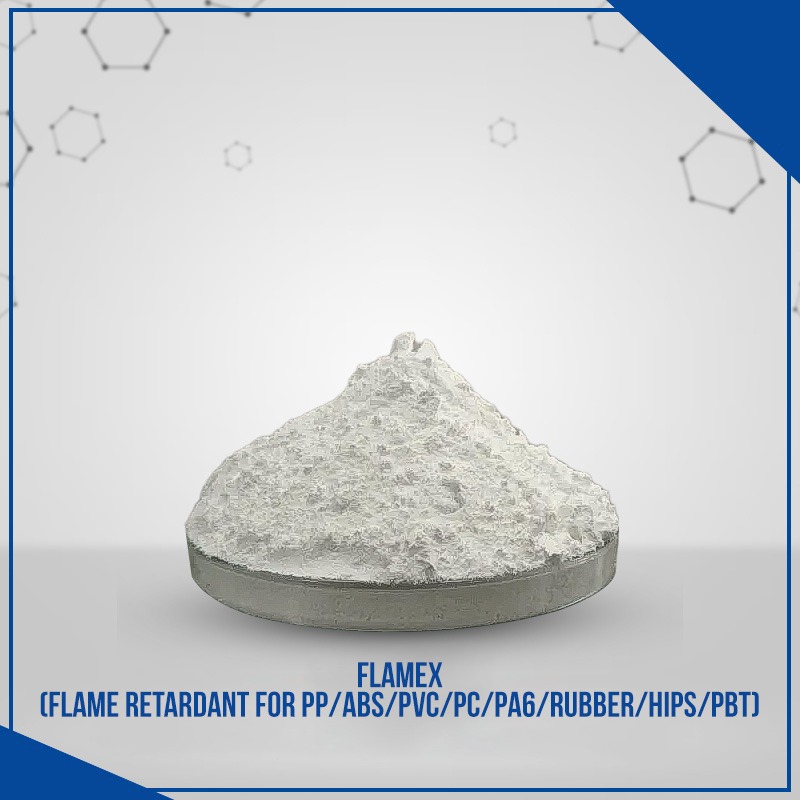 | flame retardant additives Flamex ( Flame Retardant for PP ABS PVC PC PA6 RUBBER HIPS PBT ) FLAMEX ( One Pack Flame Retardant ) manufactured by our company is widely used in PP,PA, PE,PC ,PC/ABS, PVC , Rubber ,PBT, PET, XPS, EPS, PU ,PVC,... View product → |
 | Flame Retardant Filler FAM-501 Flame Retardant Filler FAM-501 FAM - 501 Flame Retardant filler FAM-501 is One Pack Flame Retardant & Smoke Suppressant developed for Plasticized PVC applications. View product → |
Frequently asked questions
What information should you record before selecting a flame retardant for ABS?
Record the ABS grade, minimum wall thickness, colour, moulding cycle, regrind policy and the failure to prevent, such as ignition, dripping, smoke or impact breakage.
Which fire test should you choose for an ABS application?
Choose the test from the governing end-use requirement. UL 94 addresses burning behaviour, while glow-wire testing addresses ignition risk from heated electrical components; smoke requirements need separate evaluation.
How should you set a trial loading for an ABS flame-retardant additive?
Start with a supplier-supported loading range, then test at several levels around the target while checking fire performance, colour, impact, flow, cycle time and dimensional stability.
What should you check beyond the flame-retardancy result?
Check tensile and impact performance, melt flow, mould deposits, surface appearance, colour shift, smoke, dimensional distortion, processing temperature and regrind performance.
How do you qualify a flame-retardant ABS additive supplier in Bhiwadi?
Compare representative samples, technical data, batch traceability, repeat-test results, supply continuity, documentation and agreed acceptance criteria before approving regular purchases.
Related products
| FAM-501 ABOUT FAM - 501 FAM-501 is One Pack Flame Retardant & Smoke Suppressant developed for Plasticized PVC applications. View product → |
 | Zinc Borate ZINC BORATE is a highly effective multifunctional flame retardant synergist being used as a flame retardant and smoke suppressant in a wide range of... View product → |
 | Antimony Trioxide Our range of Antimony trioxide is used mainly in flame retardant formulations for plastics, rubbers, textiles, paper and paints. View product → |
 | Aluminium Trihydrate (ATH) is a very finely grounded product having a uniform and controlled particle size distribution. View product → |