
ABS flame retardancy is a formulation and validation problem, not a matter of adding any product labelled flame retardant. You will be able to compare halogenated, mineral and phosphorus-based systems, set up an ABS trial, interpret UL 94 results by thickness, and request the documents needed to qualify a supplier.
Key takeaways
- Match the chemistry to ignition, smoke, restricted substances, or mechanical-performance risks.
- Calculate additive loading as a percentage of the complete ABS compound.
- Control drying, compounding, and moulding before comparing flame-retardant results.
- Request formulation data and thickness-specific UL 94 evidence from suppliers.
Choose the ABS flame-retardant chemistry around the failure you need to prevent
Choose an ABS flame-retardant system according to the failure you must prevent: ignition and flame spread, restricted-substance exposure, smoke, or loss of mechanical performance. ABS flame retardant chemicals that pass a small plaque test can still fail after colouration, impact modification, thin-wall moulding, or long heat exposure.
| System | Strength | Check before selection |
|---|---|---|
| Halogenated flame retardant ABS | Strong flame inhibition at relatively modest loading; suitable when compact parts need a high UL 94 class | Obtain restricted-substance declarations. EU RoHS Annex II limits polybrominated biphenyls and polybrominated diphenyl ethers to 0.1% by homogeneous material; this does not prohibit every brominated flame retardant. |
| Halogen-free ABS flame retardant | Avoids halogenated chemistry and may suit customer or environmental specifications | Test melt viscosity, impact strength, weld-line strength, colour, plate-out, hydrolytic stability, and heat ageing. Passing UL 94 alone is not enough. |
| Antimony trioxide synergist | Improves a halogenated package rather than acting as the principal flame retardant | Balance it with the halogen donor and verify dispersion. Adding antimony trioxide alone does not reliably produce V-0. |
Specify the resin grade, colour and specimen thickness with the target UL 94 class: HB, V-2, V-1 or V-0. A V-0 result at 1.5 mm does not prove V-0 at 0.75 mm or in a finished housing.
UL 94 measures small-flame behaviour, not smoke, toxicity, heat release or fire growth, so request separate smoke and end-use fire data.
Set the loading as a compound percentage, then screen the formulation
Start ABS flame-retardant dosage as a percentage of the finished compound, not as a percentage of the virgin resin. For example, 8 kg additive in a 100 kg batch is 8 wt% flame-retardant loading in wt%; adding 8 kg to 100 kg of resin produces a different compound percentage.
Build a small ABS formulation trial with low, middle and high loading points around the supplier’s stated range. If no range exists, agree exploratory levels with the compounder and keep every other variable fixed: ABS grade, impact modifier, pigment, stabiliser package, screw settings and moulding conditions.
The correct loading depends on specimen thickness, colour, resin grade and the UL 94 class you need.
Use the trial to find the lowest loading that reaches the target without creating a new product failure.
- Record additive and resin mass for every batch, including carrier resin.
- Check dispersion through moulded plaques and inspect for agglomerates, streaks and plate-out.
- Measure impact strength and melt flow against the unmodified ABS, then check colour and weld-line strength.
- Expose specimens to the intended heat-aging period and inspect toughness retention.
- Record moisture, barrel residence time and regrind percentage so a passing plaque does not hide processing sensitivity.
Do not approve a formulation because one plaque passes vertical burning. A higher loading can reduce toughness, alter viscosity and weaken weld lines; compare the complete screening results before selecting the production level.
Control drying, compounding and moulding before judging the additive
A good additive can look ineffective after wet resin, excessive heat or long residence time has damaged the formulation. Lock the ABS drying requirements first: use the resin supplier’s stated temperature and time, verify moisture before feeding, and keep dried pellets sealed.
Moisture produces splay, voids and surface defects that can be mistaken for poor flame-retardant dispersion.
| Processing stage | Control to record | Failure if missed |
|---|---|---|
| Drying | Dryer temperature, time, dew point and pellet moisture | Splay, voids, hydrolysis and unstable test plaques |
| Compounding | ABS compounding temperature, residence time, screw speed, screw configuration and feeder rate | Additive decomposition, volatilisation, corrosion or uneven loading |
| Moulding | Melt temperature, mould temperature, injection speed, hold pressure, cooling time and regrind percentage | Variable thickness, weld-line weakness, burn marks and inconsistent burning |
Set the compounder below the additive’s documented decomposition or volatilisation range and below the ABS grade’s processing limit. Check a microtomed section, ash pattern or suitable microscopy method for flame-retardant dispersion; a smooth-looking plaque does not prove uniform distribution.
For injection moulding ABS, record shot size, residence time and the number of heat histories. Run fresh compound separately from regrind, then compare colour, mass, impact and flame results. A formulation that passes after short laboratory residence can fail after a hot barrel hold or repeated reprocessing.
Change one processing variable at a time before changing additive loading.
Read UL 94 by thickness and separate flame classification from smoke
A UL 94 result is valid only for the stated UL 94 specimen thickness, colour and ABS formulation. A compound rated V-0 at 1.5 mm cannot be called V-0 at 0.75 mm, in another colour, or in a thinner finished housing without new evidence.
UL 94 compares flame behaviour in a small laboratory specimen. Specify the target classification and thickness together:
| Classification | What the result indicates |
|---|---|
| HB | Horizontal burning performance; lower flame resistance than vertical classes |
| V-2 | Vertical burning with permitted flaming drips |
| V-1 | Vertical burning with tighter afterflame limits and no igniting drips |
| V-0 | Vertical burning with the tightest listed afterflame limits and no igniting drips |
For solid ABS, ask which 50 W method produced the result. IEC 60695-11-10 covers horizontal and vertical flame tests for solid insulating materials; ISO 9772 applies to small-cellular and rigid cellular plastics, so do not treat the methods as interchangeable.
Specify smoke separately. ASTM E662 smoke density measures specific optical density under flaming and non-flaming conditions; it does not identify toxic gases or prove low toxicity. Request results on the actual ABS grade, colour, thickness and formulation, not on the neat additive.
For an enclosed electrical product, add the end-product fire test required by the product standard. UL 94 V-0 alone is not a smoke, heat-release, fire-growth or finished-product safety rating.
Qualify a Bhiwadi supplier with formulation evidence, not a product label
Do not approve a chemical because its label says flame-retardant ABS. Ask a flame retardant supplier in Bhiwadi to prove how the additive behaves in your resin, at your specimen thickness, and under your moulding process.
1. An ABS flame retardant technical data sheet listing active chemistry, particle size, moisture, bulk density, ash, carrier resin, thermal stability or decomposition range, and recommended processing temperature.
2. A batch-specific certificate of analysis showing the lot number, assay or active content, moisture, appearance, and test methods. A certificate of analysis confirms shipment consistency; it does not prove that your ABS will pass UL 94.
3. A formulation report using your ABS grade, impact modifier, pigment and proposed loading in weight percent of the compound. Request plaques tested at the exact thickness and colour you will sell, with UL 94 results identified as HB, V-2, V-1 or V-0.
4. Evidence for UL recognition for the ABS compound, not merely a statement that the additive appears in a UL document. Check the recognised formulation, colour, thickness range and end-use conditions.
5. Processing and durability data covering drying, melt residence time, dispersion, plate-out, impact strength, weld-line strength, colour, heat exposure and regrind. Request smoke data from the actual ABS formulation; PVC results cannot be transferred to ABS.
Niknam Chemicals Pvt. Ltd should be assessed against this evidence checklist, including whether its sample formulation matches your resin grade and target thickness. Reject a supplier that offers only a product label or generic test plaque.
Related products
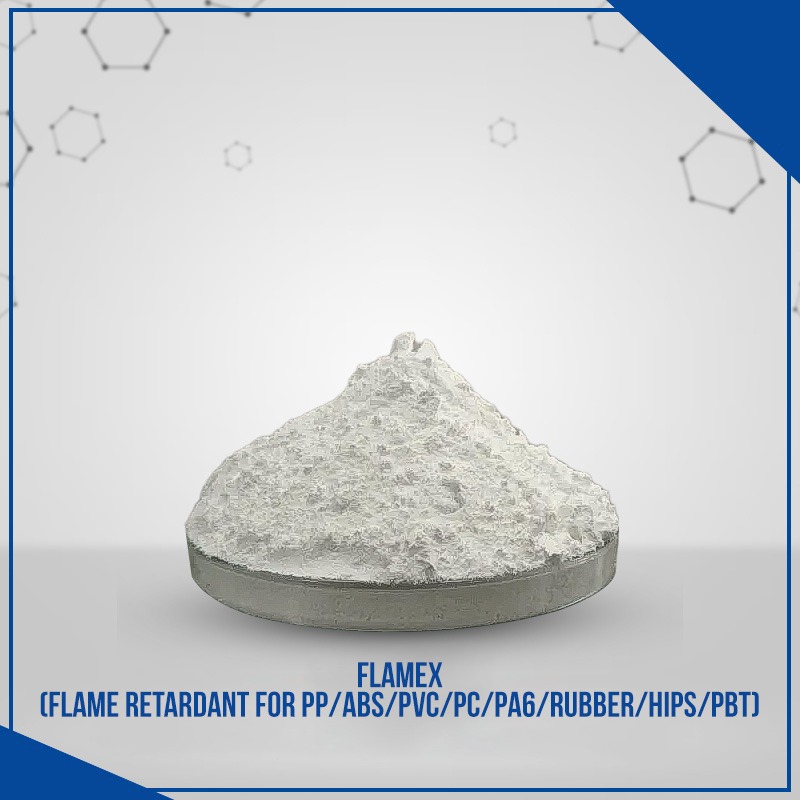 | flame retardant additives Flamex ( Flame Retardant for PP ABS PVC PC PA6 RUBBER HIPS PBT ) FLAMEX ( One Pack Flame Retardant ) manufactured by our company is widely used in PP,PA, PE,PC ,PC/ABS, PVC , Rubber ,PBT, PET, XPS, EPS, PU ,PVC,... View product → |
 | FAM-501 ABOUT FAM - 501 FAM-501 is One Pack Flame Retardant & Smoke Suppressant developed for Plasticized PVC applications. View product → |
Frequently asked questions
How should you choose flame-retardant chemistry for ABS?
Choose it around the failure you need to prevent: ignition and flame spread, restricted-substance exposure, smoke, or mechanical-performance loss.
How should you set flame-retardant loading in ABS?
Set the loading as a percentage of the complete compound, then screen the formulation after colouration, impact modification, and thin-wall moulding.
Which processing controls affect ABS flame-retardant test results?
Control drying, compounding, and moulding before judging the additive, because processing conditions can change the final performance.
How should you interpret UL 94 results for ABS?
Read the UL 94 classification by specimen thickness and keep flame classification separate from smoke performance.
How can you qualify a flame-retardant supplier in Bhiwadi?
Ask for formulation evidence, thickness-specific test data, processing guidance, and documentation rather than relying on a product label.
Related product
 | Antimony Trioxide Our range of Antimony trioxide is used mainly in flame retardant formulations for plastics, rubbers, textiles, paper and paints. View product → |