
A polypropylene additive is only suitable when the finished formulation achieves the required fire classification at the customer’s wall thickness without unacceptable losses in flow, strength, appearance or throughput. By the end, you will have a specification, trial plan and supplier checklist for qualifying a PP flame-retardant system in a Bhiwadi manufacturing operation.
Key takeaways
- Set pass/fail targets on the thinnest final molded wall.
- Match additive chemistry to PP grade, melt temperature and processing equipment.
- Confirm loading through molded-part testing, not supplier dosage alone.
- Audit batch documents, safety data and trial traceability before approval.
What must a PP flame-retardant formulation achieve before production approval?
Production approval starts with a pass/fail specification, not an additive supplier’s brochure. A flame retardant additive for polypropylene must be judged in the final molded formulation, at the thinnest intended wall, using the customer’s resin grade and processing conditions.
| Metric | Define before selection | What it does not prove |
|---|---|---|
| UL 94 V-0 V-1 V-2 | Select the required rating and specimen thickness | It does not establish ignition resistance or end-product compliance |
| IEC 60695-11-10 | Specify horizontal or vertical small-flame testing and conditioning | A result on the additive alone is not a PP classification |
| ASTM D2863 limiting oxygen index | Set an oxygen-index comparison target | A high LOI does not guarantee V-0, non-dripping behaviour or ignition resistance |
Record these non-fire requirements before trials:
- Identify the resin: PP homopolymer or PPHP, random copolymer, impact copolymer or PPCP; also record melt flow, glass or mineral reinforcement and pigment package.
- Set minimum tensile strength, impact strength, elongation, melt-flow change, colour, plate-out, regrind performance and ageing retention.
- Define the application: electrical housing, automotive part, appliance component or another use. Electrical parts may require glow-wire or other end-use testing.
- Test multiple additive concentrations after specified conditioning, not only a thick, freshly molded plaque.
For European sales, check REACH registration, restrictions, SVHC communication and SCIP duties where applicable. Separately verify India’s restricted-substance and customer-sector requirements; domestic RoHS is not blanket approval.
Which flame-retardant chemistry fits your polypropylene grade and process?
Choose the chemistry against PP melt temperature, grade and smoke requirement, not additive price. PP homopolymer and PP homopolymer (PPHP) retain stiffness but expose impact loss; random copolymer and impact copolymer need closer impact and melt-flow checks before accepting a high loading.
| Option | Main trade-off | Best fit and warning |
|---|---|---|
| Halogenated with antimony | Efficient at lower loading; greater smoke, corrosion and regulatory concern | Tight UL 94 targets where smoke and halogen restrictions permit |
| Phosphorus and nitrogen | Forms char; a phosphorus-based intumescent PP package often needs 20–30 wt% | Halogen-free flame retardant PP; ammonium polyphosphate systems need melt-flow, density and impact checks |
| Mineral hydroxides | Low smoke potential but high loading raises viscosity and can reduce strength | Aluminium hydroxide magnesium hydroxide PP; magnesium hydroxide suits PP better because it releases water at a higher temperature |
| Phosphorus synergists or zinc borate | Can improve char or suppress smoke without replacing the primary fire system | Use only after measuring smoke separately from flame rating |
Aluminium hydroxide decomposes at a lower temperature than magnesium hydroxide, so extrusion temperature and residence time decide whether it causes moisture, voids or surface defects. Check the actual PP grade, pigment package, glass or mineral reinforcement and thinnest wall in the trial.
Do not treat an additive certificate as a UL 94 result. Test the molded formulation at the intended thickness after conditioning, using the required UL 94 class—V-0, V-1 or V-2—or IEC 60695 method, then record melt flow, tensile and impact retention, colour, plate-out and regrind performance.
How do you set loading and process the additive without destabilising PP?
Calculate the PP flame-retardant dosage against resin mass, not the finished compound mass. The weight percentage phr calculation is: phr = additive mass ÷ PP mass × 100; finished-compound weight percentage = additive mass ÷ total batch mass × 100.
Thus, 5 phr means 5 kg additive per 100 kg PP, not 5 wt% of the final batch.
1. Define three or more trial loadings around the supplier’s technical recommendation, then test each in the actual part thickness and target fire method. Record melt flow, torque, injection pressure, colour, plate-out, tensile and impact retention; a loading that achieves UL 94 V-0 in a thick plaque can fail at the thinnest wall.
2. Establish the processing window from additive decomposition onset, moisture and residence time. Keep the melt temperature below the documented stability limit, especially with aluminium hydroxide, which releases water earlier than magnesium hydroxide. Excess heat creates gas, surface defects and lost flame performance.
3. Match the route to the process: injection moulding, extrusion, blow moulding, film or fibre. Run low and high feeder rates, inspect cut sections microscopically, and check ash or inorganic residue across the strand or moulded part. Dry phosphorus and mineral products to the supplier’s moisture limit; agglomerates cause feeder surging and local failures.
4. Recheck each PP homopolymer random copolymer impact copolymer grade separately. PPHP may tolerate a different loading from PPCP; rubber in impact copolymer changes flow and impact retention. Requalify after pigment, glass or mineral reinforcement, and after adding regrind.
What quality, safety and performance tests belong in a manufacturing trial?
A defensible trial tests the finished PP formulation, not the additive certificate. UL 94 V-0, V-1 or V-2 depends on specimen thickness, conditioning, pigment, reinforcement, melt flow, dispersion and processing history, so test the thinnest intended wall using the actual resin grade and moulding cycle.
- Request a batch-specific certificate of analysis for the flame retardant showing identity, assay, moisture, particle-size distribution, bulk density, colour and ash or inorganic residue.
- Require decomposition onset and thermal-stability data at the customer’s extrusion temperature; obtain the SDS and storage-handling classification for plant safety review.
- Reject unexplained batch variation before moulding. Moisture and agglomeration can cause feeder instability and inconsistent burning results.
| Evidence source | Record | What it proves |
|---|---|---|
| Plant measurements | Feeder rate, torque, pressure, melt temperature, melt flow, colour, plate-out and a defined dispersion test in PP | Whether the additive processes consistently without damaging throughput or appearance |
| Moulded specimens | Several loadings, actual PP grade, thinnest wall, conditioned UL 94 specimens, tensile and impact strength | Whether fire performance is achieved with acceptable mechanical retention |
| Retained specimens | Labelled plaques and parts from each batch, including PP regrind and ageing samples | Whether later investigation can connect a result to formulation, processing history and durability |
Keep the raw fire-test reports, photographs and specimen dimensions with the batch records. Do not claim the additive itself has a UL 94 classification; the final formulation earns that result.
How should a Bhiwadi buyer qualify the supplier and production route?
Do not approve a supplier on a certificate and one successful plaque. Qualify the material, the supplier’s controls and your actual PP production route together.
1. Check the commercial file. Obtain a current technical data sheet, SDS, certificate of analysis, batch number, shelf life, packaging specification, lead time, minimum order, price basis and written change-notification policy. A flame retardant chemical supplier in Bhiwadi should also provide traceability from incoming raw materials to finished batch. Ask Niknam Chemicals Pvt.
Ltd for the same documents before comparing its additive with another source.
2. Verify the site’s legal position. Confirm Rajasthan State Pollution Control Board consent to establish and consent to operate, then read the conditions for emissions, effluent and waste. If contaminated bags, filter dust, solvent residues or off-specification material arise, check authorisation, storage, labelling, manifests and disposal under the Hazardous and Other Wastes Rules 2016.
Chemical inventories can also trigger duties under the Manufacture, Storage and Import of Hazardous Chemical Rules, 1989.
3. For export or customer-controlled supply chains, record REACH SCIP RoHS compliance evidence rather than accepting the phrase as a certificate. Check EU registration, restrictions, SVHC communication and SCIP applicability separately; check restricted substances against the customer’s electrical or electronic specification.
4. Run a controlled production trial using the intended PP grade, additive route, temperatures, screw speed and residence time. Test more than one concentration, the thinnest wall, conditioned specimens and regrind. Require UL 94 at the specified thickness, IEC 60695-11-10 where applicable, melt-flow, tensile and impact retention, colour, plate-out and ageing results before release.
Related product
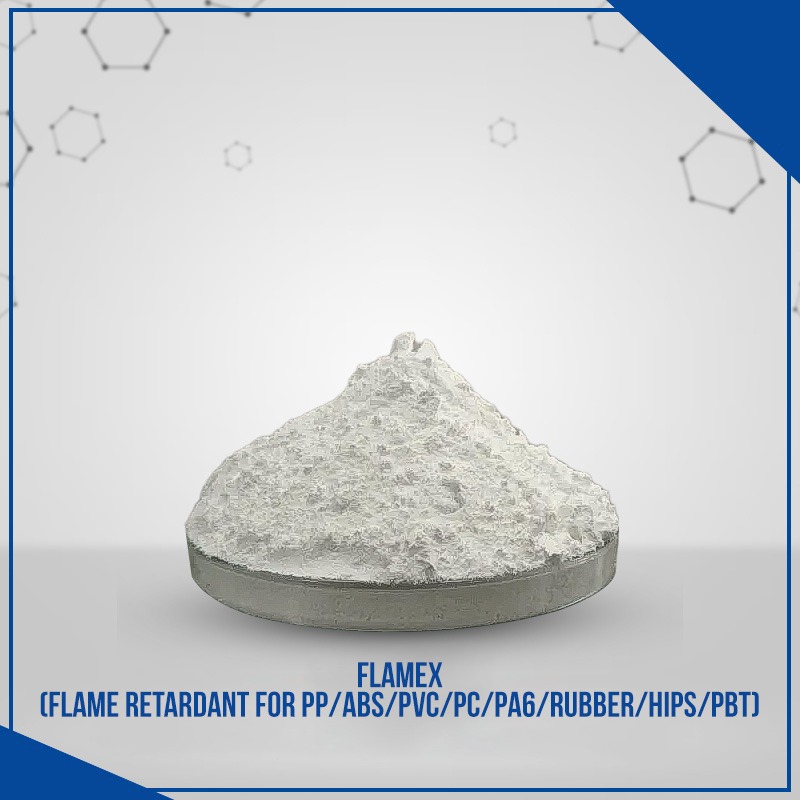 | flame retardant additives Flamex ( Flame Retardant for PP ABS PVC PC PA6 RUBBER HIPS PBT ) FLAMEX ( One Pack Flame Retardant ) manufactured by our company is widely used in PP,PA, PE,PC ,PC/ABS, PVC , Rubber ,PBT, PET, XPS, EPS, PU ,PVC,... View product → |
Frequently asked questions
What must a PP flame-retardant formulation achieve before production approval?
Define pass/fail limits for the final molded part, including the thinnest intended wall, flame performance, smoke behaviour, appearance, mechanical properties and process stability.
How do you choose flame-retardant chemistry for polypropylene?
Match the chemistry to the PP grade, target flame rating, processing temperature, required mechanical properties, colour requirements and compatibility with other additives.
How should you set additive loading for polypropylene?
Start with a controlled formulation trial, record the additive percentage and processing conditions, then approve loading only after testing molded parts from the intended resin and tool.
What should a Bhiwadi buyer check before qualifying a supplier?
Request consistent batch identification, a technical data sheet, safety data sheet, certificate of analysis, traceable samples and evidence that the supplier can support production-scale trials.