
A flame-retardant package must match the polymer, processing temperature, part thickness, fire test and smoke requirement; a generic additive claim cannot make that decision for you. By the end, you will be able to map chemistries to Bhiwadi production applications, set a controlled formulation trial, compare trade-offs and request evidence from the finished part.
Key takeaways
- Map resin, thickness, process, and end use before choosing an additive.
- Match the first trial to the target resin and finished-part thickness.
- Test flame, smoke, electrical, mechanical, and processing performance together.
- Request batch records, technical data, safety data, and test reports from suppliers.
Which Bhiwadi plastic applications need which flame-retardant approach?
Map Bhiwadi plastic applications by resin, process and end use before selecting a flame retardant; the same additive can pass in a 1.5 mm plaque and fail in a thin housing or cable.
For injection moulding of electrical housings, switchgear parts and appliance components, compare one-pack systems, halogen/antimony trioxide combinations, zinc borate and intumescent packages against UL 94, comparative tracking index, dielectric loss, corrosion, heat-humidity ageing and dimensional stability. Halogen/antimony packages can increase smoke and corrosive gases; intumescents can expand or distort thin parts.
| Resin or formulation | Process and application path | Main screening point |
|---|---|---|
| PP | Injection moulding; automotive or appliance parts | Control flaming drips, impact loss and char formation |
| ABS | Injection moulding; housings and panels | Check UL 94, colour, gloss and electrical drift |
| PVC | Profiles, sheets or cable insulation and sheathing | Separate rigid and plasticized grades; check fusion and smoke |
| PC | Injection moulding; electrical and automotive parts | Protect impact strength, transparency and dimensions |
| PA6 | Injection moulding; connectors and switchgear | Control moisture, hydrolysis and dielectric change |
| PBT | Injection moulding; electrical connectors | Check crystallisation, tracking and warpage |
| Rubber | Compounding; seals, hoses and cable jackets | Test smoke, flexibility, cure and dripping |
| Polyolefin | Plastic extrusion; cables, films and sheets | Match char, mineral reinforcement and extrusion temperature |
For rigid PVC profiles and extruded sheets, low-temperature mineral hydroxide systems differ from packages designed for higher-temperature polymers. Confirm whether the requirement covers a small moulded specimen, large panel, cable assembly or complete installed product, then verify resin grade, equipment, wall thickness and customer specification.
How should you build a first formulation trial?
Set a documented flame-retardant loading range for every candidate package; do not treat it as a guaranteed recipe. Record each additive as a weight percentage of the total formulation, including masterbatch dilution, resin moisture and order of addition.
1. Dry the resin and additives to their supplier limits, then calibrate each feeder gravimetrically. Record screw configuration, mixing shear, melt-compounding temperature and residence time.
ATH releases water at roughly 180–220 °C, while magnesium hydroxide decomposes at roughly 300–350 °C; match that reaction window to the polymer melt temperature and residence time, or premature gas release will damage dispersion and surface quality.
2. Start mineral hydroxide packages within a documented range, often about 40–65 wt% when useful flame resistance demands it. Expect higher viscosity and density, plus lower impact strength, elongation and surface quality; adjust particle treatment, screw mixing and throughput rather than simply increasing dose.
3. Use sealed handling and controlled drying for moisture-sensitive ammonium polyphosphate (APP), because hydrolysis can increase acidity, corrosion and electrical drift. For intumescents, verify acid, carbon and blowing-source ratios, dispersion and gentle-but-sufficient shear mixing; excessive shear, moisture or migration can leave cracked char.
In polyolefins, inspect flaming drips separately: char, reinforcement, polymer grade or part design may be needed.
4. Record pelletising conditions, pellet moisture and any reprocessing percentage. Mould or extrude specimens after each defined pass, retain a representative pellet and finished-part sample, and assign every trial a formulation revision number.
How do the main chemistries change each plastic and finished part?
One-pack flame retardant systems simplify dosing, but they do not remove formulation work. ATH releases water at 180–220°C; magnesium hydroxide decomposes at 300–350°C. Both often need 40–65 wt%, raising viscosity and density while reducing impact, elongation and surface quality.
| Chemistry | Mechanism and loading | Smoke, processing and property risk |
|---|---|---|
| One-pack | Pre-balanced package; supplier-specific loading | Faster trials, but screen FAM-501 or any one-pack grade; migration, colour and electrical drift remain possible |
| ATH | Endothermic cooling and dilution; high loading | Lower-temperature processing; moisture, viscosity, impact and surface risks |
| Magnesium hydroxide | Endothermic cooling at higher temperature; high loading | Wider high-temperature window; similar mechanical penalties |
| Antimony trioxide versus zinc borate versus molybdenum trioxide | Synergist, char/smoke suppressant, and smoke suppressant respectively; usually lower loading than hydroxides | Halogen/antimony can increase smoke and corrosive products; zinc borate can affect colour and fusion; molybdenum trioxide can alter colour, flexibility and electrical behaviour |
| Intumescent | Acid, carbon and blowing sources form char | Moisture, migration or excessive shear creates cracked char |
| Reactive grade | Chemically bonds into polymer | Less blooming, but can change molecular weight, cure, crystallisation, glass transition and recycling |
Rigid PVC needs dimensional stability and fusion control; plasticized PVC needs flexibility, plasticizer compatibility and low migration. Reject a smoke package if it stiffens the part, destabilises plasticizer, changes colour or disrupts fusion.
| Resin | Melt-temperature fit | Main screening flags |
|---|---|---|
| PP | Medium-high | Impact loss, dripping, blooming |
| ABS | Medium | Impact loss, colour, electrical drift |
| PVC | Low-medium | Corrosion, fusion, blooming |
| PC | High | Impact loss, dripping, electrical drift |
| PA6 | High, dry | Moisture, impact loss, crystallisation |
| PBT | High, dry | Hydrolysis, electrical drift, corrosion |
| Rubber | Cure-dependent | Cure change, blooming, flexibility |
| PE | Medium | Dripping, impact loss, blooming |
Which tests prove fire, smoke and electrical performance?
A UL 94 V-0 result proves vertical-burning behaviour only for the stated formulation, specimen thickness, conditioning protocol and geometry.
Each specimen must have no more than 10 seconds’ afterflame, with no more than 50 seconds total for five specimens, afterglow within the V-0 limit of 30 seconds per specimen, and no cotton ignition from flaming drips.
| Test | Property measured | What it does not prove |
|---|---|---|
| UL 94 V-0, V-1, V-2 | Vertical burning, afterflame, afterglow and dripping | V-0 at 1.5 mm does not establish performance at 0.8 mm; V-1 allows longer burning, while V-2 permits cotton ignition |
| ASTM D2863 LOI | Oxygen concentration threshold supporting combustion | It does not predict vertical burning, dripping or real-fire behaviour |
| ASTM E1354 cone calorimetry | Ignition time, heat-release rate, total heat released and mass loss under specified heat flux | It is not interchangeable with UL 94 |
| ASTM E662 smoke density | Optical smoke obscuration | It does not measure smoke toxicity or toxic gas composition |
| IEC 60695 glow-wire | Ignition and fire propagation from a heated wire | It applies where the electrical-product specification calls for glow-wire testing |
Test the actual compounded pellet and finished injection-moulded part, extruded sheet, cable insulation or assembly at intended thickness, colour, conditioning state and reprocessing history. A high LOI or UL 94 pass can still fail after humidity, heat or remoulding.
For electrical plastics, add comparative tracking index, dielectric loss, volume resistivity, corrosion testing and heat-humidity ageing. A flame-retardant package that passes UL 94 can still leave conductive residue, corrode electrodes or cause unacceptable electrical drift.
How should you qualify a Bhiwadi supplier and document the final package?
A promising additive becomes a controlled formulation only when every trial links a material identity to a finished-part qualification record. Use this checklist with any Bhiwadi chemical supplier:
1. Request the exact product grade, composition range, batch number, moisture specification, recommended processing window, storage conditions and change-notification policy. File the technical data sheet and SDS with the formulation revision.
2. Define the trial quantity, resin grade, additive loading, masterbatch dilution, colour, wall thickness and reprocessing history. Record local compounding or moulding support, repeat-batch consistency and the route for technical troubleshooting.
3. Demand test reports naming the resin grade, additive loading, specimen thickness, colour, conditioning, test geometry and laboratory identity. Reject a generic UL 94 V-0 claim or RoHS statement without formulation traceability; V-0 at 1.5 mm does not prove performance at 0.8 mm.
4. Complete a REACH and RoHS review before export. Check restrictions affecting substances such as decaBDE and HBCDD, and do not treat “halogen-free” or RoHS compliance as evidence of flame performance.
5. Retain the approved pellet, moulded specimen and report under one batch and revision number. Requalify after a supplier, grade, colour, loading or process change.
Niknam Chemicals Pvt. Ltd is one potential source to evaluate against these records, trial controls and support capabilities—not proof that any grade passes your customer’s finished-part test.
Related products
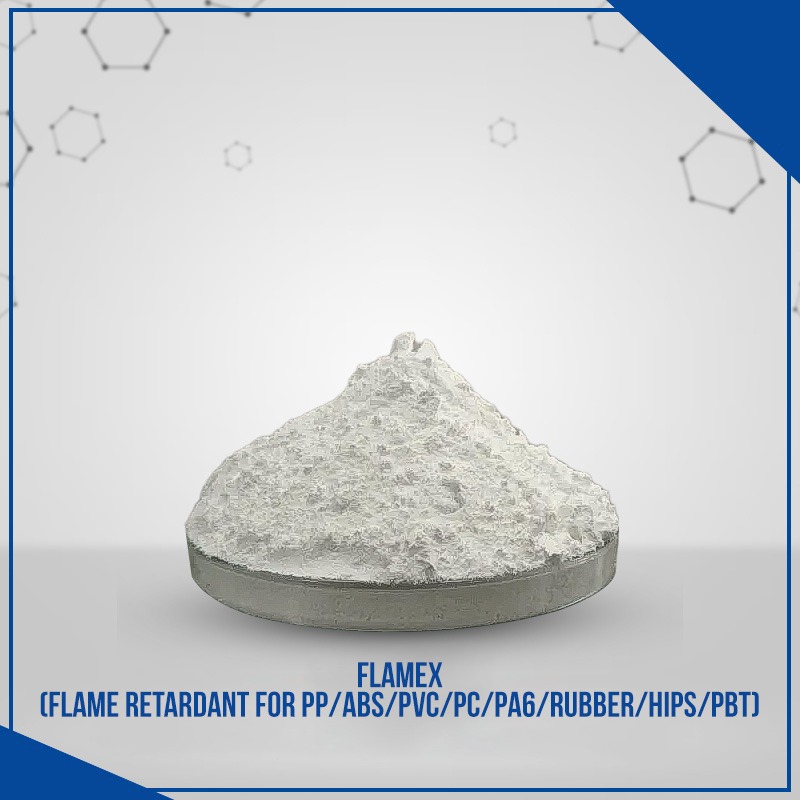 | flame retardant additives Flamex ( Flame Retardant for PP ABS PVC PC PA6 RUBBER HIPS PBT ) FLAMEX ( One Pack Flame Retardant ) manufactured by our company is widely used in PP,PA, PE,PC ,PC/ABS, PVC , Rubber ,PBT, PET, XPS, EPS, PU ,PVC,... View product → |
 | Flame Retardant Filler FAM-501 Flame Retardant Filler FAM-501 FAM - 501 Flame Retardant filler FAM-501 is One Pack Flame Retardant & Smoke Suppressant developed for Plasticized PVC applications. View product → |
Frequently asked questions
Which Bhiwadi plastic applications need which flame-retardant approach?
Select the approach by resin, processing method, part thickness, exposure to heat, and end-use requirement. A formulation that passes a 1.5 mm plaque can fail in a thin housing or cable.
How should you build a first flame-retardant formulation trial?
Define the resin grade, target loading, part thickness, processing temperature, and required test rating first. Prepare a controlled comparison with an untreated reference and record mixing, moulding, moisture, and dispersion conditions.
How do flame-retardant chemistries change each plastic and finished part?
Compare the chemistry’s effect on melt flow, colour, density, impact strength, tensile performance, surface appearance, corrosion risk, smoke, and long-term heat stability before selecting a package.
Which tests prove fire, smoke, and electrical performance?
Use the test method specified for the application, such as UL 94 for small-scale flammability, limiting oxygen index for ignition behaviour, smoke testing where required, and comparative tracking or dielectric tests for electrical parts.
How should you qualify a Bhiwadi flame-retardant supplier?
Request a current technical data sheet, safety data sheet, certificate of analysis, batch number, specification limits, storage conditions, sample traceability, and test reports linked to the actual formulation and specimen thickness.
Related products
| FAM-501 ABOUT FAM - 501 FAM-501 is One Pack Flame Retardant & Smoke Suppressant developed for Plasticized PVC applications. View product → |
 | Antimony Trioxide Our range of Antimony trioxide is used mainly in flame retardant formulations for plastics, rubbers, textiles, paper and paints. View product → |
 | Zinc Borate ZINC BORATE is a highly effective multifunctional flame retardant synergist being used as a flame retardant and smoke suppressant in a wide range of... View product → |
 | Aluminium Trihydrate (ATH) is a very finely grounded product having a uniform and controlled particle size distribution. View product → |