
Choosing a flame-retardant package is a polymer-and-process decision, not a matter of selecting the additive with the strongest product description. You will be able to connect flame-retardant mechanisms, loading levels, processing limits, test methods and mechanical trade-offs to a practical formulation decision for plastics made in Bhiwadi.
Key takeaways
- Match the additive to polymer type, part thickness and required fire rating.
- Use small loading trials to balance flame performance, impact strength and processability.
- Confirm dispersion, thermal stability and repeatability before scaling production.
- Request test reports, batch data and compliance documents before approving a supplier.
How flame retardants stop burning—and what each test actually proves
Choose the mechanism that matches the failure you need to prevent. The main flame-retardant mechanisms are gas-phase inhibition, condensed-phase char formation, dilution effect, and endothermic or “energetic decomposition” that absorbs heat and releases non-combustible gases.
| Mechanism | Fire behaviour addressed | What to verify |
|---|---|---|
| Gas-phase inhibition | Interrupts flame radicals above the surface | Flaming reduction; smoke and carbon monoxide separately |
| Condensed-phase char formation | Builds an insulating surface barrier | Char continuity, cracking and dripping |
| Dilution effect | Lowers fuel concentration with inert gases or mineral residue | Residue, density and mechanical-property loss |
| Endothermic decomposition | Absorbs heat while releasing water or other gases | Processing temperature and residue stability |
UL 94 V-0, V-1 and V-2 measure small-flame vertical burning on specified specimens. V-0 limits afterflame time and flaming drips; it does not predict heat release, flame spread, smoke or toxic effluent. Test the thinnest production wall, because a 1.5 mm plaque can pass while a 0.8 mm part fails.
LOI reports the oxygen concentration needed to sustain burning; a higher value indicates greater resistance under that test, not enclosure-fire safety. Cone calorimetry reveals time to ignition, peak heat-release rate, total heat release and smoke. Measure smoke optically and analyse gases when relevant.
Record drying, humidity and mould-to-test intervals: moisture changes viscosity, hydrolysis, dripping and char formation.
Match the chemistry to the polymer, thickness and target rating
A thin part aiming for UL 94 V-0 needs a more efficient package than a thick housing targeting V-2. Match the additive to melt temperature, viscosity, colour, electrical limits and the polymer’s decomposition chemistry.
| Polymer | Practical starting choice | Main constraint |
|---|---|---|
| PP | Halogenated flame retardants with antimony trioxide, or a halogen-free mineral system | Mineral grades require high loading and can reduce impact and flow |
| ABS | Halogenated flame retardants plus antimony trioxide; use a one-pack system for repeatability | Check gloss, impact strength and colour after compounding |
| PVC | Its chlorine content supports halogenated systems; add antimony trioxide or zinc borate synergist when testing demands it | Excess filler can stiffen the compound and worsen processing stability |
| PC | Phosphorus flame retardants, especially for thin electrical parts | Confirm hydrolysis, stress-cracking and melt-viscosity effects |
| PA6 | Polyamide-specific phosphorus flame retardants or a compatible one-pack system | Drying is critical; moisture can erase the expected rating |
| PBT | Phosphorus flame retardants or a polyester-specific one-pack system | Check hydrolysis resistance and weld-line strength |
| Rubber | Zinc borate, halogenated systems or mineral packages selected for the cure system | Do not disrupt cure rate, elongation or compression set |
Antimony trioxide is primarily a synergist, not a stand-alone replacement for halogen. Removing halogen without redesigning the mechanism can sharply reduce performance. Phosphorus systems form char or interrupt flame radicals, while minerals dilute fuel and absorb heat; neither mechanism transfers automatically between polymers.
For recycled content, requalify after changing feedstock or percentage. A supplier’s “halogen-free” label does not prove REACH or RoHS compliance, and additive systems can migrate or bloom; reactive grades improve permanence but change processing and recycling options.
Set a defensible starting loading without sacrificing the part
Start with a 5–10 phr starting loading for additive or phosphorus systems, then increase in 2–5 phr steps until the target rating is reached without breaking mechanical limits. For mineral hydroxides, begin at 30–40 wt% and screen toward 50–60 wt%; these are practical maximum filler levels for many trials, not universal formulation limits.
| System | First screening range | Main part penalty |
|---|---|---|
| Halogenated or phosphorus package | 5–20 phr | Lower impact or elongation if the polymer is over-plasticised or the package is poorly compatible |
| Aluminium hydroxide or magnesium hydroxide | 30–60 wt% | Higher density, lower tensile strength, impact resistance, elongation and melt flow |
| Zinc borate or mineral synergist | 3–15 phr | Stiffness and density increase; excessive loading can damage surface appearance |
| Rubber compounds | 10–30 phr | Reduced extensibility and rebound, with higher compound viscosity |
Mineral fillers versus reactive flame retardants involve a permanence-versus-processability trade-off. Mineral fillers dilute the resin, raise flexural strength and stiffness, and often lower melt flow; reactive chemistry stays in the polymer more permanently but can change molecular weight, glass transition, cure behaviour and recycling options.
Measure tensile strength, impact resistance, elongation and flexural strength at every loading step, not only at the final flame test. Watch density, die pressure, screw wear, surface streaks and weld lines: rising viscosity restricts knit-line flow, making welds more visible and weaker.
Request melt-flow or rheology data at the intended loading, plus maximum processing temperature and dispersion limits.
Process the package for dispersion, stability and repeatable results
Use a dry, staged feed and keep the melt inside the additive’s thermal window. Poor sequencing traps agglomerates, raises die pressure and produces different flame results from one batch to the next.
1. Dry moisture-sensitive resin and additive separately. Dry PA6 at 80°C for 4–6 hours, and dry PBT or PC at 120°C for 3–4 hours in a desiccant dryer. Confirm the supplier’s limit for phosphorus additives; do not assume a free-flowing powder is dry.
2. Premix the flame retardant, synergist, pigment and lubricant, then feed this blend with resin. For extrusion, use twin-screw compounding with distributive mixing before intensive kneading; reserve side feeding for abrasive mineral fillers that bridge the throat.
3. Set the melt window from the polymer and additive decomposition data: PP 180–220°C, ABS 210–250°C, PVC 170–190°C, PA6 240–270°C, PBT 240–260°C and PC 240–280°C. Keep residence time after complete melting near 1–3 minutes and purge before shutdown.
4. For injection moulding, use dried compounded pellets rather than dosing powder into the hopper. Keep barrel residence below 10 minutes, control back pressure to limit shear heating, and check melt flow after each loading change.
For PVC mixing, add stabiliser and lubricant to the resin first, then the flame-retardant package; hot-mix to about 110–120°C, cool below 45°C, and record fusion time. Inspect plaques for specks, streaks and surface bloom before fire testing.
Use a qualification sheet before approving a flame-retardant supplier
Do not approve a supplier from a UL 94 certificate alone. Request a qualification sheet tied to your resin grade, thinnest production wall, loading and processing history; V-0 at 1.5 mm can fail at 0.8 mm.
Ask for:
- Thermal stability data, recommended melt-temperature and residence-time limits, moisture guidance, dispersion requirements and abrasive-filler warnings.
- Rheology or melt-flow data at the intended loading, plus die-pressure, torque and surface-finish observations.
- Smoke suppression results from an optical-smoke method and, where enclosure exposure matters, carbon-monoxide or other gas analysis.
- A complete composition or regulatory statement identifying REACH registration or exemption status, RoHS restricted-substance compliance, and evidence behind any “halogen-free” claim.
- Results at several recycled-content percentages, including feedstock source, polymer contamination, pigments, moisture and legacy additives.
- Certificates of analysis for three consecutive batches, with limits for active content, moisture, particle size, colour and melt flow.
Niknam Chemicals Pvt. Ltd can be assessed on the same evidence: compare its proposed package against your actual resin and wall thickness, not a generic application list.
| Check | Acceptance evidence | Reject or requalify when |
|---|---|---|
| Virgin versus recycled resin | Same UL 94, smoke, melt flow and mechanical results | Recycled-content percentage or feedstock source changes without testing |
| Batch consistency | Three batches meet the stated limits and plaque results | Active content, flow, colour or dispersion shifts |
| Production trial | No abnormal torque, die pressure, deposits or surface defects | Processing exceeds the supplier’s temperature or residence-time limit |
Related products
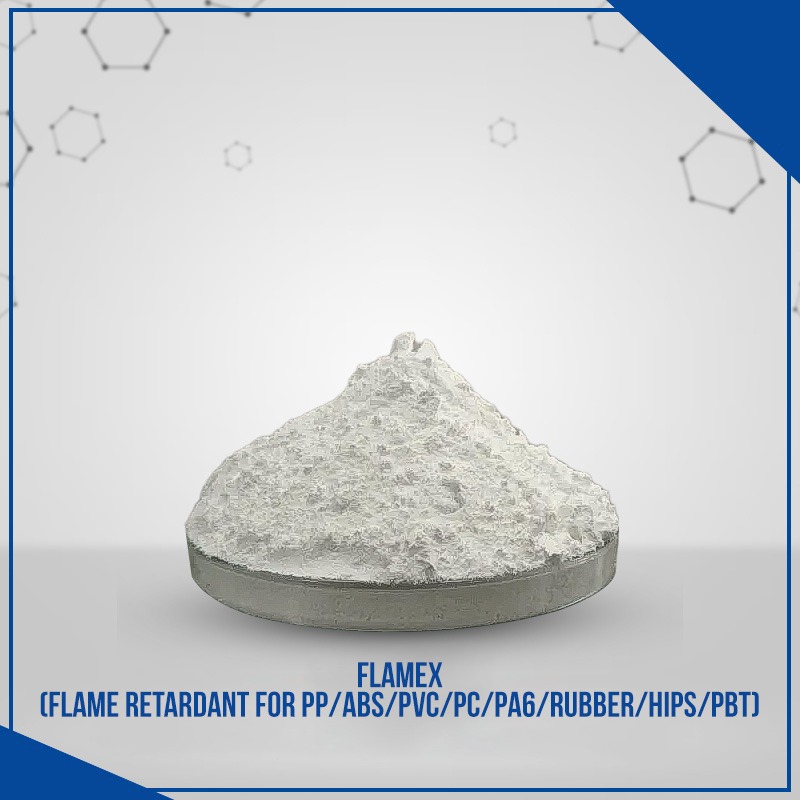 | flame retardant additives Flamex ( Flame Retardant for PP ABS PVC PC PA6 RUBBER HIPS PBT ) FLAMEX ( One Pack Flame Retardant ) manufactured by our company is widely used in PP,PA, PE,PC ,PC/ABS, PVC , Rubber ,PBT, PET, XPS, EPS, PU ,PVC,... View product → |
 | Flame Retardant Filler FAM-501 Flame Retardant Filler FAM-501 FAM - 501 Flame Retardant filler FAM-501 is One Pack Flame Retardant & Smoke Suppressant developed for Plasticized PVC applications. View product → |
Frequently asked questions
How do flame retardant chemicals stop plastics from burning?
They work through gas-phase inhibition, condensed-phase char formation, dilution, or endothermic decomposition that absorbs heat and releases non-combustible gases.
How do you choose a flame retardant for a plastic formulation?
Match the chemistry to the polymer, part thickness, processing conditions and target rating, then verify performance through the required fire tests.
How do you set a starting flame-retardant loading?
Run controlled loading trials and compare fire performance with impact strength, flow, appearance, thermal stability and part integrity.
What should a flame-retardant supplier qualification sheet include?
Record chemistry, recommended loading, particle size or form, batch identification, test reports, processing limits, compliance documents and consistency data.
Related products
| FAM-501 ABOUT FAM - 501 FAM-501 is One Pack Flame Retardant & Smoke Suppressant developed for Plasticized PVC applications. View product → |
 | Zinc Borate ZINC BORATE is a highly effective multifunctional flame retardant synergist being used as a flame retardant and smoke suppressant in a wide range of... View product → |
 | Antimony Trioxide Our range of Antimony trioxide is used mainly in flame retardant formulations for plastics, rubbers, textiles, paper and paints. View product → |
 | Aluminium Trihydrate (ATH) is a very finely grounded product having a uniform and controlled particle size distribution. View product → |