
Polypropylene burns readily in normal air, so choosing an additive by product name or broad application list is not enough. You will be able to define the required fire test, compare additive systems, set up a formulation trial and identify the processing evidence to request before approving a PP component.
Key takeaways
- Specify test method, rating, thickness and direction before selecting an additive.
- Compare mineral, halogenated, phosphorus and intumescent systems against your end-use hazard.
- Match the additive to the PP grade, processing temperature and surface requirements.
- Qualify finished parts and demand traceable supplier test evidence.
Set the fire-performance target before choosing a PP additive
Specify the test method, rating, specimen thickness, test direction and end-use hazard before asking for flame retardant additives for polypropylene. “Flame-retardant PP” is not a usable target: unmodified polypropylene has a limiting oxygen index of roughly 17–19%, below air’s 21%, so a small LOI improvement does not establish component safety.
| Rating | UL 94 requirement | What you must state |
|---|---|---|
| UL 94 V-0 | Each vertical specimen has afterflame of 10 seconds or less; total afterflame is 50 seconds or less; flaming drips must not ignite the cotton indicator | Minimum wall thickness and orientation |
| UL 94 V-1 | Individual afterflame is 30 seconds or less; total afterflame is 250 seconds or less; flaming drips must not ignite cotton | Minimum wall thickness and orientation |
| UL 94 V-2 | Same afterflame limits as V-1, but flaming drips may ignite cotton | Minimum wall thickness and orientation |
Request a result for the named formulation at the actual moulded thickness, not a resin datasheet at 3.2 mm when your rib is 1.5 mm. Confirm whether the test uses injection moulding PP, glass-filled PP or mineral-filled PP; filler, pigment and impact modifier can change the result. UL 94 V-0 is not a smoke rating.
- State the end-use requirement: electrical enclosure, appliance housing, transport interior or another defined application.
- Add separate smoke-density, toxicity or corrosivity tests when people, enclosed equipment or ventilation are at risk.
- Specify glow-wire testing, such as IEC 60695-2-11, when the product faces a heated ignition source.
Compare mineral, halogenated, phosphorus and intumescent systems
Loading is the first trade-off: mineral systems often need the highest addition, while halogenated packages reach flame ratings at lower total loading. The correct comparison is the finished formulation, not the additive name alone.
| Option | Loading and smoke | Acceptance and mechanical effect | Injection-moulding suitability |
|---|---|---|---|
| Mineral: aluminium hydroxide polypropylene or magnesium hydroxide PP | High loading, often 30–60% by weight; low smoke, but water release can affect processing. | Broad acceptance; raises stiffness and density, reduces flow and impact strength. | Suitable for thick, rigid parts when screw torque, surface finish and wall thickness allow it. |
| Halogenated with antimony trioxide PP flame retardant | Lower loading than minerals; effective flame suppression but more smoke and potentially corrosive gases. | PBB and PBDE restrictions do not ban every halogenated chemistry. Demand the active chemistry and concentration, not only a “RoHS compliant” claim. | Efficient for thin mouldings, but ventilation, customer restrictions and end-of-life handling can disqualify it. |
| Phosphorus, including a zinc borate synergist | Medium loading; smoke is often lower than with halogenated systems, but compatibility and migration require testing. | Frequently accepted where halogen-free content is requested; excessive loading can reduce toughness and flow. | Good for compact parts when the resin, pigment and stabiliser package are compatible. |
| Intumescent | Medium-to-high loading; ammonium polyphosphate, pentaerythritol and melamine must form a continuous char. | Low-smoke, halogen-free positioning; poor dispersion causes weak char and inconsistent results. | Useful for injection mouldings, but surface appearance, weld lines and flow need qualification. |
Measure smoke separately from UL 94. Specify V-0, V-1 or V-2 at the actual wall thickness; a 3.2 mm pass does not prove a 1.5 mm part will pass.
Build the formulation around the actual injection-moulding grade
Start with the exact injection-moulding PP grade, not a generic polypropylene label. Record melt-flow rate, molecular-weight distribution if available, comonomer content, and the intended wall thickness; a flame-retardant package that works in a 20 g/10 min homopolymer may fail in a lower-flow copolymer.
Check melt viscosity, filling pressure, weld-line strength, impact and surface finish after compounding.
| Variable | Check before setting dosage | Why it matters |
|---|---|---|
| Resin | Homopolymer, random copolymer or impact copolymer; MFR | Changes flow, dripping, ignition and weld-line strength |
| Filler | Glass-fibre grade, surface treatment, mineral type, loading and orientation | Alters residue, combustible flow paths, impact and fire behaviour |
| Pigment | Type, loading and carrier resin | Some pigments consume stabiliser or interfere with dispersion and colour |
| Impact modifier | Elastomer chemistry and percentage | Can dilute the package and reduce stiffness or vertical-flammability performance |
| Lubricant | Amide, ester or silicone type and concentration | Excess can cause bloom, plate-out, deposits and altered melt flow |
| Stabiliser | Phenolic antioxidant, phosphite, acid scavenger and metal content | Prevents degradation, corrosion and additive interaction during processing |
Write PP flame-retardant dosage on one basis: weight percent of finished compound or phr per 100 parts of PP. For a masterbatch, state the active content and masterbatch let-down ratio; a 20% active concentrate at 10% let-down contributes 2 weight percent active additive.
Qualify that formulation at the required thickness, rather than transferring a dosage from unfilled PP.
Compound and mould the additive without losing dispersion or surface quality
A compound that passes UL 94 can still produce streaks, brittle weld lines or mould deposits if the flame-retardant PP dispersion is poor. Control the material before it reaches the mould:
- Premix powder additives with PP or a compatible carrier in a sealed, low-dust system. Do not rely on hand blending; concentration gradients create colour and fire-performance variation.
- Use separate gravimetric feeders for resin and additive, then verify feeder output by weighing timed samples. Feed the additive into a well-melting section, not directly into an unheated hopper.
- Dry hygroscopic additives according to the supplier’s temperature and time limits, and confirm moisture with a moisture analyser. Overdrying or holding the blend hot for too long can reduce PP molecular weight and darken the compound.
- Use twin-screw compounding with distributive mixing before the kneading section and enough dispersive energy to break agglomerates. Excessive shear can damage sensitive packages, so check torque, melt pressure and pellet appearance.
- Set barrel temperatures high enough for complete wetting but below the package’s decomposition range. Record melt temperature, not only set-point temperature, because shear can raise the actual melt.
- Keep residence time short and stable. Purge during stoppages; stagnant, overheated material can cause black specks, corrosion, mould deposits and plate-out.
During single-screw injection moulding, qualify melt-flow rate, filling pressure, screw speed, back pressure and melt temperature on the compounded grade. Start with gentle screw recovery and controlled decompression, then inspect short shots, weld lines and the first production parts.
Clean the tool after a defined shot count and investigate any deposit before changing the moulding window.
Qualify the finished component and the supplier’s evidence
Require plaques moulded from your actual PP grade, additive dosage, pigment, filler and component thickness—not a generic laboratory compound. Record melt-flow rate, colour, specimen thickness and batch number, then retain approved plaques for comparison after ageing.
| Evidence | Ask for | What it proves |
|---|---|---|
| IEC 60695-2-11 glow-wire | Finished-component result at the specified wire temperature, including ignition and flame-extinction times | Product behaviour under a heated-wire fault; it is not a UL 94 result |
| UL 94 | V-0, V-1 or V-2 classification at the tested thickness and named formulation | Vertical-flammability performance |
| Oxygen index PP | Test method, oxygen concentration, specimen thickness and conditioning | Burning tendency; unmodified PP often has an LOI near 17–19% |
| FMVSS 302 polypropylene | Burn rate, specimen orientation, thickness and conditioning | Automotive interior flammability evidence |
| Smoke density | Method, heat or flame exposure, optical-density result and acidic-gas or toxicity measurements | Smoke performance, which flame rating does not establish |
Ask Niknam Chemicals Pvt. Ltd for a formulation-specific technical data sheet, safety data sheet, certificate of analysis and retained-sample traceability. The declaration must name each active chemistry and concentration; “RoHS compliant” alone does not reveal halogen content, antimony trioxide or PBB/PBDE status.
- Check additive lot, resin lot, moisture and contamination before compounding.
- Verify feeder calibration, drying temperature and time, melt temperature, residence time and screen-pack condition.
- Mould first-off parts, then recheck weight, dimensions, weld lines, colour, warpage and flame results after the agreed production interval.
Related product
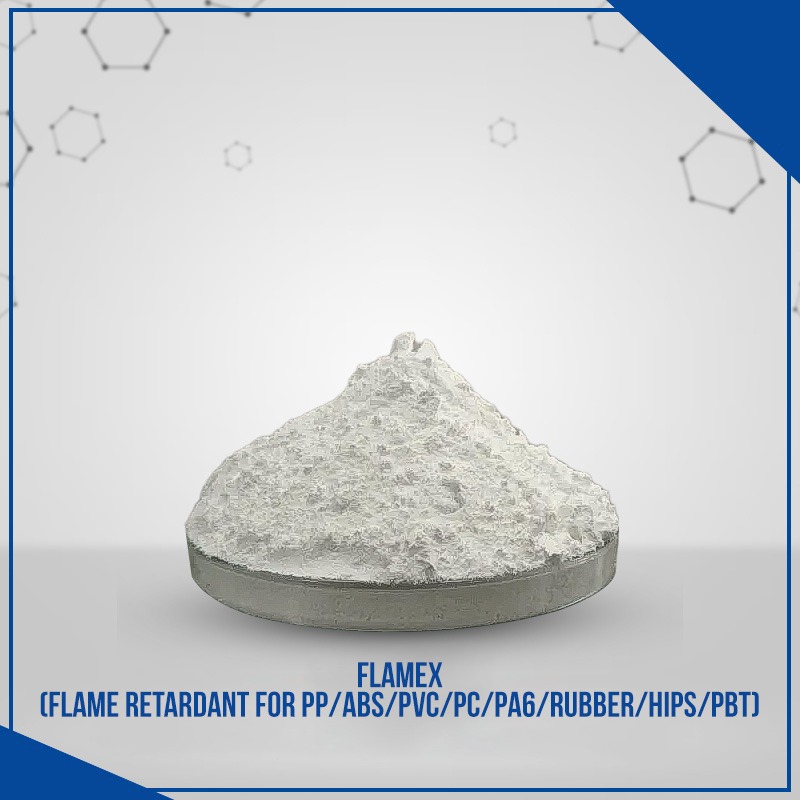 | flame retardant additives Flamex ( Flame Retardant for PP ABS PVC PC PA6 RUBBER HIPS PBT ) FLAMEX ( One Pack Flame Retardant ) manufactured by our company is widely used in PP,PA, PE,PC ,PC/ABS, PVC , Rubber ,PBT, PET, XPS, EPS, PU ,PVC,... View product → |
Frequently asked questions
What should you specify before choosing a flame retardant for polypropylene?
Define the test method, required rating, specimen thickness, test direction and end-use fire hazard. A target such as “flame-retardant PP” is too vague for formulation or purchasing.
How do mineral, halogenated, phosphorus and intumescent systems differ?
Mineral systems can affect loading, stiffness and processing; halogenated systems require smoke, corrosion and regulatory review; phosphorus systems vary by chemistry and compatibility; intumescent systems form a protective char but demand careful dispersion and formulation balance.
Why must the additive be matched to the injection-moulding grade?
The PP grade determines melt temperature, residence time, flow, filler compatibility and surface behaviour. An additive that works in one grade can cause poor dispersion, warpage, deposits or inadequate fire performance in another.
How do you qualify a flame-retardant polypropylene component and its supplier?
Test the finished component at its actual thickness and orientation, then check the formulation, batch traceability, processing guidance and laboratory reports. Ask for evidence tied to the specific additive grade and test specimen.