
A flame-retardant additive is only suitable when it matches the polymer, resin grade, plasticizer package, processing window and finished-part test. By the end, you will be able to define the required fire objective, compare additive chemistries, request usable formulation data and qualify a supplier without relying on a generic flame-rating claim.
Key takeaways
- Name the test standard, specimen thickness, conditioning, colour, and rating before choosing an additive.
- Check polymer compatibility, processing temperature, moisture sensitivity, and end-use exposure.
- Compare additive loading against strength, flow, colour, smoke, cost, and recyclability trade-offs.
- Request batch data, technical documents, trial support, and consistent production samples from suppliers.
Define the fire-performance target before comparing additives
The required pass/fail result—not the additive name—should start your selection. Define whether the part must resist ignition, limit flame spread, reduce heat release, or meet a smoke density limit, then name the product standard, specimen thickness, colour, conditioning and rating. A formulation that passes one target can fail another.
| Test or classification | What it measures | Use it when |
|---|---|---|
| UL 94 vertical burning | V-0, V-1 or V-2 afterflame and dripping behaviour | The buyer specifies a polymer enclosure or component; request the exact resin grade, colour and wall thickness |
| ASTM E84 | Flame-spread index and smoke-developed index | The product is an exposed construction surface |
| ISO 5660-1 cone calorimetry | Ignition time, heat-release rate, total heat release, mass loss and smoke-related data | Fire growth and smoke suppression matter in an industrial part |
| EN 13501-1 | Reaction-to-fire class, including smoke-production classification | A construction or infrastructure project requires product classification |
| IEC 60332-1-2 or IEC 60332-3 | Flame propagation along a cable | The additive is being qualified for cable insulation or sheathing |
Use Limiting Oxygen Index as a controlled comparison between formulations, not as a prediction of fire growth. A high LOI does not guarantee low heat release or smoke density. Treat flame retardancy and smoke suppression as separate targets; a supplier’s V-0 result is not smoke evidence.
Write the acceptance target into the trial plan: for example, “UL 94 V-0 at 1.5 mm” or a specified cone-calorimeter heat-release limit. Test the actual resin grade, loading, colour, thickness and filler package; a thin white plaque can hide failure in a dark, glass-filled production part.
Match the chemistry to the polymer and end-use part
A flame retardant that works in one polymer can fail in another because decomposition temperature, polarity and melt flow control whether the additive disperses and forms protective char. Confirm polymer compatibility before comparing suppliers, then match the chemistry to the actual compound rather than to a generic resin family.
- Polymer type: Identify whether the matrix is a flexible, semi-rigid or engineering thermoplastic, and select chemistry that remains stable across its processing temperature.
- Resin grade: Use the exact grade, molecular weight, impact modifier and processing-aid package; a result in an unfilled grade does not transfer automatically to a glass-reinforced grade.
- Plasticizer system: In flexible PVC and similar compounds, check whether plasticizer type and level promote additive migration, blooming or extraction after heat cycling and contact with oil or cleaner.
- Filler package: Glass fibre, calcium carbonate, talc and other minerals alter char formation, melt viscosity, heat transfer and the loading required for fire performance.
- Part design: Check wall thickness, ribs, bosses, weld lines and flow direction. Thin sections can quench differently from thick sections, while corners and knit lines can burn through first.
Qualify the candidate in the production resin grade, colour, thickness and filler package. Test mechanical, electrical, ageing, smoke and extraction performance alongside the flame test; a white laboratory plaque cannot validate a dark, thick enclosure. UL 94 V-0 describes the tested specimen, not automatically the finished product, cable or construction assembly.
Use the end-use standard when the market requires reaction-to-fire, flame propagation, smoke density or toxicity classification.
Compare one-pack systems, mineral fillers and synergists by trade-off
Choose a one-pack flame-retardant system when batching accuracy, fast scale-up and consistent dosing matter more than maximum formulation flexibility. Choose individual additives when you need to tune flame spread, smoke, colour, viscosity or mechanical properties independently.
| Option | Main advantage | Trade-off and best fit |
|---|---|---|
| One-pack flame retardant | Pre-balanced blend reduces weighing and compatibility errors | Less freedom to optimise each component; use it when the supplier has validated your resin, thickness and process |
| ATH or aluminium hydroxide | Releases water at about 180–220 °C and provides non-halogenated flame resistance | Requires high loading, raises viscosity and density, and reduces elongation; use it in lower-temperature polymers that tolerate mineral filler |
| Zinc borate | Supports char formation and can reduce afterglow or smoke in selected polymers | Performance depends strongly on resin and companion additives; use it when smoke or glowing is also a target, then test smoke separately |
| Antimony trioxide | Strong synergist for many halogenated systems at practical loading | Removing it can increase loading and worsen smoke, colour or processing; use it only with a compatible halogen package |
| Molybdenum trioxide | Useful smoke-suppression synergist in selected halogenated formulations | Higher cost and possible colour or dispersion issues; choose it when smoke reduction justifies the formulation change |
Do not treat a flame rating as proof of smoke performance. For cables, also match the formulation to the test: IEC 60332-1-2 covers one vertical insulated wire or cable, while IEC 60332-3 covers bunched cables. A passing result in one does not establish the other.
Set the loading and processing window without damaging the compound
A production trial needs a formulation window, not a single dosage: define the recommended loading range, maximum loading, addition order, melt temperature and residence time before mixing material.
1. Screen on total compound weight. Use 8–20% halogenated package with 2–6% antimony trioxide only as a starting range; removing the synergist can increase dosage, smoke and property loss. Screen ATH at 30–60%, magnesium hydroxide at 40–60%, and intumescent packages at 20–35%. Confirm each range with the supplier’s grade data.
2. Set the maximum loading at the point where torque, melt pressure, density, elongation, impact strength or injection filling becomes unacceptable. High mineral loading is not cost-neutral: it raises viscosity and can block cable dies or cause short shots. Treat 60% as a screening ceiling, not an automatic production limit.
3. Dry resin and moisture-sensitive powders to their technical data-sheet limits. Melt the polymer first, then side-feed mineral powders where possible; add liquid plasticizer downstream and vacuum-vent volatiles. Premix halogenated additives with their synergist instead of dosing them separately.
4. Keep the lowest melt temperature that gives complete dispersion and record actual peak temperature. ATH releases water around 180–220 °C; magnesium hydroxide decomposes around 300–350 °C. Run at the intended residence time and at twice that time to expose discoloration, volatilization or decomposition.
5. Check torque, pressure, colour, surface bloom and mechanical properties before testing the required rating at the actual wall thickness.
Qualify the supplier with production-grade evidence
Require a qualification file tied to your actual product, not a generic “UL 94 V-0 additive” claim. The file must identify resin grade, colour, wall thickness, additive loading, batch number and test laboratory; V-0 applies only to the tested specimen, not automatically to a finished enclosure or cable.
Require these before approval:
- A current certificate of analysis, technical data sheet and safety data sheet, with assay, particle size, ash, bulk density, moisture limits and shelf life.
- Sealed packaging details, liner material, pack size, storage temperature and humidity limits, plus instructions for resealing opened bags. Test the powder after your specified warehouse conditioning, not only as received.
- A UL 94 test report for your exact polymer, colour, thickness and loading. For cables, require IEC 60332-1-2 for a single vertical wire or cable, or IEC 60332-3 for bunched cables; one does not prove the other.
- ISO 5660-1 cone calorimetry data covering heat-release rate, total heat release and smoke production, alongside mechanical, electrical and ageing results.
- Production trials using your compound and moulded part, with retained samples and repeat batches. Do not transfer results from a thin white plaque to a dark, glass-filled part.
- Batch traceability, change-notification terms, complaint records and an auditable quality-control process. Niknam Chemicals Pvt. Ltd can be evaluated by the same evidence, regardless of its Bhiwadi location.
Related products
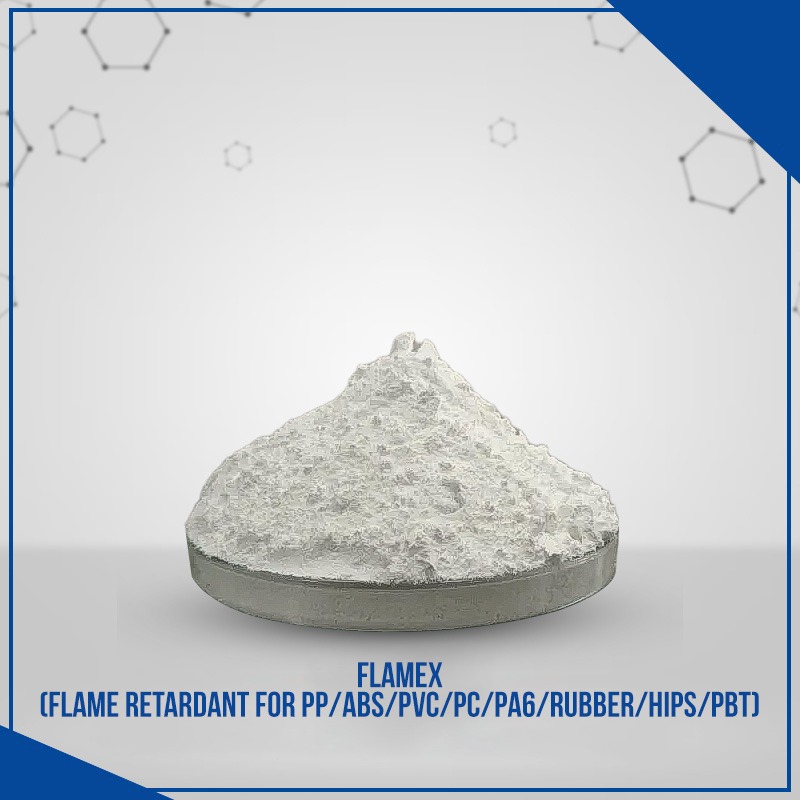 | flame retardant additives Flamex ( Flame Retardant for PP ABS PVC PC PA6 RUBBER HIPS PBT ) FLAMEX ( One Pack Flame Retardant ) manufactured by our company is widely used in PP,PA, PE,PC ,PC/ABS, PVC , Rubber ,PBT, PET, XPS, EPS, PU ,PVC,... View product → |
 | Flame Retardant Filler FAM-501 Flame Retardant Filler FAM-501 FAM - 501 Flame Retardant filler FAM-501 is One Pack Flame Retardant & Smoke Suppressant developed for Plasticized PVC applications. View product → |
Frequently asked questions
What should you define before comparing flame-retardant additives?
Define the pass/fail target, product standard, specimen thickness, colour, conditioning, and required rating. Specify whether you need ignition resistance, limited flame spread, lower heat release, or a smoke-density limit.
How do you match a flame-retardant additive to a polymer?
Check compatibility with the resin, decomposition temperature, processing temperature, moisture sensitivity, mechanical requirements, colour limits, and the part’s service environment.
How should you compare one-pack systems, mineral fillers, and synergists?
Compare the complete formulation, including loading, dispersion, smoke, density, strength, flow, surface quality, cost, and processing complexity rather than comparing additive prices alone.
What evidence should you request from a flame-retardant additive supplier?
Request a technical data sheet, safety data sheet, certificate of analysis, batch number, recommended processing conditions, test-method details, production samples, and evidence from trials in your polymer and part geometry.
Related products
| FAM-501 ABOUT FAM - 501 FAM-501 is One Pack Flame Retardant & Smoke Suppressant developed for Plasticized PVC applications. View product → |
 | Zinc Borate ZINC BORATE is a highly effective multifunctional flame retardant synergist being used as a flame retardant and smoke suppressant in a wide range of... View product → |
 | Antimony Trioxide Our range of Antimony trioxide is used mainly in flame retardant formulations for plastics, rubbers, textiles, paper and paints. View product → |
 | Aluminium Trihydrate (ATH) is a very finely grounded product having a uniform and controlled particle size distribution. View product → |