
A flame-retardant additive is only useful when it matches the polymer, processing temperature, end-use exposure and fire test you must pass. By the end, you will be able to define the application, compare additive mechanisms, set a defensible trial plan and screen supplier data for plastics used in Mumbai’s humid, industrial and coastal environment.
Key takeaways
- Match the additive to ignition, flame spread, droplets, cable travel or insulation failure.
- Set the required fire test target before comparing chemical mechanisms.
- Check mineral, intumescent and synergist effects against polymer and processing limits.
- Ask Mumbai suppliers for test reports, batch data, SDS and formulation support.
Match the plastic application to the fire hazard
A plastic part in a Mumbai building, vehicle or factory must prevent the specific fire failure that threatens people and equipment: ignition, flame spread, burning droplets, cable flame travel or loss of electrical insulation. Match the application to that failure before selecting a chemical.
| Application | Fire hazard | Formulation must prevent |
|---|---|---|
| Electrical enclosures | Internal arcing ignites the housing and sustains flame | Ignition, flame spread, flaming drips and loss of enclosure integrity |
| Cable compounds | A burning cable carries fire along a tray or riser | Flame propagation, melt-dripping and excessive smoke in occupied or enclosed areas |
| Automotive interiors | A seat, trim panel or dashboard ignites after a vehicle fire starts | Rapid flame spread, dripping and smoke that reduces visibility or delays evacuation |
| Appliance housings | A motor, relay or wiring fault heats the plastic locally | Ignition, sustained burning and hot deformation around live components |
| Construction products | A wall panel, conduit or insulation product feeds a room or façade fire | Surface flame spread, heat release and falling burning fragments |
Do not treat “halogen-free” as “low-smoke.” Smoke depends on the polymer, additives, oxygen and ventilation; test it separately because carbonyl and hydrocarbon products can remain dense and hazardous. Mumbai’s humid coastal storage also makes moisture-sensitive systems vulnerable to poor dispersion or surface migration.
Check restricted-substance rules before approving brominated or chlorinated chemistry for electronics or export supply chains.
Choose the test target before choosing the chemical
The test target determines the additive package: a thin electrical cover needs a different formulation from a cable, wall panel or appliance housing. Start by defining the end-use test, specimen thickness, conditioning protocol and failure limit before selecting chemistry.
| Test target | What the result means | How it changes formulation |
|---|---|---|
| UL 94 | HB is basic horizontal burning; V-2, V-1 and V-0 are vertical ratings, with V-0 the strictest of these three | Match specimen thickness exactly. A polymer can pass V-0 in a thick plaque and fail in a thin section because dripping, heat loss and flame spread change. |
| Glow-wire | IEC 60695 testing challenges ignition from a heated wire, including ignition and flame-extinction time | Choose additives that protect against short, intense heat exposure; a UL 94 pass alone does not prove glow-wire compliance. |
| Building product | ASTM E84 measures flame spread and smoke developed across a larger surface | Prioritise char formation, surface spread and smoke control rather than relying on a small-plaque rating. |
| Cable | IEC 60332 tests flame propagation on insulated wires or cable assemblies | Control dripping, flame travel and insulation integrity; the jacket and conductor geometry influence the package. |
| Oxygen index | LOI measures the oxygen concentration sustaining combustion in a defined test geometry | Use it for formulation screening, not as a fire prediction. A high LOI can still accompany rapid spread, severe dripping or high heat release. |
UL 94 classifications do not measure room-fire behaviour, smoke toxicity or structural survival. Test the finished, pigmented and aged compound after moisture conditioning, thermal or UV exposure and repeated extrusion; record each protocol beside the result. Halogen-free also does not mean low smoke.
Compare mineral, intumescent and synergist mechanisms
ATH works best when the polymer’s processing temperature stays below its decomposition range. Aluminium trihydrate, also called aluminium hydroxide, releases about 34.6% water endothermically and is commonly suited to 180–220 °C processing; above that range it can decompose before the part is formed.
| Option | Mechanism and practical gain | Main trade-off or fit |
|---|---|---|
| Aluminium trihydrate (ATH) | Cools the polymer and dilutes combustible gases | High loading can reduce strength, elongation, appearance and flow; unsuitable for many high-temperature plastics |
| Magnesium hydroxide | Releases about 31% water at roughly 300–350 °C, giving a higher processing window | Usually needs tens of weight percent, increasing viscosity, die pressure and losses in impact strength and elongation |
| Zinc borate | Promotes protective char or glassy residue and can reduce afterglow and smoke | Usually works as a mineral synergist, not a complete replacement for the primary retardant |
| Antimony trioxide | Strengthens halogen-containing flame-retardant systems | It is not a universal halogen-free substitute; performance depends on halogen chemistry, loading and dispersion |
| Molybdenum trioxide | Supports char formation and smoke suppression in selected systems | Higher cost and polymer-specific compatibility make screening essential |
| Intumescent or one-pack blend | Combines acid, carbon and blowing sources, or supplies a pre-balanced package | A one-pack simplifies dosing and dispersion, but limits formulation control; under-dosing one intumescent component produces weak, discontinuous char |
Mineral hydroxides are attractive for halogen-free formulations, but their loading penalty is substantial. Compare every option at the same specimen thickness, conditioning state and UL 94 target; V-0 at one thickness does not validate another.
Build a starting formulation around polymer and processing limits
Start with the polymer’s thermal ceiling, then screen additive loading against the required classification. Treat every figure below as a compounding trial, not a guaranteed UL 94 result; test the finished thickness after moulding.
1. PP: Start with 20–40 phr magnesium hydroxide or 20–30 phr intumescent. Dry mineral powder at 100–120°C, feed it after PP has melted, and compound at 190–220°C. Keep ATH below its 180–220°C decomposition window unless the residence time is short.
2. ABS: Start with 10–20 phr of a compatible one-pack or halogenated-synergist system. Dry ABS at 80°C for 3–4 hours, dry the additive as its supplier specifies, and compound at 210–240°C. Add the package after melt formation to reduce dispersion defects.
3. Rigid PVC: Begin at 5–15 phr. Add the flame retardant with stabiliser during dry blending and keep melt processing near 160–190°C. Plasticized PVC can begin at 10–25 phr, but check plasticizer migration, flexibility and smoke separately.
4. PC: Use a high-temperature package at 5–15 phr; dry PC at 120°C for 3–4 hours and process around 260–300°C. Avoid ATH.
5. PA6 and PBT: Start at 15–25 phr and 10–20 phr respectively. Dry PA6 at 80°C and PBT at 120°C until moisture meets the resin supplier’s limit, then compound near 240–270°C.
6. Rubber: Screen 30–60 phr mineral loading. Add filler early, flame-retardant package next, and curatives last; keep mixing below scorch temperature.
For a masterbatch, calculate the masterbatch let-down ratio from active content, not bag weight. Recheck viscosity, impact and flame performance after repeated extrusion.
Qualify a Mumbai supplier with evidence, not a product label
Approve a supplier only after its evidence survives your polymer, process and ageing conditions—not because a label says “one-pack” or “halogen-free.”
1. Request the technical data sheet, safety data sheet, batch-specific certificate of analysis, declared active chemistry, recommended loading, moisture limit, particle-size data, processing window and storage life. Ask for reports identifying specimen thickness and conditioning for every UL 94 result; V-0 at 1.6 mm does not prove V-0 at 0.8 mm.
2. Require an application trial in your actual resin and machine. Record drying, addition order, melt temperature, torque, die pressure, dispersion, surface finish, tensile properties and electrical performance. For a Mumbai source such as Niknam Chemicals Pvt.
Ltd., request retained samples and a lot number so a failed trial can be traced to material, processing or formulation.
3. Test the finished compound, not only an as-received plaque. Use IEC 60695 glow-wire for ignition behaviour, and ISO 5660-1 cone calorimetry with heat flux, specimen orientation, ignition time, heat-release rate, peak heat-release rate, total heat released and mass loss recorded.
4. For cable compounds, commission separate tests: IEC 60332 for flame propagation, IEC 61034 for smoke density and IEC 60754 for halogen-acid gas. One pass does not establish the others.
5. Repeat testing after moisture conditioning, thermal ageing, UV exposure, repeated extrusion, pigment addition and filler addition. Record each protocol, then check dripping, char, smoke, electrical properties and flame classification; halogen-free does not automatically mean low smoke.
Related products
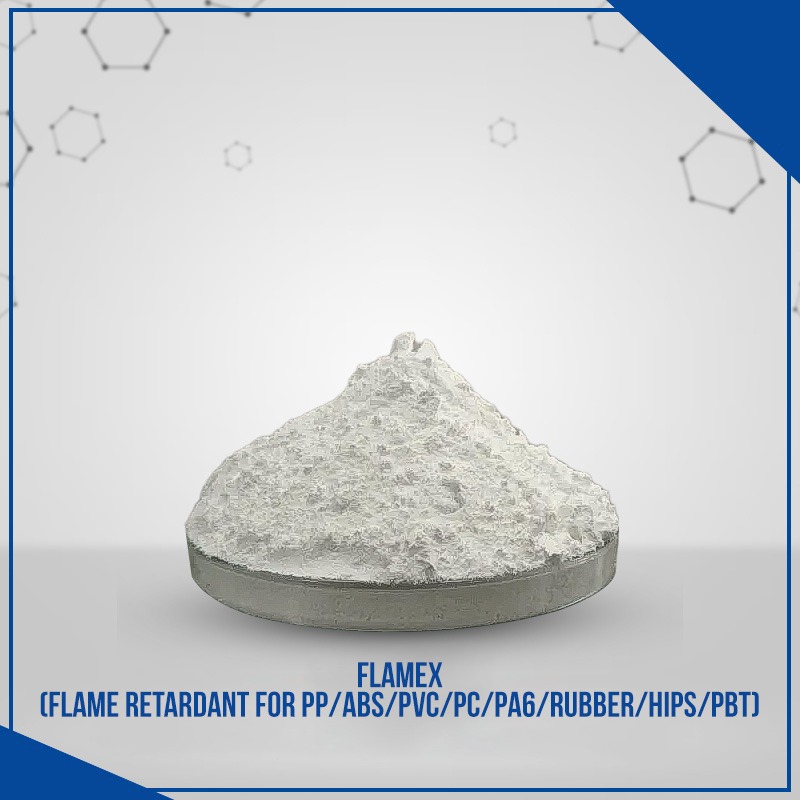 | flame retardant additives Flamex ( Flame Retardant for PP ABS PVC PC PA6 RUBBER HIPS PBT ) FLAMEX ( One Pack Flame Retardant ) manufactured by our company is widely used in PP,PA, PE,PC ,PC/ABS, PVC , Rubber ,PBT, PET, XPS, EPS, PU ,PVC,... View product → |
 | Flame Retardant Filler FAM-501 Flame Retardant Filler FAM-501 FAM - 501 Flame Retardant filler FAM-501 is One Pack Flame Retardant & Smoke Suppressant developed for Plasticized PVC applications. View product → |
Frequently asked questions
How do you match a plastic application to the fire hazard?
Identify the failure that matters first: ignition, flame spread, burning droplets, cable flame travel or loss of electrical insulation. Then select the test target that measures that failure.
Why choose the fire test target before the chemical?
A chemical is useful only when it helps the finished plastic meet its required test. Define the standard, specimen geometry, thickness and acceptance result before comparing additives.
How do mineral, intumescent and synergist flame retardants differ?
Mineral additives cool, dilute combustible gases or form protective residues. Intumescent systems expand into an insulating char. Synergists improve the performance of a primary flame retardant, often at a lower total loading.
What should you check when building a starting formulation?
Check the polymer, additive loading, melt-processing temperature, residence time, dispersion, mechanical properties, colour and electrical performance. Confirm that the formulation fits the processor's equipment and limits.
How do you qualify a flame-retardant supplier in Mumbai?
Request a current SDS, technical data sheet, certificate of analysis, batch number, test reports for the relevant polymer and thickness, and evidence of consistent supply. Compare documented results rather than relying on a product label.
Related products
| FAM-501 ABOUT FAM - 501 FAM-501 is One Pack Flame Retardant & Smoke Suppressant developed for Plasticized PVC applications. View product → |
 | Antimony Trioxide Our range of Antimony trioxide is used mainly in flame retardant formulations for plastics, rubbers, textiles, paper and paints. View product → |
 | Zinc Borate ZINC BORATE is a highly effective multifunctional flame retardant synergist being used as a flame retardant and smoke suppressant in a wide range of... View product → |
 | Aluminium Hydroxide ALUMINIUM HYDROXIDE is a Super Fine Precipitated Special ATH. View product → |