
Adding fire protection to a plastic compound can improve ignition resistance while reducing ductility, impact strength, flow or surface quality. By the end, you will be able to compare additive types, predict processing trade-offs and define a test plan for the resin grade, moulding conditions and humid Mumbai environment you actually use.
Key takeaways
- Expect higher stiffness and viscosity with lower elongation and impact resistance.
- Check weld-line strength and drop performance, not only the UL 94 rating.
- Control additive loading, melt heat and humidity during compound trials.
- Match additive chemistry to the polymer and the fire mechanism.
How fire protection changes strength, stiffness and appearance
A flame-retardant package changes more than burn rating. Depending on polymer and loading, it can raise flexural modulus, hardness, density and melt viscosity while reducing tensile strength, elongation and impact resistance. A brittle, high-modulus compound may pass UL 94 yet crack at a weld line or fail a drop test.
| Property | Common effect of additive package | Trade-off to interpret |
|---|---|---|
| Tensile strength | Can fall as filler loading rises | Check load direction and weld-line strength |
| Elongation | Usually falls with rigid minerals or poorly dispersed solids | Lower ductility signals cracking risk |
| Impact resistance | Can decline sharply, especially in ABS, PA6 and PC/ABS | Test notched and unnotched impact after conditioning |
| Flexural modulus | Often rises with mineral reinforcement | Added stiffness does not prove toughness |
| Density and melt flow | Density rises; flow can fall or shift with chemistry | Confirm mould filling, pressure and cycle time |
| Appearance | Colour, gloss, transparency and surface finish can change | Inspect the actual moulded housing, not only a plaque |
Do not transfer a PP concentrate into ABS, PC/ABS, PA or PBT without qualification. Use the production resin grade, pigment package, glass-fibre content, moulding cycle and recycled-content level; a mismatched package can cause plate-out, stress cracking or colour drift.
A cylinder body should be condition-tested at the same moisture state as the production resin. Specify dry-as-moulded and humidity-conditioned results rather than accepting a single number. Film, fibre-filled and recycled-content grades also need separate comparisons because filler orientation and contaminants change the result.
Surface finish, colour, transparency and plate-out belong in the same review as strength data; a compound that passes a plaque test can still fail a visible injection-moulded housing. Judge the trade-off against the part’s drop, flexing, ageing and appearance requirements, not against UL 94 alone.
Why loading, heat and humidity change processing behaviour
A higher additive loading can reduce melt flow and raise melt viscosity, so the same injection settings fill the mould more slowly and create longer weld lines. Mineral packages also increase screw torque and die pressure; poor dispersion then causes pressure swings, incomplete filling and surface roughness.
Raising melt temperature can restore flow, but it can also accelerate polymer degradation or additive decomposition. Aluminium hydroxide is commonly processed below its principal dehydration range of about 180–220 °C, while magnesium hydroxide decomposes at roughly 300–350 °C. Excessive heat or residence time can release vapour, create voids and destabilise pressure.
PA6 absorbs water, which plasticises the resin and changes its processing behaviour between dry and conditioned states. Dry the resin to its specified moisture target, then avoid excessive drying residence that causes oxidation or thermal damage.
Ask for the moisture limit and Karl Fischer or loss-on-drying data, not only a statement that the powder is dry.
In Mumbai’s monsoon conditions, use sealed bags, control warehouse humidity and recheck the compound after humidity ageing. Compare every modified run with an unmodified control under identical settings:
- Melt-flow rate and mould-filling time
- Screw torque and die pressure
- Cycle time and weld-line quality
- Surface roughness and colour
A dry-as-received result can hide later instability. Confirm that processing remains stable after the compound has experienced the humidity exposure your plant and supply chain impose.
Choose the additive architecture for the polymer and fire mechanism
Select the architecture by matching decomposition temperature, fire mechanism and resin—not by choosing the highest-rated additive. Aluminium trihydrate releases water from around 180–220 °C, so it suits systems processed comfortably below that range. Magnesium hydroxide decomposes at a higher range, commonly around 300–350 °C, which suits higher-temperature polymers.
Both release water vapour and can create voids or surface defects if overheated.
| Option | What it does | When it applies |
|---|---|---|
| Mineral filler | Cools the polymer and dilutes combustible material | Use aluminium trihydrate or magnesium hydroxide when high loading, density and viscosity are acceptable |
| Synergist | Strengthens a fire mechanism already present | Use zinc borate or antimony trioxide with a compatible primary package; do not treat antimony trioxide as a universal replacement |
| One-pack formulation | Combines additives for consistent dosing and dispersion | Use it to simplify production after confirming performance in the exact resin grade |
Hydrated minerals often require loadings in the tens of weight percent, increasing density, viscosity, torque and abrasive wear. Zinc borate or antimony trioxide can act as synergists, but changing the halogen-to-antimony balance can sharply change afterflame performance.
A one-pack is not interchangeable between PP, ABS, PC/ABS, PA6, PBT or PVC. Check compatibility, colour, migration, electrical behaviour and the actual resin grade before approval. Smoke suppression is a separate result: lower smoke density can still alter char, viscosity, colour or flame performance.
Match the fire test to the failure you need to prevent
Specify the test against the failure you need to prevent, not simply “V-0 material.” UL 94 V-0, UL 94 V-1 and UL 94 V-2 classify burning on a small vertical specimen; they do not measure heat release, room flame spread, smoke toxicity or fire-compartment performance.
| Test | What it measures | When to specify it |
|---|---|---|
| UL 94 V-0, V-1, V-2 | Afterflame and burning behaviour | Small-flame screening of a defined thickness |
| IEC 60695 glow-wire testing | A defined hot-wire ignition challenge | Electrical housings and ignition-risk parts |
| ASTM E662 | Smoke density under a specified optical test | Smoke-sensitive enclosures and transport parts |
| Limiting oxygen index | Oxygen concentration needed to sustain upward burning | Comparative oxygen-demand screening |
| ASTM E1354 cone calorimetry | Peak heat-release rate, total heat release and time to ignition | Building, transport or enclosure applications where small-flame screening is insufficient |
These tests answer different questions, so a V-0 result does not prove low smoke, low heat release, glow-wire resistance or acceptable fire-compartment performance. Measure smoke in the finished formulation: a smoke suppressant’s name or loading does not predict optical density after it changes the polymer’s char, colour or viscosity.
Specify each test with its actual specimen and conditioning details:
- State the resin grade, additive loading, specimen thickness, pigment, glass-fibre content, conditioning state, afterflame limits and test standard revision.
- For PA6, report dry and humidity-conditioned results.
- Include cone calorimetry or ASTM E662 when smoke or heat is part of the risk.
- For insulating plastics, add comparative tracking index, dielectric strength, and surface or volume resistivity after humidity conditioning.
Build a compound trial that exposes compatibility problems early
Approve the additive against a small trial compound, not its trade name. A supplier’s product name or a generic V-0 claim is not a substitute for compound-level data. Use the actual resin grade, mould, pigment package, fibre content and recycled-content level planned for production in Mumbai.
1. Record a torque comparison with an untreated control and measure melt flow after compounding. Inspect a cryo-fractured surface by optical or scanning electron microscopy for agglomerates, voids and poor wetting. Use ash content to check mineral loading against the formulation record, then record plate-out, colour drift and surface defects.
2. Mould treated and untreated samples through the same cycle. Record tensile strength, elongation, notched impact, flexural modulus, hardness, density, colour and surface finish. A formulation that passes in a plaque can still fail at a weld line or thin section.
3. Repeat fire and smoke tests after heat ageing, extraction or humidity exposure where the application demands it. For intumescent packages, inspect whether the char forms a continuous, mechanically stable layer; poor dispersion or incompatible plasticizer can cause thin-wall failure.
4. Ask the supplier for particle-size distribution, moisture limit, recommended processing window, residence-time limit, loading basis and polymer-specific data. Niknam Chemicals Pvt. Ltd can be considered as one supplier for this evidence-gathering stage, but approve the formulation only after its sample performs in your actual production formulation.
Related products
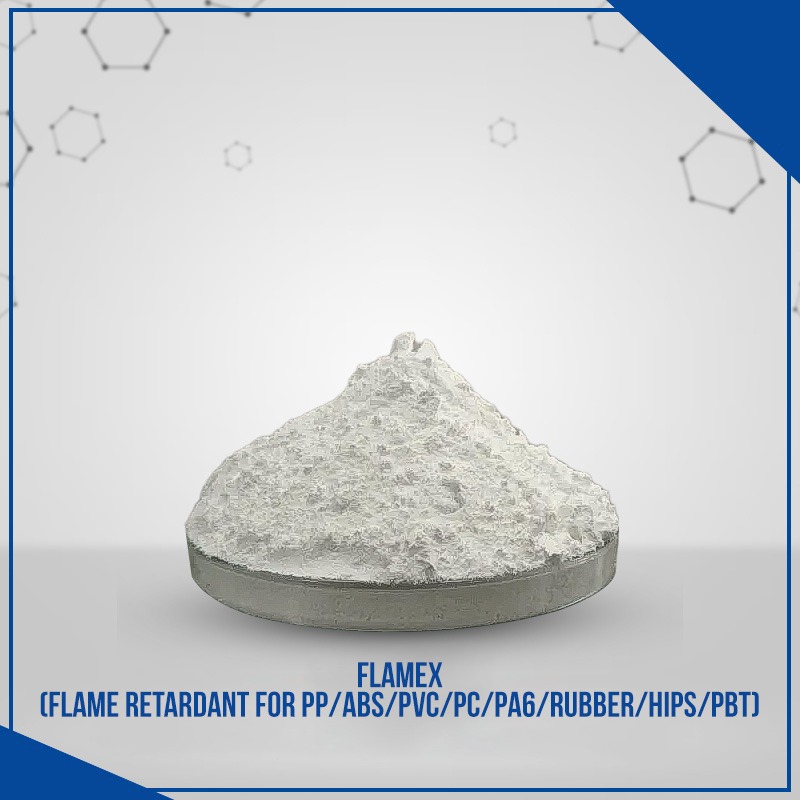 | flame retardant additives Flamex ( Flame Retardant for PP ABS PVC PC PA6 RUBBER HIPS PBT ) FLAMEX ( One Pack Flame Retardant ) manufactured by our company is widely used in PP,PA, PE,PC ,PC/ABS, PVC , Rubber ,PBT, PET, XPS, EPS, PU ,PVC,... View product → |
 | Flame Retardant Filler FAM-501 Flame Retardant Filler FAM-501 FAM - 501 Flame Retardant filler FAM-501 is One Pack Flame Retardant & Smoke Suppressant developed for Plasticized PVC applications. View product → |
Frequently asked questions
How do flame-retardant additives change plastic strength, stiffness and appearance?
They can raise flexural modulus, hardness and density while reducing tensile strength, elongation and impact resistance. The compound may also become more brittle or change appearance, depending on the polymer, additive and loading.
Why do loading, heat and humidity affect flame-retardant plastic processing?
Higher additive loading can increase melt viscosity and make dispersion harder. Heat can alter the polymer or additive, while humidity can affect moisture-sensitive materials and processing consistency. Control these variables during trials so you can separate formulation problems from processing problems.
How do you choose a flame-retardant additive architecture for a polymer?
Start with the polymer’s processing temperature, polarity, melt viscosity and failure mode. Then select an additive package that supports the required fire mechanism without causing unacceptable losses in impact strength, elongation, weld-line performance or appearance.
Which fire test should you use for a plastic application?
Choose the test that represents the failure you need to prevent. UL 94 evaluates vertical or horizontal burning behaviour, but it does not prove resistance to cracking at a weld line, impact, heat exposure or every end-use fire scenario.
What should a compound trial test before production?
Measure flame performance alongside tensile strength, elongation, impact resistance, flexural modulus, hardness, density, melt viscosity, appearance and weld-line behaviour. Include the intended processing heat, additive loading and humidity conditions to expose compatibility problems early.
Related products
| FAM-501 ABOUT FAM - 501 FAM-501 is One Pack Flame Retardant & Smoke Suppressant developed for Plasticized PVC applications. View product → |
 | Antimony Trioxide Our range of Antimony trioxide is used mainly in flame retardant formulations for plastics, rubbers, textiles, paper and paints. View product → |
 | Aluminium Trihydrate (ATH) is a very finely grounded product having a uniform and controlled particle size distribution. View product → |
 | Zinc Borate ZINC BORATE is a highly effective multifunctional flame retardant synergist being used as a flame retardant and smoke suppressant in a wide range of... View product → |