
Choosing a flame-retardant additive for ABS is not a matter of selecting the highest bromine, phosphorus or nitrogen percentage. You need to match the chemistry and loading to the ABS grade, tested thickness, processing conditions, colour and end-product standard, then verify the trade-offs in your own moulded parts.
Key takeaways
- Define the ABS grade, processing route, wall thickness and target UL 94 classification first.
- Compare brominated, phosphorus and mineral systems by performance trade-offs, not element percentage.
- Confirm additive loading through controlled compounding trials that protect melt flow and impact strength.
- Specify final-part fire, mechanical, smoke and electrical tests before approving a Mumbai supplier.
Start with the ABS grade and the fire classification you actually need
Specify the part, not merely “ABS,” before you compare flame-retardant packages. Record the processing route, polymer structure, reinforcement, recycled content and thinnest wall section; an additive that works in injection-moulding ABS can fail in extrusion ABS because residence time, shear and melt flow differ.
| Grade or construction | Specify before additive selection | Fire target to define |
|---|---|---|
| Injection-moulding ABS | Neat, filled or glass-fibre-reinforced; wall thickness and moulding temperature | UL 94 V-0, V-1 or V-2 at the actual thickness |
| Extrusion ABS | Sheet, profile or filament; residence time and melt strength | UL 94 classification at the finished sheet or profile thickness |
| Flame-retardant ABS/PC | ABS-to-PC ratio, impact modifier and processing temperature | UL 94 class plus any glow-wire requirement for the end product |
| Impact-modified ABS grades | Rubber type, impact target and weld-line requirement | The required UL 94 class without sacrificing Izod impact |
Name the exact test method and specimen thickness in the purchasing specification. “UL 94 V-0” is incomplete without thickness, because a formulation can pass at 3.2 mm and fail at 1.5 mm. Treat glow-wire testing and cone calorimetry as separate targets, not substitutes for UL 94.
Then define the material scope: neat ABS, recycled ABS, filled ABS or glass-fibre-reinforced ABS. Request a full trade-off table for impact, tensile strength, heat-deflection temperature, density, colour and melt viscosity; phosphorus, bromine or nitrogen percentage alone cannot predict the result.
Compare flame-retardant chemistries by their trade-offs, not their element percentage
Element percentage is a poor buying shortcut for ABS. Decomposition temperature, volatility, dispersion, melt rheology and interaction with the rubber phase decide whether an additive passes the test without sacrificing impact strength, colour or process stability.
| Chemistry | Main advantage in ABS | Trade-off to check |
|---|---|---|
| Aromatic brominated flame retardant plus antimony trioxide synergist | High fire-retardant efficiency and a practical route to UL 94 V-0 in many injection-moulding grades | Raises density and can reduce toughness, worsen colour and surface appearance; antimony trioxide is not an efficient stand-alone flame retardant |
| Phosphorus flame retardant | Can promote condensed-phase char and reduce reliance on halogens | An unstable grade can volatilize, hydrolyse or plasticize ABS, causing odour, plate-out, die deposits, bloom or lost performance |
| Mineral system | Low volatility and useful smoke or heat resistance | High loading increases melt viscosity and density, weakens impact performance and can make thin-wall processing difficult |
| Zinc borate system | Supports char formation and smoke suppression, often as part of a hybrid package | Its result depends strongly on the companion chemistry, dispersion and moisture control; alone, it is rarely a complete V-0 solution |
| Expandable graphite | Expands into a heat-insulating barrier and can reduce heat release | Dark colour, surface defects, anisotropic flow and poor thin-section performance can limit use in appearance parts |
Compare each package in the exact neat ABS, PC/ABS, recycled, filled or glass-fibre grade and specimen thickness you will sell. Ask for UL 94 data, not a bromine or phosphorus percentage.
Set the loading and compounding process without damaging ABS performance
Treat flame-retardant additive dosage as a formulation variable, not a fixed percentage. Express loading as weight percent of the complete compound, then adjust it against the required UL 94 class at the specified specimen thickness. Higher loading can raise viscosity and reduce Izod impact, elongation and weld-line strength.
1. Start with a small design matrix around the supplier’s recommended range. For a brominated ABS system, test the complete package, including antimony trioxide, rather than varying bromine additive alone. Change total loading in controlled steps, such as 2 percentage points, and retain a no-additive control.
2. Set ABS drying conditions from moisture measurements and the additive’s technical data sheet. Dry hygroscopic ABS and phosphorus- or nitrogen-containing additives separately when required; a practical trial for ABS is 80–90°C for 3–4 hours in a desiccant dryer with a dew point near −30°C.
Excess moisture can cause hydrolysis, odour, plate-out and unstable fire results.
3. Use twin-screw compounding with gravimetric feeders, adequate distributive mixing and the lowest temperature that gives complete melting and dispersion. Begin within the resin supplier’s processing window, commonly about 220–250°C for ABS, then confirm that the additive does not volatilise or decompose.
4. Record melt viscosity and residence time at each trial. Excessive shear, a long residence time or a restricted die can increase deposits and colour change; insufficient mixing leaves additive-rich domains that weaken impact and produce erratic UL 94 results. Recheck pellets after humid conditioning before approving the dosage.
Validate fire, mechanical, smoke and electrical performance on the final formulation
A passing UL 94 result proves only small-scale vertical burning behaviour in the tested plaque. Test the exact ABS grade, additive loading, colour, impact modifier, specimen thickness and conditioning state; a UL 94 V-0, V-1 or V-2 classification at 1.5 mm does not predict performance at 3 mm or in a vented enclosure.
| Test | What it shows | What to record |
|---|---|---|
| UL 94 | Afterflame, afterglow and dripping behaviour in vertical and horizontal specimens | V-0, V-1 or V-2, plaque thickness, conditioning and individual burn times |
| IEC 60695-2-11 glow wire test | Ignitability of the finished product or test specimen after contact with a heated wire | Wire temperature, ignition, flaming time and whether the flame reaches specified parts |
| ASTM E662 | Smoke optical density during flaming and non-flaming combustion | Maximum specific optical density and test mode |
| ISO 5659-2 | Smoke generation from a defined specimen under radiant heat | Optical smoke density, heat flux and flaming or non-flaming condition |
| ASTM D256 or ISO 180 | Notched impact retention after compounding and conditioning | Impact strength before and after humidity exposure |
| IEC 60112 | Electrical tracking resistance of the moulded grade | Comparative tracking index and test voltage |
Do not call a resin “glow-wire rated” from its UL 94 certificate. IEC 60695-2-12 covers material GWFI and GWIT, while IEC 60695-2-11 covers finished-product or specimen ignitability.
Run smoke and mechanical tests after the same drying and humidity conditioning used in Mumbai production. Record tensile strength, flexural modulus, impact, dielectric strength and volume resistivity when the ABS is used near live electrical parts. A formulation that passes dry but fails after conditioning is not production-ready.
Turn the technical requirements into a Mumbai-ready purchasing specification
Request a formulation-specific specification, not a generic “UL 94 compliant” claim. Name the ABS grade, processing route, end-use matrix, target rating, specimen thickness, colour and test method. For Mumbai production, also state drying conditions and the conditioning protocol before fire, impact and electrical testing.
1. Ask for a technical data sheet stating the recommended loading in weight percent, usable loading range, carrier or active content, density, particle size, melt-processing temperature, storage conditions and compatibility with injection-moulding ABS, extrusion ABS, PC/ABS, recycled, filled or glass-fibre-reinforced grades.
2. Require the supplier to identify the exact UL 94 result: V-0, V-1 or V-2; specimen thickness such as 0.8, 1.6 or 3.2 mm; colour; specimen conditioning; and laboratory test method. “V-0 certified” without these details is incomplete.
3. Obtain a certificate of analysis for every shipment. It must link the batch number and moisture content to the supplied material, with limits for active content, ash, particle size and appearance. For hygroscopic phosphorus or nitrogen additives, require a Karl Fischer moisture result and a stated drying temperature, time and maximum moisture limit.
4. Request a property table at each proposed loading, covering afterflame, impact strength, tensile or flexural performance, melt viscosity, density, colour change, smoke and electrical results. Ask how to adjust dosage after a failed UL 94, glow-wire or cone-calorimeter result.
5. Obtain substance-specific declarations covering RoHS, REACH and the Stockholm Convention. Check PBDEs, decabromodiphenyl ether and HBCDD individually; “halogen-free” does not mean “RoHS compliant.”
Niknam Chemicals Pvt. Ltd can be included in a supplier comparison only after its additive is evaluated in your exact ABS grade and process, rather than accepted from performance data generated in polyamide or polycarbonate.?sia
Related product
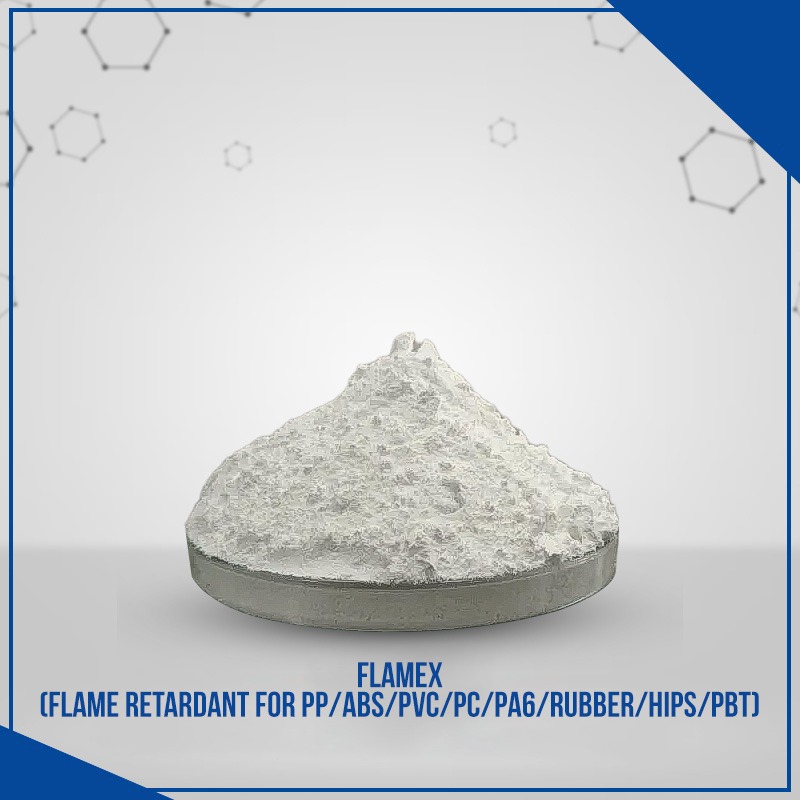 | flame retardant additives Flamex ( Flame Retardant for PP ABS PVC PC PA6 RUBBER HIPS PBT ) FLAMEX ( One Pack Flame Retardant ) manufactured by our company is widely used in PP,PA, PE,PC ,PC/ABS, PVC , Rubber ,PBT, PET, XPS, EPS, PU ,PVC,... View product → |
Frequently asked questions
Which ABS details must you record before selecting a flame-retardant additive?
Record the processing route, polymer structure, reinforcement, recycled content, melt-flow requirements and thinnest wall section. These details determine whether the package can disperse and meet the target classification.
How should you compare flame-retardant chemistries for ABS?
Compare brominated, phosphorus-based and mineral systems by their effects on UL 94 performance, colour, impact strength, melt flow, smoke, electrical properties, processing temperature and regulatory documentation—not by element percentage alone.
How do you set additive loading without damaging ABS performance?
Run controlled compounding trials across loading levels, monitor dispersion and residence time, then measure melt flow, impact strength, tensile properties and appearance before selecting the lowest effective loading.
What tests should validate a flame-retardant ABS formulation?
Test the final formulation for the required UL 94 classification at its thinnest wall, plus mechanical properties, smoke behaviour, electrical insulation and ageing performance where the application requires them.
What should a Mumbai purchasing specification include?
State the ABS grade, processing route, target fire classification, wall thickness, additive loading range, colour limits, mechanical and electrical test requirements, batch documents, delivery conditions and acceptance criteria.