
ABS flame-retardant selection depends on the resin grade, wall thickness, fire-test method, processing temperature and required mechanical performance—not on the additive name alone. By the end, you will be able to define a testable formulation brief, compare brominated and mineral systems, and screen a Mumbai supplier for processing and compliance evidence.
Key takeaways
- Match brominated chemistry and ATO to the ABS grade and UL 94 wall thickness.
- Start screening at 15–25 phr brominated retardant and 3–8 phr ATO.
- Dry ABS and additives before compounding to limit moisture-related moulding defects.
- Specify batch data, dispersion, dosage tolerance and test conditions before approving supply.
Match the flame-retardant chemistry to the ABS grade and fire target
A realistic starting point for injection-moulding ABS is 15–25 phr brominated flame retardant with 3–8 phr antimony trioxide (ATO) when the target is UL 94 V-0 at a defined wall thickness. ATO is a synergist, not a stand-alone flame retardant; the bromine-to-antimony ratio and dispersion determine whether the formulation reaches V-0 or only V-1/HB.
| ABS grade or chemistry | Realistic fire target | Main limitation |
|---|---|---|
| Standard injection-moulding ABS with bromine/ATO | UL 94 V-0 or V-1 at the tested thickness | Lower impact strength and melt flow |
| High-impact ABS with rubber modifier | V-1 or V-0 after grade-specific trials | Rubber content increases the loading and can reduce impact retention |
| Extrusion-grade ABS | HB or selected V ratings after process trials | Residence time, flow and thermal history differ from injection moulding |
| Flame-retardant ABS grade | UL 94 V-0 at the supplier’s stated thickness | Confirm the exact resin, colour and production-part result |
| ABS/PC blend | V-0 with a blend-specific package | Do not transfer ABS-only dosage or processing data |
| ATH or magnesium-hydroxide system | Difficult to achieve V-0 at low loading | High loading harms flow, surface quality and weld lines |
- Specify UL 94 V-0, V-1 or HB with specimen thickness, not “fire resistant.” Add IEC 60695 glow-wire requirements when the end-product standard demands them.
- Test ribs, bosses, knit lines and thin walls: a standard bar can pass while the production component fails.
- Treat colour, tensile and impact retention, melt-flow range, density and heat-deflection temperature as formulation limits, not afterthoughts.
Compare brominated, mineral and synergist-based systems before choosing loading
A one-pack additive is a convenience, not a performance category. Compare its declared active chemistry and recommended bromine-to-antimony ratio with separate components; a lower quoted dosage may simply include carrier resin or a preblended package. Test plaques at the actual part thickness.
| System | What it contributes | Main comparison point |
|---|---|---|
| One-pack additive | Premixed flame retardant and synergist | Demand the full composition, carrier level, dosage basis and lot-to-lot analysis |
| Brominated flame retardant | High efficiency at moderate loading | Check smoke, colour, regulatory status and impact retention |
| Antimony trioxide synergist | Strengthens brominated action; does not work as a stand-alone solution | Compare ratio, particle dispersion and residue |
| Zinc borate | Can reduce afterglow and smoke and support protective residue | Treat it as a secondary synergist, not a replacement for bromine |
| Aluminium trihydrate ATH | Halogen-free mineral filler with smoke and flame benefits | Water release near ABS processing temperatures can cause voids, splay and flow loss |
| Magnesium hydroxide | Halogen-free mineral flame retardant | Higher decomposition temperature helps processing, but high loading can damage impact, weld lines and surface finish |
For a brominated system, a screening trial often starts around 15–25 phr flame retardant with 3–8 phr antimony trioxide, then adjusts for grade, thickness and UL 94 target. Compare each formulation at equal total loading, density and colour; do not rank suppliers by additive price per kilogram.
Mineral-hydrate systems suit applications that accept filler-like loading and lower flow. They are a poor shortcut when thin-wall ABS needs high impact strength, clean moulded surfaces and reliable V-0 performance.
Set starting dosage and predict the effect on ABS performance
Start with 20 phr of brominated flame retardant and 5 phr of antimony trioxide, where phr means parts per hundred parts of ABS resin. This sits inside the practical trial range of 15–25 phr brominated flame retardant and 3–8 phr antimony trioxide.
Bracket the centre point with lower and higher formulations, then test each at the exact specimen thickness required for the target UL 94 class.
Compare every formulation with the unmodified ABS grade using the same mould, drying cycle, barrel profile and conditioning time. Do not treat a passing flame test as proof that the mechanical properties remain acceptable.
- Melt flow: expect melt flow to fall as additive loading rises, increasing fill time, injection pressure and the risk of short shots. Record melt-flow rate before and after compounding.
- Impact strength: expect impact strength to decrease, especially at weld lines and low temperatures. Test notched Izod or Charpy impact on conditioned specimens.
- Tensile strength: measure tensile strength, elongation and modulus; brominated packages often reduce strength and elongation as the resin is diluted.
- Density: expect density to increase with additive content. Measure moulded plaques because the change affects part weight and dimensional calculations.
- Heat-deflection temperature: measure HDT under the chosen load rather than predicting it from chemistry. The result can remain similar, increase or decrease with the ABS grade and package.
Control drying, compounding and moulding conditions in Mumbai
Run ABS drying and additive handling as one moisture-control plan, especially during Mumbai’s monsoon. Keep bags sealed until charging, rotate stock by receipt date, and check moisture against the resin or concentrate supplier’s stated moisture limit; do not substitute a generic ABS drying temperature or time.
- Dry ABS and the flame-retardant concentrate separately when their technical data sheets specify different conditions.
- Feed a low-dose additive through a compatible masterbatch when it improves dosing accuracy; confirm the carrier resin matches the ABS grade.
- Use gravimetric feeders for direct addition, because hand-blended powder can segregate and produce rich and lean flame-retardant zones.
- In twin-screw extrusion, establish the feed position, distributive-mixing elements, screw speed and residence time with the compound supplier; excessive kneading can raise temperature and damage ABS.
- Check strand or pellet dispersion through microscopy, ash or metal-oxide consistency, and moulded-part inspection for specks, brittleness and burning variations.
Set the barrel profile from the compound supplier’s recommendation, then validate it on the actual injection machine by measuring melt temperature rather than relying only on controller readings. Excessive heat or residence time can cause discolouration, volatile release, polymer degradation and die or mould plate-out.
Record drying time, hopper exposure, feed rate, screw speed, back pressure and purge practice for each trial. If parts show splay, voids, odour, flow changes or erratic flammability, stop adjusting the dosage first: recheck moisture, dispersion and thermal history.
Build a supplier specification that survives component qualification
Require a supplier dossier that identifies the exact ABS base resin, additive chemistry, loading in phr or weight percentage, colour, target UL 94 class, specimen thickness and processing window. “Flame-retardant ABS additive” is not enough to reproduce a qualified formulation.
- Request the safety data sheet, technical data sheet, RoHS and REACH status, and a lot-specific certificate of analysis covering assay, moisture, particle size and batch number.
- Require reports for UL 94 V-0 at the production-relevant thickness and IEC 60695 glow-wire performance, including the test temperature and specimen details.
- Add ASTM E662 specific optical density or ISO 5659-2 smoke generation when smoke matters. State whether flaming, non-flaming or both exposure modes apply.
- Specify melt-flow range, density, tensile and impact retention, heat-deflection temperature and CTI tested under IEC 60112. Never infer electrical tracking performance from a UL 94 result.
- Demand compounding and moulding instructions: feed order, drying temperature and time, screw conditions, residence-time limit and dispersion checks. Require sealed packaging, moisture limits and stock-rotation guidance for Mumbai’s monsoon storage.
- Obtain production-part evidence using the final colour, wall thickness, moulding orientation and gate layout. Test ribs, knit lines, screw bosses and sharp transitions; a standard bar can pass while a thin enclosure feature fails.
Ask Niknam Chemicals Pvt. Ltd for a formulation-specific trial record rather than relying on a catalogue polymer list. Approve the supplier only after retained production parts, test reports and the lot certificate match the same recipe and processing window.
Related products
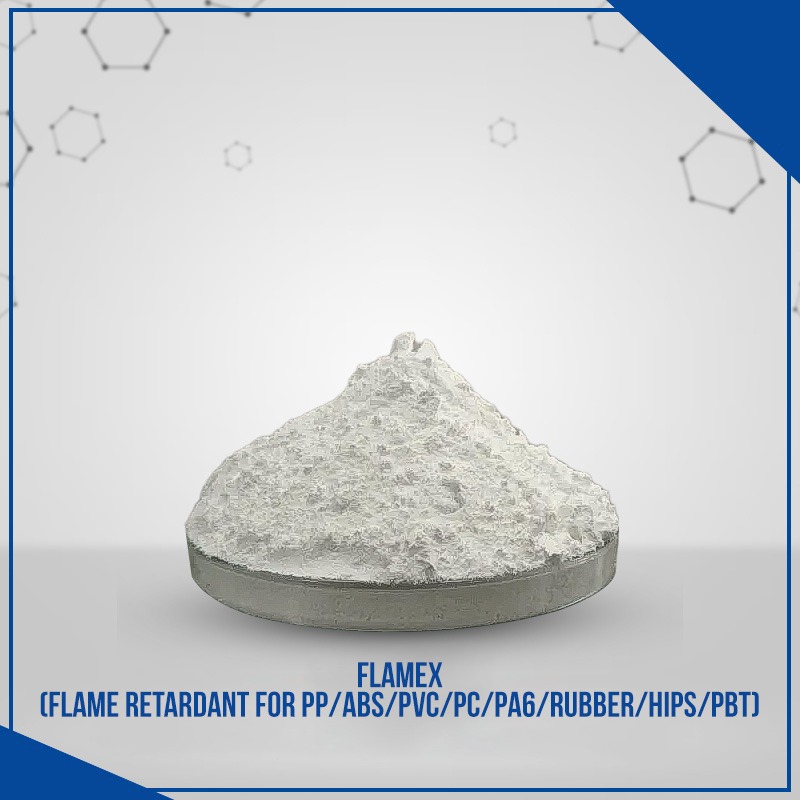 | flame retardant additives Flamex ( Flame Retardant for PP ABS PVC PC PA6 RUBBER HIPS PBT ) FLAMEX ( One Pack Flame Retardant ) manufactured by our company is widely used in PP,PA, PE,PC ,PC/ABS, PVC , Rubber ,PBT, PET, XPS, EPS, PU ,PVC,... View product → |
 | Antimony Trioxide Our range of Antimony trioxide is used mainly in flame retardant formulations for plastics, rubbers, textiles, paper and paints. View product → |
Frequently asked questions
Which flame-retardant chemistry suits an ABS component?
Match the chemistry to the ABS grade, target UL 94 rating and component wall thickness. Brominated systems with antimony trioxide are a practical starting point for V-0 screening; mineral systems and synergist combinations require separate loading and performance trials.
What starting dosage should you test for flame-retardant ABS?
For a V-0 target at a defined wall thickness, screen 15–25 phr brominated flame retardant with 3–8 phr antimony trioxide. Adjust the loading only after checking UL 94 results, dispersion, impact strength, colour and flow.
How do drying and moulding conditions affect flame-retardant ABS?
Dry the ABS and additives according to their supplier data before compounding, then control melt temperature, residence time, shear and mould temperature. Excess heat or residence time can damage ABS, discolour the part or alter flame performance.
What should an ABS flame-retardant supplier specification contain?
State the ABS grade, target UL 94 rating, test wall thickness, formulation range, bromine-to-antimony ratio, moisture limit, particle form, dispersion requirement, batch identification and certificate-of-analysis fields.
Related products
 | Zinc Borate ZINC BORATE is a highly effective multifunctional flame retardant synergist being used as a flame retardant and smoke suppressant in a wide range of... View product → |
 | Aluminium Trihydrate (ATH) is a very finely grounded product having a uniform and controlled particle size distribution. View product → |
 | Aluminium Hydroxide ALUMINIUM HYDROXIDE is a Super Fine Precipitated Special ATH. View product → |
 | Magnesium Hydroxide MAGNESIUM HYDROXIDE is a very finely grounded product having an extremely uniform and narrow particle size distribution. View product → |