
ABS parts in Mumbai electrical, automotive, appliance, telecom and transport manufacturing often need more than a generic “flame-retardant grade” claim. You will be able to match the additive package to the part, process and fire test, then qualify loading, processing stability, mechanical performance and documentation before production release.
Key takeaways
- Specify the UL94 class together with the tested ABS wall thickness.
- Match additives to colour, impact strength, processing temperature and smoke limits.
- Test finished parts, not only compounded pellets, before production approval.
- Record drying, melt temperature, additive loading and lot traceability during compounding.
Where flame-retardant ABS is used across Mumbai manufacturing
Mumbai industries use flame-retardant ABS where an enclosed plastic part sits near electrical heat, switching arcs, wiring or occupied interiors. The material is compounded into injection-moulding pellets, then dried, melted and formed into housings, covers and structural inserts. Specify the required UL94 class with its wall thickness; “V-0 grade” alone is incomplete.
| Industry | Typical flame-retardant ABS parts | Manufacturing or use requirement |
|---|---|---|
| Electrical and electronic | Electrical enclosures, electronic housings, switchgear parts, connector bodies and terminal blocks | Injection moulding for thin walls, snap-fits and screw bosses; control ignition risk near live components |
| Appliances | Control panels, motor covers, thermostat housings and power-tool bodies | Maintain impact strength after moulding and repeated handling |
| Telecom and consumer electronics | Router housings, modem covers, charger bodies and cable-management components | Use consistent colour, surface finish and dimensional stability across high-volume moulding |
| Automotive | Instrument panels, dashboard bezels, console parts and clips | Protect against heat and assembly loads; a passing fire result does not prevent clip or weld-line failure |
| Railway and metro | Interior equipment covers, cable ducts and control-unit housings | Match EN 45545-2 to the product location, operating category, R-category and HL level |
For each part, review the ignition source, wall thickness, ventilation and assembly method before approving the resin. Thin electrical housings expose melt-flow and weld-line weaknesses, while high filler loading can prevent complete cavity filling. Enclosed cabinets and passenger interiors also require smoke, corrosivity and heat-release requirements beyond UL94.
ABS parts that receive flame-retardant additives
The parts most often compounded with flame-retardant ABS include injection-moulded housings, connector bodies, terminal blocks, dashboards, instrument panels and cable-management components. The flame-retardant package is compounded into ABS pellets before moulding, commonly using a halogenated additive with antimony trioxide as a synergist.
| Component | Moulding detail | Performance risk |
|---|---|---|
| Electrical housings | Thin walls, ribs and bosses must fill without hesitation | Higher additive or mineral loading can raise melt viscosity and weaken weld lines |
| Connector bodies | Small gates, tight dimensional tolerances and repeated plugging loads | Reduced ductility or impact strength can cause cracked latches and assembly failure |
| Terminal blocks | Inserts, screw loads and narrow sections concentrate stress | A passing vertical-flammability result does not prove adequate retention strength |
| Dashboards and instrument panels | Large surfaces, visible colour and long flow paths | Excessive melt temperature or residence time can cause colour change, odour and variable flammability |
Wall thickness is part of the fire-performance specification. A formulation that passes at 3.0 mm can fail at a 1.5 mm production wall because thinner sections burn differently and cool faster.
Use the actual production screw, drying cycle, temperature profile and regrind percentage during validation. Repeated processing can degrade the polymer or additives, while uncontrolled recycled ABS can introduce non-FR resin, unknown brominated chemistry and inconsistent fire results. Thin electrical housings and automotive clips deserve mechanical testing at weld lines, not only a flame test.
How to choose the right flame-retardant system for ABS
A package that passes in PP or PVC is not an ABS formulation. Start with ABS compatibility: check whether the additive remains dispersed, preserves melt flow, and avoids excessive loss of impact strength, weld-line strength, heat resistance and colour at the required wall thickness.
| System | Why a direct transfer fails in ABS | Selection point |
|---|---|---|
| PVC formulation | Plasticiser, stabiliser and chlorine chemistry change the burning and processing balance. | Rebuild the package around ABS, not PVC resin ratios. |
| PP formulation | PP uses different melt behaviour and often different synergists or mineral loading. | Check mould filling, viscosity and impact strength in the ABS grade. |
| PA6 formulation | PA6’s polarity, moisture sensitivity and heat performance alter additive interaction. | Recheck dispersion, drying conditions and heat-deflection performance. |
| PC/ABS formulation | PC contributes different thermal stability and flame behaviour. | Qualify the package in the actual ABS resin and production wall. |
The established high-efficiency route is a halogenated flame retardant with an antimony trioxide synergist. Do not treat antimony trioxide as a complete stand-alone retardant: reducing it can lower vertical-flammability performance even when primary-retardant loading stays unchanged. Requalify every replacement at the production wall thickness.
A halogen-free phosphorus system, with nitrogen, mineral or intumescent components, can suit smoke, corrosivity or restricted-substance priorities, but one-for-one substitution by weight is unreliable. Request data for the actual compound, masterbatch, pigment and synergist package; RoHS declarations must address each homogeneous material.
For rail, specify the EN 45545-2 R-category and HL level, not merely “railway-grade ABS.”
Which fire tests and formulation measurements determine approval
Approval depends on the part specification, not on additive loading alone. Test plaques at the production wall thickness and run a loading matrix, such as 5, 10 and 15 wt% total flame-retardant package, while recording resin, synergist and additive levels separately.
Requalify after changing the brominated system or reducing antimony trioxide: it is a synergist, not a stand-alone replacement.
- Record the UL 94 result at the thinnest section: UL 94 V-0 demands the shortest burn time, while UL 94 V-1 and UL 94 V-2 allow progressively less stringent self-extinguishing performance. UL 94 HB is a horizontal-burn classification and cannot substitute for a required vertical rating.
- Run the glow-wire test specified for the product, such as IEC 60695-2-11 for finished parts or IEC 60695-2-12 for materials. Record ignition, flame duration and whether the specimen ignites the specified tissue.
- Measure oxygen index under ASTM D2863 and smoke obscuration under ASTM E662. E662 reports flaming and non-flaming smoke density; it does not prove smoke toxicity or occupied-space safety.
- Check Izod impact, tensile and weld-line strength, elongation, heat-deflection temperature, melt-flow rate, colour and surface deposits. A V-0 housing that cracks at a clip or fails mould filling is not approved.
| Test | Approval evidence | Record with the result |
|---|---|---|
| UL 94 | Required class at part thickness | After conditioning |
| Glow wire | Required ignition and flame limits | Test temperature and time |
| ASTM E662 | Smoke limit where specified | Flaming and non-flaming values |
How to compound, process and qualify flame-retardant ABS in production
Set the production window before approving the compound: record resin drying, screw design, barrel temperatures, melt temperature, residence time, injection settings and regrind percentage. A laboratory pass can disappear when the factory adds heat history.
1. Use twin-screw extrusion for controlled dispersion, and verify feeder accuracy by weighing each feeder over a timed run. Poor dosing changes both flame performance and impact strength. Keep the flame-retardant package compatible with ABS; do not transfer a PVC or PP recipe without comparative trials.
2. Control degradation by avoiding excessive melt temperature, long residence time and repeated reprocessing. Check pellets and mouldings for colour shift, odour, plate-out, lower impact, reduced weld-line strength and changing melt flow. Set a maximum regrind percentage and validate it.
3. Test the finished grade for mechanical trade-offs, including impact, tensile strength, ductility, heat deflection, weld-line strength and mould filling. High mineral loading can raise viscosity, leaving thin housings or automotive clips short-shot or brittle.
4. Measure smoke, corrosivity and colour alongside flammability. For electrical products, qualify the specified IEC 60695 glow-wire temperature and acceptance result; UL94 alone is not proof. For automotive interiors, FMVSS 302 requires a horizontal-burn rate no greater than 102 mm/min.
5. Obtain the actual formulation, batch COA, processing window, SDS and RoHS declaration for the homogeneous ABS compound, masterbatch, pigment and synergist. Niknam Chemicals Pvt. Ltd can be asked for formulation-specific data when assessing a package containing antimony-based synergist, rather than accepting a generic product label.
Related product
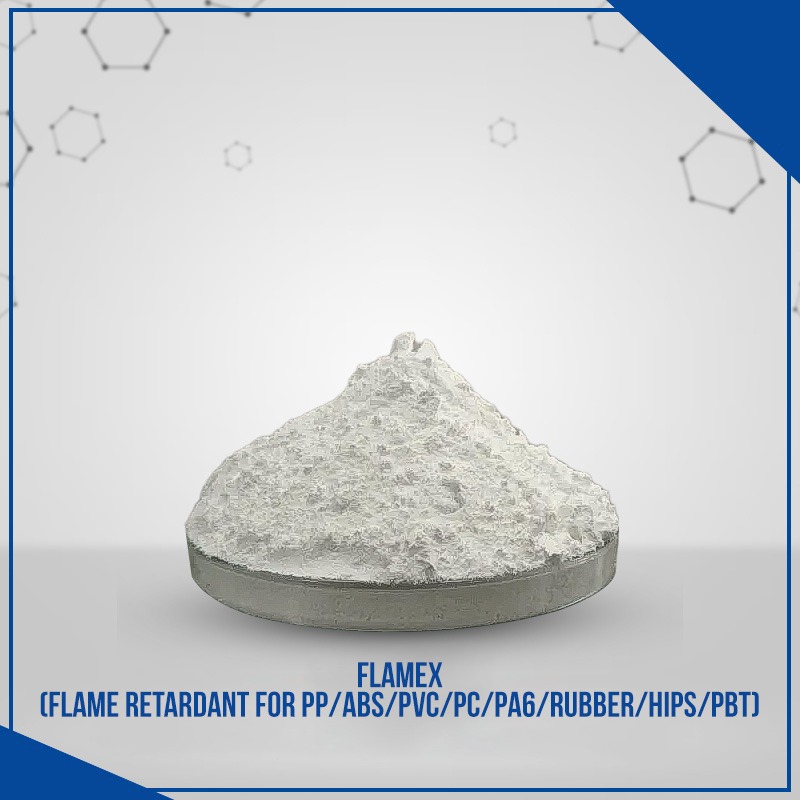 | flame retardant additives Flamex ( Flame Retardant for PP ABS PVC PC PA6 RUBBER HIPS PBT ) FLAMEX ( One Pack Flame Retardant ) manufactured by our company is widely used in PP,PA, PE,PC ,PC/ABS, PVC , Rubber ,PBT, PET, XPS, EPS, PU ,PVC,... View product → |
Frequently asked questions
Where is flame-retardant ABS used across Mumbai manufacturing?
It is used for electrical housings, equipment covers, control-panel parts, wiring enclosures and interior components exposed to electrical heat, switching arcs or occupied spaces.
Which ABS parts receive flame-retardant additives?
Manufacturers compound additives into injection-moulding pellets for housings, covers, bezels, structural inserts and other enclosed parts requiring controlled ignition and burning behaviour.
How do you choose a flame-retardant system for ABS?
Compare the required UL94 class and wall thickness with impact strength, colour, smoke performance, melt-processing conditions, additive loading and the final part geometry.
Which fire tests and measurements determine approval for flame-retardant ABS?
Approval depends on tests such as UL94 at the specified thickness, alongside checks for additive loading, moisture, melt flow, density, dimensions and finished-part performance.