
Choosing a flame-retardant additive for polypropylene is a formulation decision, not a product-name decision. You will be able to compare additive families, set realistic loading and processing checks, specify the right fire tests, and screen suppliers against the conditions your PP part must survive.
Key takeaways
- Start with an intumescent system for many PP grades targeting UL 94 V-0.
- Expect APP-based packages around 20–30 wt% in initial compound trials.
- Expect magnesium hydroxide formulations to require roughly 50–65 wt%.
- Compare suppliers using batch records, moisture data, and Hyderabad storage conditions.
Choose the Additive Family Against the PP Grade and Fire Target
Start with an intumescent system for many polypropylene grades when the target is UL 94 V-0 at moderate loading. APP-based packages often begin at 20–30 wt% of the total compound; magnesium hydroxide PP formulations commonly need 50–65 wt%, which can sharply reduce melt flow, impact strength, elongation, and density control.
| Chemistry | Starting loading and behaviour | Best starting point |
|---|---|---|
| APP-based intumescent | 20–30 wt% of total compound; forms a protective char | V-0 targets where mechanical retention and lower filler loading matter |
| Magnesium hydroxide | 50–65 wt%; decomposes around 330–350 °C | Halogen-free formulations needing higher thermal stability during PP processing |
| Halogenated package with antimony trioxide | Lower brominated-additive demand; higher density, smoke, opacity, and regulatory scrutiny | Tight V-0 targets when the complete electrical and smoke profile accepts the package |
| Aluminium trihydrate | Releases water around 180–220 °C | Usually unsuitable as the primary retardant for conventional PP melt processing |
Treat PP grade compatibility as a formulation decision, not a datasheet checkbox. Homopolymer, impact copolymer, glass-filled PP, talc-filled PP, pigments, nucleating agents, and processing aids can change dispersion, char formation, weld-line strength, colour, and electrical tracking.
A V-0 plaque does not prove part suitability. Specify the actual UL 94 rating and thickness, then mould plaques with production-representative flow direction, gate design, cooling, and skin/core structure; agglomerates or orientation can make one direction pass and another fail.
Set Loading, Processing Temperature, and Moisture Controls Before Trials
Start with flame-retardant loading expressed as weight percent of the total compound, not as a percentage of resin alone. Screen APP loading in PP at 20–30 wt% for an intumescent system; magnesium hydroxide commonly needs 50–65 wt%, which raises torque, viscosity, density, and wear.
1. Set the trial recipe by active additive content. Correct masterbatch dilution for its carrier and assay, then record resin, additive, synergist, and carrier percentages separately. Request lot data for moisture, particle size, bulk density, and active content before weighing.
2. Set the PP extrusion temperature at the lowest profile that produces a fully wetted melt, commonly about 190–220 °C, then confirm torque, die pressure, and melt appearance. Do not use aluminium trihydrate as a routine primary choice in this window: its water release begins near 180–220 °C.
The magnesium hydroxide decomposition temperature is commonly 330–350 °C, but its high loading still demands controlled residence time and shear.
3. Keep moisture-sensitive APP and nitrogen-containing packages sealed until use. Hyderabad humidity can turn an opened bag into a source of bubbles, surface defects, plate-out, and variable burning results; dry only to the supplier’s specified temperature and time, and verify moisture before compounding.
Feed mineral powder steadily, avoid long hot holds, and inspect pellets for agglomerates or additive-rich streaks. Mould qualification plaques with production-representative screw speed, back pressure, residence time, cooling, and thickness; excessive shear or a skin/core concentration gradient can change the flame result.
Specify the Fire Tests by Rating, Thickness, and End Use
A V-0 result on a 1.5 mm plaque does not prove that a 4 mm housing will pass. Put the target rating and thickness in the purchase specification: UL 94 V-0 PP, V-1, or V-2 at the finished part’s thinnest wall, specified colour, conditioning state, gate location, and flow orientation.
Use each test for a defined question, not as a universal approval:
| Test | Specimen and result to specify | What it proves |
|---|---|---|
| UL 94 vertical | Finished PP plaques at each production thickness; record afterflame, afterglow, flaming drips, orientation, colour, and conditioning | Ignition, burning duration, afterglow, and dripping for the required V-0, V-1, or V-2 classification |
| ASTM D2863 or ISO 4589-2 | Cut specimens from the formulation at the intended thickness; report limiting oxygen index | Oxygen concentration needed to sustain combustion; useful for comparing formulations, not a component approval |
| ASTM E662 smoke density | Match the end-use thickness and report flaming and non-flaming specific optical density | Smoke obscuration under two specified exposure modes |
For electrical or electronic parts, add the product standard’s glow-wire, hot-wire, needle-flame, or tracking test. A resin or additive certificate does not transfer to a moulded component with different thickness, colour, mould design, or processing history.
For transport, enclosures, or occupied spaces, request heat-release data such as cone-calorimeter results alongside ASTM E662. A passing UL 94 flame test alone does not establish low smoke or acceptable fire growth.
Protect Mechanical, Electrical, and Surface Properties During Qualification
A V-0 result does not prove that the part remains fit for service. Compare the flame-retardant PP formulation with the unmodified PP grade at the same thickness, colour, fibre or mineral content, moulding conditions, and conditioning state.
Run the comparison on production-representative plaques and parts, including flow and transverse directions. Check:
- Impact strength using ISO 179 or ISO 180, especially at the service temperature.
- Tensile strength and elongation using ISO 527, reporting retention against the control.
- Weld-line performance on a moulded specimen containing the actual gate and weld-line location.
- Electrical tracking using IEC 60112 when the part carries voltage or sits near conductive contamination.
- Surface condition after moulding and heat exposure: look for blooming, plate-out, gloss change, streaks, bubbles, and colour drift.
Glass-fibre PP needs separate scrutiny because the package can disrupt fibre wetting, orientation, and weld-line strength. Examine fracture surfaces and test both a fibre-aligned region and a weld-line region; a good flame result does not repair a weak joint.
Confirm compatibility in the complete formulation, not in resin-only plaques. Screen the additive with the selected PP homopolymer or copolymer, pigment, nucleating agent, fibre or talc, stabiliser, and processing aid. Record melt flow, density, and warpage after conditioning.
If impact or tensile retention falls outside your part specification, reduce loading, change the additive balance, or reject the package despite its flame rating.
Build a Supplier Comparison That Includes Batch Evidence and Local Storage
Approve a supplier only after its lot documents, retained sample, and Hyderabad storage controls match the material you will run. Your PP flame-retardant supplier Hyderabad shortlist should compare evidence, not brochure claims or phosphorus percentage alone.
1. Request a batch certificate identifying the lot number, manufacture date, active-content or phosphorus assay, moisture content additive, particle-size distribution, thermal-stability result, bulk density, colour, and test methods. For ammonium polyphosphate, request phase identification and polymer-coating details; phase-II APP is the stronger candidate for higher-temperature PP processing and water resistance.
2. Ask for a retained-sample procedure tied to each lot. Keep a sealed sample from the approved batch, record its mass and storage condition, and use it to investigate a later shift in torque, dispersion, colour, plate-out, or burning behaviour.
3. Demand production-relevant trial data: melt-flow rate after compounding, torque or die pressure at your intended throughput, screen-pack pressure, pellet appearance, and performance after the planned residence time. A laboratory UL 94 result does not predict a finished part if loading, colour, thickness, moulding history, or dispersion changes.
4. Inspect local stock before release. Confirm sealed moisture-barrier bags, pallet storage off the floor, stock age, lot segregation, FIFO rotation, and a rule to reseal opened bags immediately. Hyderabad’s seasonal humidity can turn wet additive into bubbles, surface defects, or inconsistent flame results.
Use the same checklist for Niknam Chemicals Pvt. Ltd and competing suppliers, then approve the lot that survives your production-representative plaque trial—not simply the lowest quoted price.
Related product
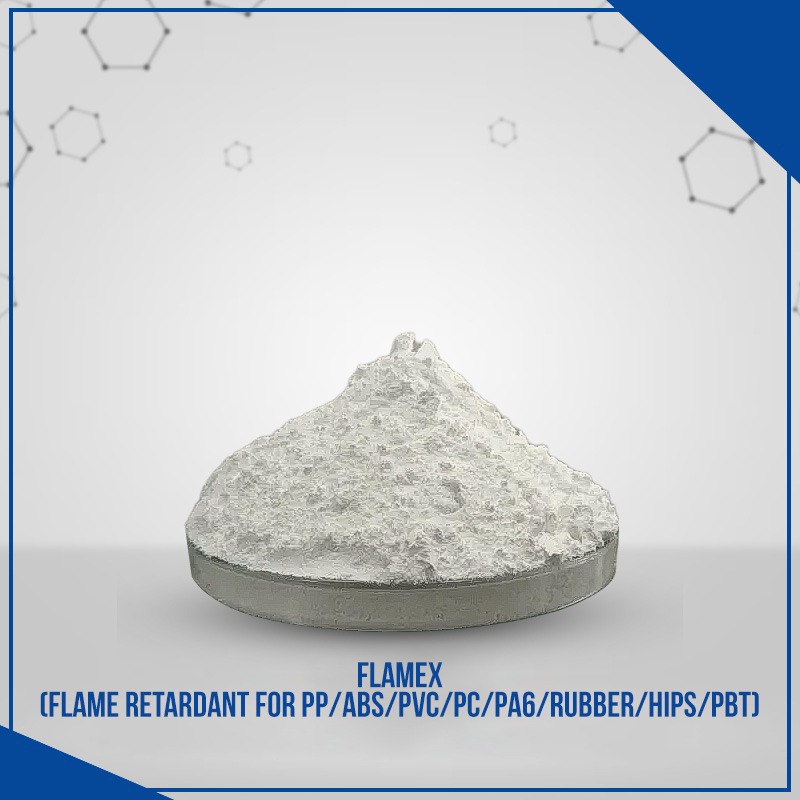 | flame retardant additives Flamex ( Flame Retardant for PP ABS PVC PC PA6 RUBBER HIPS PBT ) FLAMEX ( One Pack Flame Retardant ) manufactured by our company is widely used in PP,PA, PE,PC ,PC/ABS, PVC , Rubber ,PBT, PET, XPS, EPS, PU ,PVC,... View product → |
Frequently asked questions
Which flame-retardant additive family suits polypropylene targeting UL 94 V-0?
Start by evaluating an intumescent system for many polypropylene grades. APP-based packages often begin at 20–30 wt% of the total compound, while magnesium hydroxide formulations commonly require 50–65 wt%.
What must you control before trialling a flame retardant in PP?
Set the additive loading, record the PP grade and processing-temperature window, and control moisture before compounding. Use the supplier’s drying and handling instructions, then document actual trial conditions.
Which fire tests should you specify for a polypropylene formulation?
Name the required UL 94 rating, test specimen thickness, mounting orientation, and end use. A V-0 target at one thickness does not prove performance at another thickness or in a different application.
How can you compare flame-retardant suppliers for polypropylene?
Request batch identification, composition or specification data, moisture information, and test evidence tied to the supplied grade. Also check packaging, shelf-life guidance, and storage arrangements that protect material quality in Hyderabad.