
A flame-retardant package must match the resin, processing temperature, part thickness and fire test; adding a fixed percentage to every compound is not a reliable manufacturing method. By the end, you will be able to map the additive from resin drying and compounding through final-part testing, compare loading and processing trade-offs, and specify the evidence a Hyderabad supplier should provide.
Key takeaways
- Match the additive package to resin, end use, thickness and fire rating.
- Control drying, loading and melt temperature from feed system to finished pellet.
- Test flame, smoke and mechanical performance after conditioning at the final wall thickness.
- Specify batch tests, dosage limits and acceptance criteria before approving a supplier.
Start with the resin, end use and required fire rating
A flame-retardant package belongs to a specific resin, end use and required fire rating; it is not a universal powder for every Hyderabad production line.
Begin resin selection with the polymer’s decomposition temperature, melt viscosity, dripping behaviour and char formation, then define the finished-part thickness and target result, such as UL 94 V-0 at 1.5 mm.
| Resin | Typical decision point | Compatibility question |
|---|---|---|
| PP | Electrical housings, automotive parts or cable compounds | Will the package disperse without excessive stiffness, impact loss or melt-flow change? |
| ABS | Enclosures and appliance components | Does it preserve impact strength and surface finish while meeting the specified UL 94 rating? |
| PVC | Wire, cable and profiles | Does it remain compatible with plasticisers, stabilisers and the processing temperature? |
| Plasticized PVC | Flexible cable or film use case | Will the additive resist migration, bloom and plasticiser interaction? |
| PA6 or PBT | Connectors and high-temperature electrical parts | Does it remain stable during drying and high-temperature melt processing? |
Write the product test into the specification before approving additives. UL 94 alone does not approve an enclosure, cable or transport component; the finished product may need glow-wire, wire-flame, vertical-wire, smoke or construction-specific testing. For a concentrate, confirm that its carrier resin matches the production resin and that dilution remains accurate on the customer’s screw.
Recycled content requires fresh checks for ash, moisture, melt flow, mechanical retention and fire rating. Treat “halogen-free” separately from RoHS, and request chlorine and bromine evidence rather than accepting a total-phosphorus claim.
Control loading, drying and melt blending from feed to pellet
A dosage calculation starts with the total compound mass, not the resin mass: additive percentage = additive mass ÷ (resin + additive + other ingredients) × 100. Convert the target active percentage when using a concentrate; a 40% masterbatch requires 12.5% concentrate to deliver 5% active additive.
- Verify resin and additive certificates, then sieve or screen powders that contain agglomerates.
- For drying hygroscopic PA6, moisture is the first control: follow the resin supplier’s time and temperature procedure, and test moisture before feeding. Wet PA6 can hydrolyse, causing splay, voids and reduced molecular weight.
- Premix powder with resin for direct compounding, or meter a compatible masterbatch through a calibrated loss-in-weight feeder. Check dilution accuracy because a carrier resin that mismatches PA6, PBT, ABS or PC can weaken dispersion.
- Feed steadily into a twin-screw extruder. Use enough distributive and dispersive mixing to break agglomerates, but avoid excessive shear and residence time, which can degrade the polymer or destabilise the additive.
- Set barrel zones from the polymer’s melt range and keep the melt below the additive’s decomposition limit. Aluminium hydroxide has a tighter thermal limit than magnesium hydroxide; either can raise torque and viscosity at high loading.
- Monitor melt pressure, torque, temperature and die deposits. Strand- or underwater-pelletise only after confirming a uniform melt, then dry and seal pellets before final moulding.
Recheck melt flow, pellet moisture, ash and fire performance after compounding, especially with recycled resin. A laboratory plaque made from oven-dried material does not prove production performance.
Balance flame performance against smoke, mechanics and processability
A formulation that becomes self-extinguishing can still fail commercially: high filler loading raises torque, viscosity and density, while a low-smoke formulation can lose impact strength or surface quality. Compare the whole compound, not just the vertical-flame result.
| Mechanism | Main fire effect | Manufacturing and product trade-offs |
|---|---|---|
| Halogenated flame retardants with antimony trioxide | Gas-phase radical quenching; rapid self-extinguishing | Effective at modest loading, but smoke suppression, corrosive gases, migration, colour and regulatory constraints require separate checks |
| Phosphorus intumescent systems | Heat release reduction through char and gas-phase action | Can reduce dripping and improve smoke suppression, but additive grades may plasticize, volatilize or bloom; reactive grades alter polymer chemistry |
| ATH | Cooling and dilution through dehydration | High loading raises torque and viscosity; dehydration limits processing temperature |
| Magnesium hydroxide | Cooling, dilution and residue formation | Higher temperature tolerance than ATH, but loading can reduce tensile and impact performance |
| Antimony trioxide | Synergist that strengthens halogen flame inhibition | Not a standalone solution; excess loading adds density and cost without fixing a poor halogen donor or poor dispersion |
Measure smoke separately. A passing flame test does not establish acceptable optical obscuration or gas toxicity. For each candidate, compare additive loading, melt temperature, residence time, torque, tensile strength, elongation, impact, density, smoke output and heat release under the same moisture and conditioning state.
Wet polyamide or polyester can lose molecular weight during processing, making a flame-retardant package look mechanically worse than it is.
Test the compound at the thickness and conditioning state that matters
A formulation is suitable for the finished product only when it passes at the product’s actual specimen thickness, conditioning state and orientation. A plaque that earns UL 94 V-0 at 1.6 mm does not prove V-0 at 0.8 mm; retest every commercially used thickness after the specified drying, humidity and temperature conditioning.
| Test | What it proves | Critical specimen detail |
|---|---|---|
| UL 94 V-0, V-1, V-2 | Self-extinguishing behaviour, afterflame, afterglow and flaming drips | Record thickness and vertical or horizontal orientation; V-0, V-1 and V-2 have different limits |
| Limiting oxygen index | Oxygen concentration needed to sustain burning | Use the finished compound at the target thickness, not an additive plaque |
| Glow-wire testing | Ignition and flame persistence from a hot wire on electrical parts | Test the actual enclosure, connector or insulation geometry |
| Cone calorimetry and smoke density testing | Heat release, ignition, smoke production and optical obscuration | Report heat-release rate, total smoke and smoke density under the chosen heat flux |
Condition specimens exactly as the product standard requires, then test both conditioned and dried states when moisture changes performance. Nylon, wood-filled compounds and hygroscopic additives can show a different result after moisture uptake.
Also inspect flaming drips: a passing vertical result can still ignite material below the part. For cables, enclosures or transport components, add the applicable wire-flame, vertical-wire, smoke, toxicity or product-specific fire test; UL 94 alone is not an end-product approval.
Turn a Hyderabad trial into a controlled purchasing specification
Do not approve a trial pellet for production until the supplier’s data can be converted into a purchase specification. Record the resin grade, additive loading, drying cycle, melt-temperature window, conditioning state, target fire test, and acceptance limits for the final compound.
1. Request a technical data sheet stating recommended loading, additive type, phosphorus oxidation state where relevant, density, moisture limit, ash, melt flow, decomposition or processing-temperature limit, and storage conditions.
2. Request the SDS, current RoHS status, and written confirmation of whether the product is halogen-free. Treat “halogen-free” as a separate specification and request chlorine and bromine analytical evidence; do not infer it from a general RoHS statement.
3. Require a COA for every delivery, linked to batch number traceability. Set measurable release limits for moisture, ash, melt flow, active content, colour, and particle or pellet form. A passing first batch does not control later lots.
4. Write electrical properties into the specification for cable or insulating parts, including dielectric strength, volume resistivity, dissipation factor, and water-aged performance. Test the final compound because smoke suppressant can alter viscosity, density, dielectric loss, or moisture sensitivity.
5. Add recycled polymer qualification before repeat orders: recheck melt flow, ash or inorganic content, mechanical retention, moisture, and the required fire rating for each feedstock lot.
Niknam Chemicals Pvt. Ltd can be evaluated against this same evidence-based checklist; compare its proposed package with the approved loading and test limits, not with a product name alone. Keep the signed specification, trial report, COA, and retained sample together for supplier changes and complaint investigations.
Related products
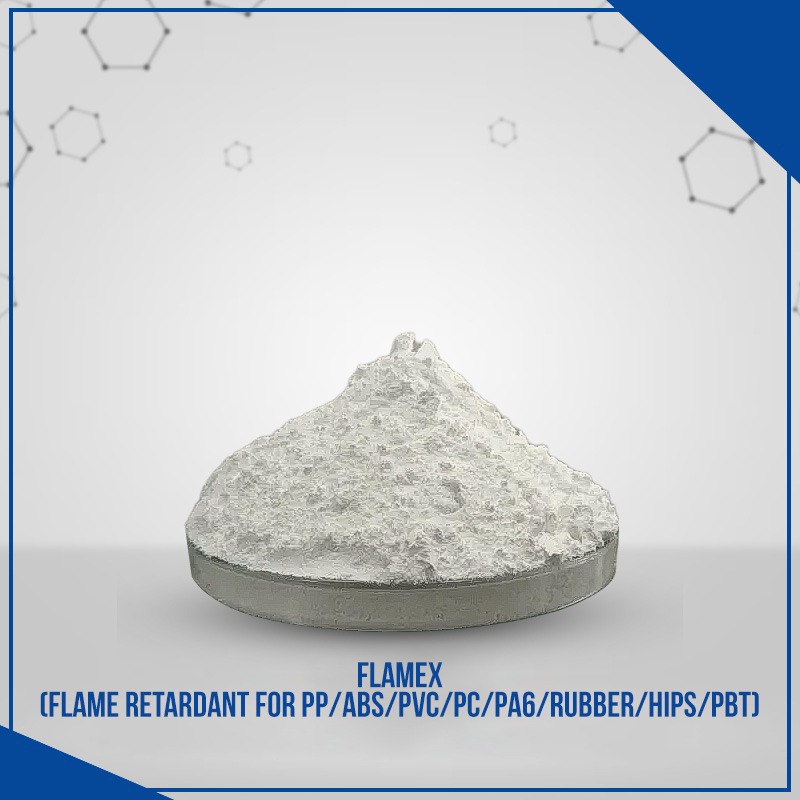 | flame retardant additives Flamex ( Flame Retardant for PP ABS PVC PC PA6 RUBBER HIPS PBT ) FLAMEX ( One Pack Flame Retardant ) manufactured by our company is widely used in PP,PA, PE,PC ,PC/ABS, PVC , Rubber ,PBT, PET, XPS, EPS, PU ,PVC,... View product → |
 | Flame Retardant Filler FAM-501 Flame Retardant Filler FAM-501 FAM - 501 Flame Retardant filler FAM-501 is One Pack Flame Retardant & Smoke Suppressant developed for Plasticized PVC applications. View product → |
Frequently asked questions
How do you choose a flame-retardant additive for plastic manufacturing?
Start with the resin, end use, wall thickness and required fire rating. Then compare packages against smoke, mechanical and processing limits.
What process controls matter when adding flame retardants?
Control additive loading, resin and additive drying, feeder accuracy, melt temperature, residence time and pellet quality from feed to extrusion.
Why must flame-retardant compounds be tested at final thickness?
Fire performance changes with specimen thickness and conditioning. Test the compound in the geometry and moisture or temperature state required for the end use.
What should a Hyderabad purchasing specification include?
Define the resin grade, additive dosage range, drying conditions, processing window, required fire rating, smoke limits, mechanical targets and batch-release tests.
Related products
| FAM-501 ABOUT FAM - 501 FAM-501 is One Pack Flame Retardant & Smoke Suppressant developed for Plasticized PVC applications. View product → |
 | Aluminium Hydroxide ALUMINIUM HYDROXIDE is a Super Fine Precipitated Special ATH. View product → |
 | Antimony Trioxide Our range of Antimony trioxide is used mainly in flame retardant formulations for plastics, rubbers, textiles, paper and paints. View product → |
 | Aluminium Trihydrate (ATH) is a very finely grounded product having a uniform and controlled particle size distribution. View product → |