
Polypropylene burns readily in air, so a small additive dose is rarely enough to deliver dependable fire performance. You will be able to compare additive chemistries, set a defensible test plan, screen a formulation, and buy material with the documents and processing controls needed for Hyderabad production.
Key takeaways
- Set UL 94 V-0, V-1 or V-2 at the finished-part thickness.
- Compare intumescent, mineral and halogenated systems against your PP grade.
- Check additive dispersion, impact strength, flow and moulded-part performance.
- Request samples, technical documents and batch traceability before buying.
Set the fire-performance target before choosing an additive
A polypropylene product has no universal “pass” level: the required result comes from its end-product standard, customer specification and installation risk. For a vertical-burning requirement, set the target as UL 94 V-0, V-1 or V-2 at the moulded-part thickness. V-0 is the strictest of these classes; V-2 permits flaming drips that ignite the cotton indicator.
| Target | What the result establishes | How to compare supplier claims |
|---|---|---|
| UL 94 V-0 | Short afterflame and no flaming drips that ignite cotton | Compare only with V-0 data at the same thickness and conditioning |
| UL 94 V-1 | Short afterflame, with stricter dripping behaviour than V-2 | Do not treat it as equivalent to V-0 |
| UL 94 V-2 | Short afterflame, but flaming drips can ignite cotton | Reject “V-2 or better” when the product specification requires V-0 |
Ask for the complete report, not a certificate that says only “flame-retardant grade.” It must name UL 94 or IEC 60695-11-10, specimen thickness, conditioning, colour, additive concentration, afterflame and afterglow times, and dripping behaviour.
Do not substitute ASTM D2863 limiting oxygen index or ASTM E662 smoke density for a UL 94 classification. They measure different phenomena. Compare a polypropylene flame retardant only against data generated on the same PP grade, formulation, colour, thickness and test method; otherwise a promising claim can fail in your finished part.
Compare intumescent, mineral and halogenated routes for PP
Choose the chemistry against the finished part, not the additive name. A thin electrical housing needing UL 94 V-0, low smoke and a light colour points to a different route from a thick industrial cover where cost and mechanical toughness dominate.
| Route | Fire and smoke | Colour and processing | Mechanical and fit |
|---|---|---|---|
| Intumescent | A halogen-free flame retardant package using ammonium polyphosphate, pentaerythritol and melamine forms a protective char. It produces lower smoke and corrosion than halogenated systems when the char is coherent. | Intumescent polypropylene often needs about 20–30 wt% package, which can restrict flow, surface quality and colour. | High loading can reduce tensile strength, impact strength and elongation. Choose it for V-0 targets where smoke and halogen restrictions matter. |
| Mineral | Magnesium hydroxide releases water and dilutes combustible gases; smoke and corrosive emissions are low. | It is white, thermally stable and suitable for light colours, but high loading raises viscosity and can impair mould filling. | Particle agglomerates act as impact initiators and weaken the part. Use a defined particle-size and dispersion specification. |
| Halogenated | Brominated chemistry paired with antimony trioxide gives strong gas-phase flame suppression at lower loading. | It usually preserves flow and surface finish better, but smoke, corrosive combustion products and customer substance exclusions can rule it out. | It often retains more toughness than high-loading mineral or intumescent systems. |
Require flame data at the actual part thickness. Agglomerated powder creates under-protected regions and inconsistent results.
For ammonium-polyphosphate systems, demand sealed storage, dry compounding and moisture data. A zinc borate synergist can reduce afterglow, but it cannot replace the primary flame retardant without reformulation.
Build the formulation around PP grade, loading and process
Use the additive’s loading window as a starting point, not a guaranteed recipe. For an intumescent FLAMEX grade, screen 20–30 wt% total package; mineral hydroxide systems often need 40–60 wt%. Higher loading can raise torque, die pressure and viscosity while reducing impact strength, elongation and surface quality.
1. For PP homopolymer, begin with the lowest FLAMEX loading that can reach the target classification, using a PP-based carrier with similar melt-flow behaviour. Homopolymer offers stiffness and heat resistance, but excess filler can make moulded parts brittle. Run 20%, 25% and 30% package levels before changing the carrier.
2. For PP random copolymer, use a compatible PP carrier and check transparency, gloss and weld-line strength. Its lower stiffness and sealing-friendly behaviour make dispersion critical; agglomerates can produce weak regions and inconsistent flame-test results. Keep the carrier free of moisture and avoid a loading that causes visible bloom.
3. For PP impact copolymer, preserve the rubber phase by choosing a carrier with comparable polarity and melt viscosity. Flame-retardant particles can become impact initiators, so compare not only tensile strength but also notched impact after conditioning. Do not assume the homopolymer recipe will transfer.
4. Compound with a defined twin-screw profile: dry the resin and additive as specified, feed powders steadily, use sufficient distributive mixing, and avoid unnecessary melt residence time. Record barrel temperatures, screw speed, torque, pressure and throughput for every trial. Sealed storage matters for moisture-sensitive ammonium polyphosphate packages.
Screen dispersion, mechanical properties and finished-part performance
A compound works only when it passes dispersion, property and finished-part trials at the intended wall thickness—not just a screening plaque.
1. Compound a small batch using the proposed screw profile, temperature profile, residence time and drying procedure. Record torque, melt pressure and output; excessive torque or pressure signals that a high-loading mineral system will strain production.
2. Check pellets and moulded cross-sections for agglomerates by microscopy, and compare ash or additive distribution across the section. Reject batches with visible clusters because they create under-protected regions and impact-initiation sites.
3. Mould tensile, flexural and impact specimens from the same batch, then compare results with unfilled PP and the customer’s minimum values. Test the actual PP grade: homopolymer, random copolymer, impact copolymer, glass-fibre PP or recycled PP can respond differently to the same additive.
4. Run UL 94 or IEC 60695-11-10 at the product’s real thickness and conditioning state. Record afterflame time, afterglow, dripping and smoke observations; a V-0 result at 3.2 mm does not prove performance at 0.8 mm.
5. Process production-like parts through PP injection moulding and PP extrusion, including thin ribs, weld lines, corners and long flow paths. Inspect warpage, surface bloom, colour, fibre exposure, dimensional stability and electrical function after conditioning.
6. Repeat flame and mechanical checks on parts after ageing, humidity exposure and recycled-content variation. Release the formulation only when process settings, thickness, dispersion and test results remain within documented limits.
Buy and qualify flame-retardant PP additives in Hyderabad
Request a production sample and complete technical file before accepting a quotation. A “flame-retardant grade” claim is not qualification: UL 94, IEC 60695-11-10, ASTM D2863 and ASTM E662 measure different phenomena.
1. Ask for a certificate of analysis for the exact batch, stating active chemistry, additive concentration, colour, moisture, particle-size range, test method, specimen thickness, conditioning, afterflame time, afterglow, dripping and smoke result. Require an ASTM E662 result under both flaming and non-flaming conditions when smoke matters; it does not prove smoke toxicity.
2. Request the safety data sheet, technical data sheet and defined compounding procedure. Check carrier compatibility with your PP grade, recommended melt-processing temperature, feeder settings and whether the package includes zinc borate, antimony trioxide or another synergist.
Do not substitute zinc borate alone for a primary flame retardant, or remove antimony from a brominated system, without fresh testing.
3. Inspect each Hyderabad delivery for an intact moisture barrier, legible lot number, manufacture date and consistent pellet or powder appearance. Reject unlabelled material, caked powder or a broken seal.
4. Control batch traceability from additive lot to compound lot and moulded-part test report. Retain a sealed reference sample and approve production only after testing the actual wall thickness.
Evaluate Niknam Chemicals Pvt. Ltd by these documents, lot controls and trial results, not by the product name; any flame-retardant additive supplier Hyderabad plants can audit should meet the same standard.
Related product
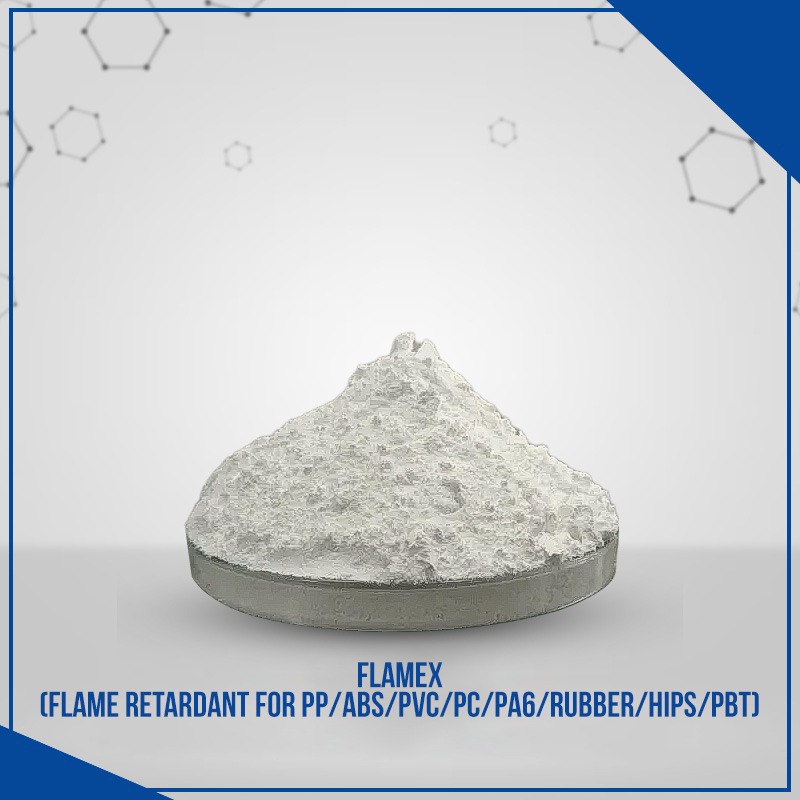 | flame retardant additives Flamex ( Flame Retardant for PP ABS PVC PC PA6 RUBBER HIPS PBT ) FLAMEX ( One Pack Flame Retardant ) manufactured by our company is widely used in PP,PA, PE,PC ,PC/ABS, PVC , Rubber ,PBT, PET, XPS, EPS, PU ,PVC,... View product → |
Frequently asked questions
How do you set a fire-performance target for polypropylene?
Start with the end-product standard, customer specification and installation risk, then specify UL 94 V-0, V-1 or V-2 at the moulded-part thickness.
Which flame-retardant routes can be used in polypropylene?
Compare intumescent, mineral and halogenated systems by their fire performance, loading, processing requirements, smoke behaviour and effect on mechanical properties.
What should you check when formulating flame-retardant polypropylene?
Match the additive to the PP grade, loading level and processing conditions, then screen dispersion, flow, mechanical properties and finished-part performance.
How can you qualify a flame-retardant additive supplier in Hyderabad?
Request representative samples, technical data, batch information and test documentation, then confirm that the material performs consistently in your own PP formulation and moulded part.