
Polypropylene burns readily because its limiting oxygen index is typically only 17–19%, and molten PP can drip while feeding the flame. You will learn how to match a chemical system to your PP grade and product, compound it without losing processability, and specify fire and smoke tests that produce a defensible purchase decision.
Key takeaways
- Qualify the finished PP part, not a flame-retardant in generic resin.
- Match additive loading and dispersion to PP grade, wall thickness and end use.
- Compare mineral, phosphorus, nitrogen, halogen and synergist trade-offs.
- Specify UL 94, glow-wire, smoke and heat-release tests for the actual risk.
Why polypropylene grade and product design determine the flame-retardant strategy
A polypropylene flame retardant that achieves V-0 in a thin homopolymer plaque can fail in a thick, glass-filled housing. Grade, end use and wall design control crystallinity, melt flow, dripping, heat release and additive dispersion, so qualify the finished formulation rather than a generic PP resin.
| PP grade | Typical end uses | Flame-retardant decision |
|---|---|---|
| PP homopolymer | Rigid appliance housings, electrical parts, caps | High crystallinity and stiffness can support dimensional stability, but the melt can drip readily; address both burning and flaming drips. |
| Random copolymer PP | Transparent containers, medical parts, flexible consumer components | Lower crystallinity and altered melt strength change dispersion, transparency and drip behaviour; check appearance and impact after adding the system. |
| Impact copolymer PP | Automotive trim, battery covers, protective housings | Its rubber phase improves impact resistance but changes ignition, smoke and char behaviour; a formulation suited to homopolymer PP cannot be transferred directly. |
Wall thickness changes the result: a 1.5 mm electrical cover does not burn like a 3 mm test bar. Glass fibre, mineral filler, nucleating agent, pigment, recycled PP, molecular weight and melt-flow rate also alter heat transfer, dispersion and melt strength.
A high mineral-hydroxide loading can improve fire performance while reducing elongation, impact strength and flow.
Use the intended grade, colour, filler package, thickness and processing history for qualification. Check the end use separately: a cable component needs control of flaming drips and ignition, while an automotive enclosure also needs impact retention, smoke evaluation and dimensional stability after heat exposure.
The same additive performs differently because the polymer matrix controls where it disperses, how the melt flows, and whether a protective char stays intact.
How to compound flame retardants into polypropylene
Start with the additive’s active content, not the bag weight. A PP additive dosage of 15% masterbatch containing 50% flame retardant delivers only 7.5% active material. Record both figures before comparing formulations.
| Route | Choose it when | Main control point |
|---|---|---|
| Direct powder addition | You need maximum formulation flexibility or high loading | Use dry, free-flowing powder and verify feeder accuracy |
| Flame-retardant masterbatch | You need cleaner handling, repeatable dosing or lower dust | Match its carrier resin to the intended PP grade |
For initial screening, test three active-load levels around the supplier’s recommended range rather than changing several variables together. Intumescent and phosphorus systems often need a lower starting range than mineral hydroxides; aluminium hydroxide or magnesium hydroxide systems can require about 50–65 wt% active filler. Recheck melt flow, impact and density at every step.
- Dry hygroscopic powders and PP as specified; moisture creates voids and unstable fire results.
- Feed the polymer and additive into a distributive mixing section, then use limited dispersive shear to break agglomerates without excessive heating.
- Set barrel zones high enough to melt the PP, commonly within about 180–230 °C, but follow the additive supplier’s limit. Aluminium trihydrate can dehydrate near 180–200 °C, while APP can degrade during prolonged heat exposure.
- Watch torque, die pressure and melt temperature. Reduce throughput or adjust feeding when torque rises sharply, and shorten residence time if the melt darkens, gases or loses flow.
- Examine a polished cross-section for additive-rich islands; poor dispersion can produce conflicting UL 94 results between specimens.
Qualify the final compound using the actual PP grade, colour, wall thickness and processing history.
Comparing mineral, phosphorus, nitrogen, halogen and synergist systems
For PP, the main choices are mineral hydroxides, halogen systems, phosphorus–nitrogen intumescents, and synergists. The best combination depends on whether you prioritise low loading, smoke control, mechanical retention, or a halogen-free formulation.
| System | Useful combination | Poor choice when |
|---|---|---|
| Mineral hydroxide | Magnesium hydroxide with a surface treatment and compatibiliser | You need high elongation, impact strength or low density; 50–65 wt% loading can damage all three |
| Aluminium trihydrate | Filler or smoke-control aid in low-temperature processing | PP is processed at 180–230 °C; aluminium hydroxide starts dehydrating around 180–200 °C, causing premature water release |
| Phosphorus–nitrogen | Ammonium polyphosphate phase II, a polyol such as pentaerythritol, and melamine | You cannot tolerate 20–30 wt% additive, moisture sensitivity, or demanding dispersion control |
| Halogen–antimony | A compatible halogen donor with antimony trioxide | Smoke composition, corrosive gases, substance restrictions or end-of-life rules exclude the specific chemistry |
| Synergist | Zinc borate, zinc stannate or a selected molybdate with the primary system | You expect a synergist alone to deliver reliable flame retardancy or low smoke |
Magnesium hydroxide survives normal PP melt processing better than aluminium trihydrate, but its high loading raises torque and can reduce melt flow. Antimony trioxide is not a stand-alone replacement for a halogen donor; without that gas-phase partner, its benefit is limited.
An intumescent PP formulation needs tight control of moisture, dispersion and additive compatibility. Zinc borate or molybdate can reduce afterglow or smoke in a complete formulation, but a UL 94 result does not measure smoke yield or fire growth.
Select tests that measure the fire and smoke risk you actually need to control
Request the measured outputs, not just “fire grade.” UL 94 V-0 requires afterflame and afterglow times, flaming-drip observations and the specimen thickness; also request UL 94 horizontal burning when the part’s orientation or end-use standard requires it.
| Test | Request | What it tells you |
|---|---|---|
| UL 94 | UL 94 V-0 or another class, afterflame, afterglow and dripping results | Small-flame ignition and self-extinguishing behaviour; it does not predict heat release or real-fire ignition |
| ASTM D2863 LOI | Limiting oxygen index value and specimen details | Screening comparison of formulations; ASTM D2863 LOI measures candle-like downward burning, not complete-part fire performance |
| Cone calorimetry | Time to ignition, heat-release rate, peak heat-release rate, total heat release, mass loss and smoke data | Fire growth and energy release under a defined heat flux |
| ASTM E662 | Specific optical density under flaming and non-flaming modes, including peak and elapsed-time results | Smoke obscuration; it does not establish smoke toxicity |
A high limiting oxygen index is not a standalone pass/fail result. Thickness, orientation, ignition source, ventilation, dripping and geometry can change the outcome, so specify plaques or bars, dimensions, exposed face, gate or flow direction and test orientation.
Put conditioning in the specification: identify ASTM D618 conditions, conditioning duration and moisture history. This matters for polypropylene containing ammonium polyphosphate, melamine systems or inorganic powders, particularly after monsoon storage. Without those details, a dry laboratory result cannot reliably represent factory handling or the finished part.
Turn the result into a PP purchase specification in Hyderabad
Approve the compound, not the additive name. Your flame-retardant PP specification should state the PP grade, additive loading by weight, specimen thickness, target UL 94 class, afterflame and afterglow limits, flaming-drip rule, colour, density, melt-flow range, ASTM D618 conditioning history and ASTM E662 smoke density limits.
| Supplier comparison | Evidence to request | Disqualifying gap |
|---|---|---|
| Fire performance | UL 94 report at your thickness, plus flaming and non-flaming ASTM E662 values; request cone-calorimeter data when heat-release rate matters | “Self-extinguishing” claim without method or thickness |
| Mechanical performance | Tensile strength, elongation, notched Izod or Charpy impact, before and after conditioning | Fire result supplied without strength and impact data |
| Processing | Melt-flow range, drying temperature and time, screw-temperature window, residence-time limit and recommended dosing sequence | No production guidance for your injection or extrusion line |
| Economics | Density, compound price per kilogram and calculated cost per part volume | Lowest price per kilogram but higher density and part mass |
Calculate cost per part as compound price per kilogram multiplied by finished-part mass. Compare cost per cubic centimetre as price per kilogram multiplied by density, then confirm that the higher loading has not reduced cycle stability or increased rejects.
Approve three production-representative lots only after checking:
- Moisture before processing and after Hyderabad monsoon storage
- Melt flow, density and colour against the agreed range
- Flame, smoke, tensile and impact results after ASTM D618 conditioning
- Warpage, screw torque, back pressure, cooling time and surface defects on your machine
Niknam Chemicals Pvt. Ltd can be one Hyderabad chemical supplier to ask for lot-specific certificates, dosage guidance and processing data rather than accepting a generic “one-pack” description. Keep the approved formulation, resin batch, drying record and test specimens together for requalification.
Related product
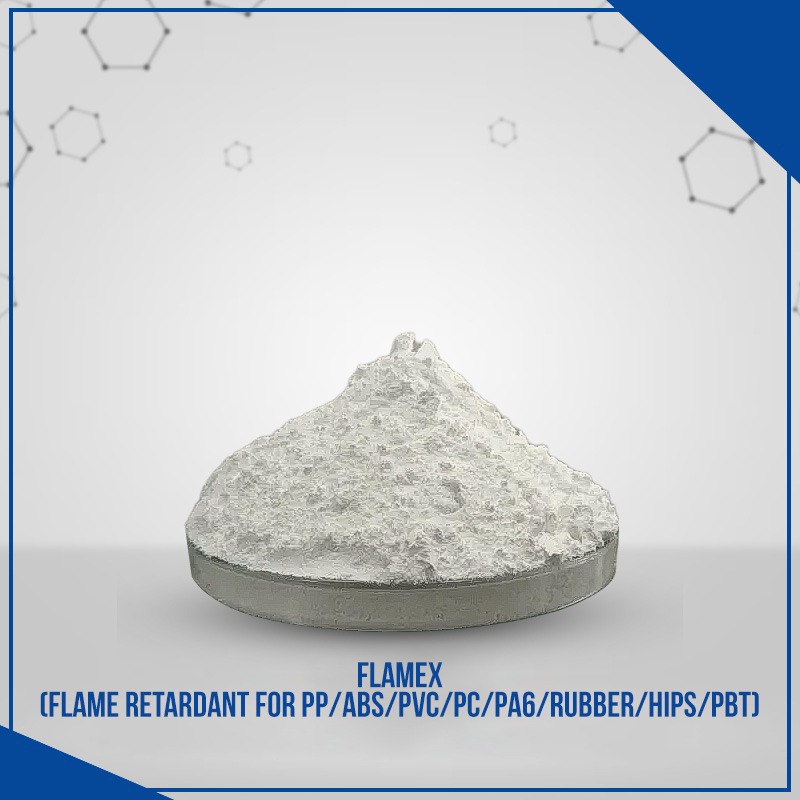 | flame retardant additives Flamex ( Flame Retardant for PP ABS PVC PC PA6 RUBBER HIPS PBT ) FLAMEX ( One Pack Flame Retardant ) manufactured by our company is widely used in PP,PA, PE,PC ,PC/ABS, PVC , Rubber ,PBT, PET, XPS, EPS, PU ,PVC,... View product → |
Frequently asked questions
Why does polypropylene grade affect flame-retardant performance?
Homopolymer, copolymer and glass-filled PP differ in crystallinity, melt flow, dripping and additive dispersion. Qualify the exact grade and molded part.
How are flame retardants compounded into polypropylene?
Use a controlled masterbatch or direct-feed process, then verify additive loading, melt dispersion, residence time and processing temperature against the PP grade.
Which flame-retardant system should you compare for PP?
Compare mineral, phosphorus, nitrogen, halogen and synergist systems for flame rating, smoke, mechanical properties, color, processing stability and regulatory requirements.
Which tests measure fire and smoke risk in polypropylene parts?
Select tests such as UL 94, limiting oxygen index, glow-wire testing, cone calorimetry and smoke measurements according to the part's real ignition and fire exposure.
What belongs in a polypropylene flame-retardant purchase specification in Hyderabad?
State the PP grade, additive chemistry, loading range, target wall thickness, UL 94 class, smoke limits, test method, batch documents and acceptance criteria.