
Choosing a flame retardant for ABS starts with the part, wall thickness and required test result—not with a product label such as “self-extinguishing.” You will be able to compare halogenated, halogen-free and synergist systems, set a sensible screening plan, and qualify a Hyderabad supplier with evidence that survives production changes.
Key takeaways
- Define the ABS resin, part geometry and thinnest wall before selecting an additive.
- Compare primary retardants with mineral systems and synergists, not by price alone.
- Set loading through fire testing, impact results, flow behaviour and surface appearance.
- Request test reports, batch controls and production evidence from Hyderabad suppliers.
Start with the ABS part and the exact fire classification
Define the ABS part by resin, geometry, and worst-case wall before choosing an ABS flame retardant. Identify whether it is an injection-moulded housing, electrical enclosure, connector, automotive trim or appliance component, then record:
- ABS grade, including impact-modified, high-heat or glass-fibre-filled resin
- Minimum wall thickness and locations of ribs, weld lines, inserts and sharp corners
- Exposure to heat, impact, chemicals and electrical voltage
- Required classification at the actual moulded thickness, not a thicker laboratory plaque
| Fire requirement | What it means | Define before selection |
|---|---|---|
| UL 94 V-0 ABS | Short vertical-flame exposure with limited afterflame, no cotton-igniting flaming drips and limited afterglow | State the tested thickness, such as 1.5 mm or 3.2 mm |
| UL 94 V-1 and V-2 | Vertical classifications with less demanding afterflame or drip limits than V-0 | Confirm whether the application permits flaming drips and specify thickness |
| UL 94 HB | Horizontal-burning classification, not a substitute for a vertical rating | State the required burn-rate limit and specimen thickness |
A V-0 result at 1.5 mm does not transfer automatically to a ribbed part or a thinner wall. Ask for the exact UL 94 report and specimen thickness.
Also separate flame extinction from smoke control: UL 94 gives no smoke-density rating. Specify ASTM E662 or another application-specific smoke test when smoke matters. Request the additive’s chemical identity and REACH status; “brominated” is not enough, particularly where decaBDE restrictions affect export components.
Compare primary flame retardants, mineral systems and synergists
Select the primary chemistry before choosing a synergist. A brominated system remains the established route to UL 94 V-0 in thin ABS housings, while halogen-free ABS usually demands higher additive loading and tighter compounding control.
| Chemistry | What it does in ABS | Suitable use and trade-off |
|---|---|---|
| Brominated organic flame retardant plus antimony trioxide | Creates gas-phase inhibition; antimony trioxide forms volatile antimony-halogen species in the flame | Thin-wall electrical enclosures, connectors and appliance housings; verify the exact chemical identity and regulatory status, especially for decaBDE under REACH and PBB or PBDE restrictions under RoHS |
| Aluminum hydroxide or magnesium hydroxide | Releases water and cools or dilutes combustion gases | Halogen-free ABS parts when the polymer tolerates high loading; excess mineral reduces impact strength, elongation, flow, surface quality and electrical performance |
| Zinc borate, molybdenum compounds or selected metal oxides | Promotes char or suppresses smoke in a formulation-specific manner | Use as a secondary synergist after measuring smoke and fire performance; loading can alter colour, opacity, melt flow and surface finish |
Antimony trioxide is not a complete flame retardant by itself. Pair it with a compatible brominated primary when you need efficient V-0 performance; do not treat the pairing as interchangeable with a mineral system.
A zinc borate ABS formulation makes sense when smoke reduction or char support is a defined target, not because “smoke suppressant” sounds protective. Request the test method and before-and-after smoke values, then recheck UL 94 at the finished wall thickness.
Set loading ranges without sacrificing ABS performance
Start with a 100-part ABS resin basis: phr means parts of additive per 100 parts of resin, not weight percentage of the finished compound. Treat each figure as a screening range, then confirm UL 94 at the actual wall thickness.
| System | Initial flame-retardant dosage in phr | Main risk |
|---|---|---|
| Brominated organic FR + antimony trioxide | 10–20 phr FR + 3–6 phr antimony trioxide | Excess additive reduces impact and flow |
| Phosphate FR | 10–25 phr | Plasticisation lowers Vicat, HDT or impact retention |
| ATH or magnesium hydroxide | 30–60 phr | High filler loading damages flow, elongation and surface quality |
Antimony trioxide loading must match the brominated chemistry; antimony trioxide alone is not a complete ABS flame retardant. A thicker 3.2 mm specimen can pass at a lower ABS flame retardant loading than a 1.5 mm specimen, while ribs, weld lines and fibre orientation can still produce local failures.
Screen the formulation against these variables:
- ABS grade and melt-flow rate: a high-rubber impact grade retains toughness better but may need different additive levels than a rigid, high-flow grade.
- Impact modifier and pigment level: both dilute the resin package and can change ABS impact strength, colour and burning behaviour.
- Glass fibre: it improves stiffness but can reduce impact retention and create exposed fibres at the surface.
- Total additive volume: excessive filler raises viscosity, worsens mould filling and produces gloss or sink defects.
Measure UL 94 V-0, V-1 or V-2 at the specified thickness alongside impact, melt flow, Vicat or HDT, colour and surface appearance.
Control drying, compounding and injection moulding conditions
Treat pellet moisture as a controlled input, not a warehouse issue. ABS drying must follow the resin compounder’s validated temperature, time and maximum moisture value; generic settings can leave enough water to cause splay, voids, molecular-weight loss and inconsistent impact strength.
1. Verify the drying certificate before charging the hopper. Keep dried pellets in a sealed, dehumidified hopper, and recheck moisture after any prolonged exposure during Hyderabad’s monsoon conditions.
2. Follow a documented ABS compounding procedure. Premix the resin, flame retardant and pigment consistently, or use a flame retardant masterbatch with a defined carrier and let-down ratio. Control feeder accuracy, screw speed, torque, melt temperature and residence time so the additive disperses without repeated heat history.
3. Set the ABS processing temperature from the formulation’s validated melt window, not from the additive’s datasheet alone. Excessive heat can degrade ABS, discolor the part or change impact performance; insufficient shear leaves additive-rich and additive-poor zones that burn differently.
4. Reject hydrated mineral systems that release water near the chosen melt temperature. Aluminium hydroxide is a poor sole high-loading choice for conventional ABS, while magnesium hydroxide can demand loadings that damage flow and mechanical properties.
5. Mould trial plaques at the production wall thickness, then inspect colour, splay, weld lines, surface deposits and short shots. Record barrel temperatures, screw recovery, back pressure, injection speed and residence time, and revalidate after changing resin, pigment, recycled content or additive lot.
Qualify a Hyderabad supplier with test data and production controls
Approve the additive against the exact ABS grade, formulation, loading and wall thickness—not against a generic “flame-retardant grade” claim. Whether you assess Niknam Chemicals Pvt. Ltd or another flame retardant chemical supplier in Hyderabad, use the same evidence gate.
1. Request the technical data sheet, safety data sheet, chemical name or CAS number, active-content range, recommended loading, storage conditions and a lot-specific certificate of analysis. The certificate should report identity, active content, moisture and any melt-flow impact.
2. Ask for a retained production sample and a fresh sample from the proposed lot. Record the batch number, seal condition and sample mass, then compare powder appearance, dispersion and moisture before compounding.
3. Require a molded ABS plaque report showing ABS UL 94 testing, specimen thickness, conditioning, resin grade, pigment, impact modifier, additive loading and complete burn results. V-0 at 1.5 mm does not prove V-0 in your 0.8 mm housing.
4. Specify an ASTM E662 smoke test when smoke release matters; UL 94 measures burning behaviour, not smoke density. Review flaming and non-flaming smoke values separately.
5. Obtain RoHS and REACH flame retardants declarations with substance-level names, not “halogenated.” Confirm decaBDE status, concentration limits and exemptions under REACH, then repeat testing after any resin, pigment, lubricant, recycled content or supplier change.
Related products
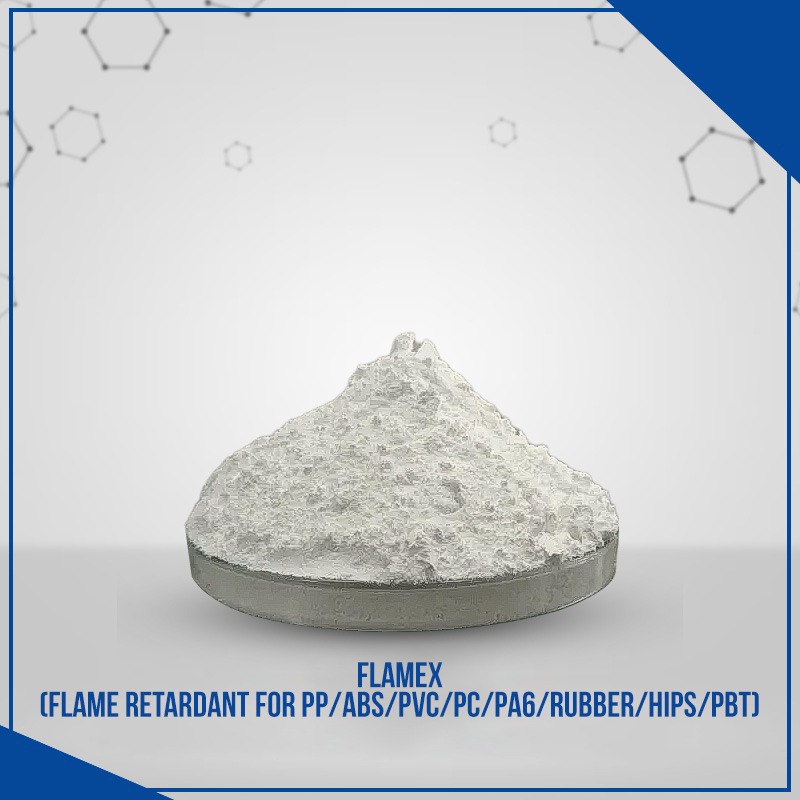 | flame retardant additives Flamex ( Flame Retardant for PP ABS PVC PC PA6 RUBBER HIPS PBT ) FLAMEX ( One Pack Flame Retardant ) manufactured by our company is widely used in PP,PA, PE,PC ,PC/ABS, PVC , Rubber ,PBT, PET, XPS, EPS, PU ,PVC,... View product → |
 | Flame Retardant Filler FAM-501 Flame Retardant Filler FAM-501 FAM - 501 Flame Retardant filler FAM-501 is One Pack Flame Retardant & Smoke Suppressant developed for Plasticized PVC applications. View product → |
Frequently asked questions
What information should you record before choosing a flame retardant for ABS?
Record the ABS resin grade, part type, geometry, thinnest wall, processing method and required fire classification. Include the worst-case wall section because fire performance can change with thickness.
How do primary flame retardants, mineral systems and synergists differ in ABS?
Primary flame retardants provide the main fire-performance effect, mineral systems can add heat absorption or residue formation, and synergists improve the efficiency of a primary system. Compare each option against ABS impact strength, flow, colour and smoke behaviour.
How should you set flame-retardant loading in ABS?
Start with the supplier's recommended formulation range, then confirm the lowest effective loading through fire classification, impact, tensile, flow and appearance testing on your actual part thickness.
Which processing controls matter when compounding and moulding flame-retardant ABS?
Control resin and additive drying, compounding temperature and residence time, pellet moisture, injection temperature, mould temperature, shear and hold conditions. Verify that the finished part meets its fire rating after processing.
What should you ask a Hyderabad ABS flame-retardant supplier to provide?
Request the technical data sheet, safety data sheet, batch or certificate-of-analysis records, recommended processing window, fire-test evidence, consistency controls and samples for trials. Match the evidence to your resin grade and part geometry.
Related products
 | Zinc Borate ZINC BORATE is a highly effective multifunctional flame retardant synergist being used as a flame retardant and smoke suppressant in a wide range of... View product → |
 | Antimony Trioxide Our range of Antimony trioxide is used mainly in flame retardant formulations for plastics, rubbers, textiles, paper and paints. View product → |