
Polypropylene burns readily in normal air, and the additive that improves flame performance can also change flow, impact strength, surface finish and moulding stability. You will be able to shortlist a PP grade, compare flame-retardant chemistries, plan a controlled moulding trial and request the test evidence needed before approving production parts.
Key takeaways
- Define PP grade, wall thickness and fire-test target before selecting an additive.
- Compare loading, smoke, toughness, flow and surface effects—not flame rating alone.
- Control drying, dispersion, melt temperature and moulding conditions during trials.
- Test finished parts at production thickness and geometry, not only laboratory plaques.
Choose the PP grade and fire target before choosing the additive
Start with the part, not the additive: define the injection-moulding process, PP grade, wall thickness and required fire test. A homopolymer PP gives stiffness and flow, while impact copolymer PP improves toughness but can respond differently to crystallisation, shrinkage and flame-retardant loading.
| PP grade | What it means | Define before compounding |
|---|---|---|
| Homopolymer PP | Higher stiffness and heat resistance; lower impact strength | Specify stiffness, melt-flow rate and minimum impact value |
| Impact copolymer PP | Better low-temperature impact; different phase structure | Specify impact target, weld-line strength and allowable stiffness loss |
| Random copolymer PP | Better clarity and softer behaviour | Specify appearance, heat resistance and fire target |
| Talc- or mineral-filled PP | Higher modulus and dimensional stability | Specify filler percentage, shrinkage, warpage and surface finish |
| Glass-fibre-reinforced PP | High stiffness with anisotropic shrinkage | Specify fibre content, flow direction, weld-line strength and impact |
Set the fire target at the actual part thickness. UL 94 V-0 is not equivalent to low smoke, and a rating on a 1.5 mm plaque does not validate a 0.8 mm housing. State the required UL 94 class, thickness, orientation and conditioning, then add smoke, glow-wire or oxygen-index limits if the application needs them.
Unmodified PP has a limiting oxygen index near 18 vol%, so reaching V-0 usually requires a dedicated package rather than a small dose. Also record tensile strength, impact, melt flow, colour, gloss, deposits, humidity-aged performance and dimensional stability. This baseline lets you judge whether the resulting flame retardant polypropylene remains a usable PP moulding compound.
Compare flame-retardant chemistries by loading, smoke and part performance
Three systems are plausible for moulded polypropylene: halogenated packages, phosphorus-based halogen-free systems, and mineral or synergist blends. The right choice depends on the fire rating, smoke limit, wall thickness and impact requirement.
| Option | Loading and smoke trade-off | Part-performance trade-off |
|---|---|---|
| Halogenated flame retardant | Lower loading than many mineral or intumescent systems; antimony-based synergists improve efficiency but can increase smoke, corrosivity, density and approval burden. | Preserves flow and surface finish more readily, but check regulatory acceptance and electrical-contact corrosion. |
| Halogen-free PP flame retardant | Often needs a higher dose; an intumescent polypropylene package commonly falls around 20–30 wt%, with lower smoke as a potential benefit. | High loading can reduce impact strength, elongation, weld-line strength and surface quality. |
| Ammonium polyphosphate PP | Use coated or moisture-resistant APP; uncoated material risks moisture uptake, acid-related processing effects and weaker humidity durability. | Coating changes dispersion and compatibility, so the same APP percentage will not deliver the same rating in every PP grade. |
| Mineral synergist blend | Zinc borate, zinc stannate or molybdates can suppress smoke or improve synergy, but they are not interchangeable. | Added density, stiffness or loss of toughness is possible, and effectiveness depends on the primary chemistry and filler treatment. |
Do not treat a small additive dose as a route to V-0: unmodified PP has a limiting oxygen index near 18 vol% and burns readily in air. Start with a supplier-recommended range, then adjust against UL 94, smoke, impact and mould-flow results; a UL 94 pass alone does not prove low-smoke performance.
Build the trial around drying, dispersion and moulding conditions
A high PP flame retardant dosage turns a stable injection process into a feeding, viscosity and surface-finish problem. Build the trial as a controlled study: change one variable at a time and retain plaques and moulded parts from every run.
1. Dry the PP and flame-retardant package according to each supplier’s data sheet. Use coated, moisture-resistant APP rather than uncoated APP when the formulation contains ammonium polyphosphate; moisture can worsen dispersion, processing stability and humidity retention.
2. Calibrate the gravimetric feeder before compounding. Record the actual additive rate, not only the setpoint, and prepare at least three dosage levels around the supplier’s recommended starting point. Do not treat a V-0 target as proof that a small dose will work.
3. Check masterbatch dispersion in the compound through cut pellets, microscopy or ash mapping. Local additive-rich zones cause brittle areas and streaks; additive-poor zones can fail the flame test. Excessive screw shear and long residence time can also damage phosphorus-containing packages.
4. Set the flame retardant processing temperature inside the additive supplier’s recommended window, then adjust screw speed, back pressure and residence time together. Watch melt-filter pressure, torque, colour and venting during each run.
5. Mould the trial using the intended injection moulding polypropylene grade, gate, wall thickness and cycle. Keep injection speed, mould temperature, packing pressure and cooling time recorded; changing these can alter weld lines, orientation and final flame performance.
Avoid aluminium trihydrate unless its water-release behaviour suits the process. Magnesium hydroxide tolerates higher temperatures but needs heavier loading, which can raise viscosity and reduce toughness.
Test the compound as a part, not only as a laboratory plaque
A plaque can pass UL 94 and still fail after moulding because thickness, flow direction, weld lines and additive distribution change the fire behaviour. Mould the actual part, or a worst-case replica containing its thinnest wall, ribs, bosses, gates and weld lines.
| Test or check | What to record | What failure reveals |
|---|---|---|
| UL 94 vertical burn | Rating at the part’s minimum thickness, including after conditioning | A formulation that misses the required UL 94 V-0 polypropylene target |
| FMVSS 302 PP | Horizontal burn rate, self-extinguishment and dripping on the vehicle-part geometry | UL 94 V-0 does not prove compliance with the 102 mm/min automotive limit |
| Limiting oxygen index | Oxygen concentration supporting combustion | Useful for comparing batches, not for predicting UL 94 or end-use performance |
| Glow-wire testing | Ignition, flaming and afterglow at the specified temperature | Local ignition risk in electrical housings |
| Mechanical and dimensional checks | Flame retardant PP mechanical properties, melt flow, shrinkage, warpage and weld-line strength | Excessive loading, poor dispersion or altered crystallisation |
Run flammability tests on as-moulded and humidity-conditioned specimens. Compare colour, gloss, surface deposits and melt-filter pressure against unmodified PP; deposits or rising pressure can signal additive separation or degradation.
Check feeder calibration, pellet moisture and residence time during the trial. Excessive shear can degrade some phosphorus systems, while weak distributive mixing leaves additive-rich and additive-poor zones that create inconsistent results. A passing plaque is evidence, not approval for production.
What to request from an Ahmedabad additive supplier before a production trial
Ask a flame retardant additive supplier Ahmedabad for a trial pack from a defined batch, not an unlabelled powder. Request enough material for repeated plaques and representative moulded parts, plus a retained sample for comparison after testing.
Request these items before approving a flame retardant additive trial:
- A PP flame retardant technical data sheet stating chemistry, active content, recommended loading in phr or weight percentage, particle size, density, moisture limit, processing-temperature range and UL 94 results at each tested thickness.
- A certificate of analysis for the supplied batch, including assay, moisture, ash, particle-size data and batch number.
- The safety data sheet, storage conditions and shelf life.
- A formulation guide identifying compatible PP grades, coated versus uncoated APP status, synergists, compatibiliser requirements, drying conditions and maximum residence time.
- A processing note covering feeder calibration, screw-mixing guidance, melt-filter pressure and cleaning procedure.
| Evidence to compare | What to verify | Why it matters |
|---|---|---|
| Formulation sample | Virgin PP, additive package, pigment and filler details | A plaque result may not transfer to your grade |
| Trial recipe | Loading, mixing order and adjustment steps | You need to link fire rating with impact, flow and colour |
| Test report | Specimen thickness, conditioning, orientation and moulding history | UL 94 V-0 is not approval of every production part |
Niknam Chemicals Pvt. Ltd can be asked to identify which supplied package suits your PP grade and moulding process, rather than treating a one-pack product as a universal starting formulation.
Related product
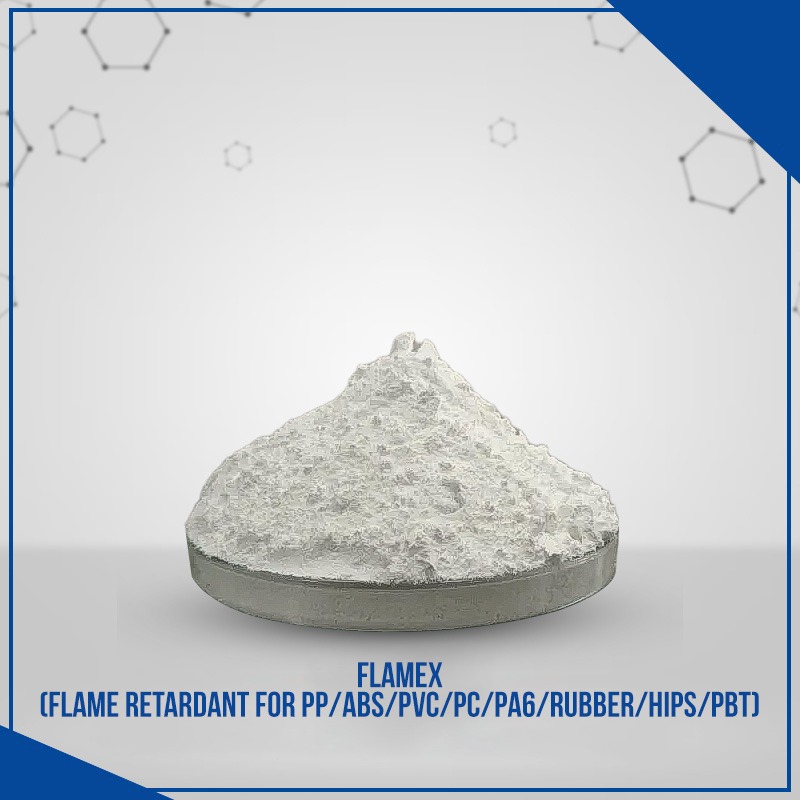 | flame retardant additives Flamex ( Flame Retardant for PP ABS PVC PC PA6 RUBBER HIPS PBT ) FLAMEX ( One Pack Flame Retardant ) manufactured by our company is widely used in PP,PA, PE,PC ,PC/ABS, PVC , Rubber ,PBT, PET, XPS, EPS, PU ,PVC,... View product → |
Frequently asked questions
How do you choose a flame retardant for a polypropylene moulded part?
Define the PP grade, injection-moulding process, wall thickness and required fire test first. Then compare chemistries by loading, smoke, flow, toughness and surface effects.
Why does the PP grade matter when adding a flame retardant?
Homopolymer PP provides stiffness and flow, while impact copolymer PP improves toughness. Their crystallisation, shrinkage and response to additive loading can differ.
What should you control during a flame-retardant PP trial?
Control additive drying, dispersion, melt temperature, residence time, mould temperature, injection speed and cooling so the trial reflects production conditions.
Should flame-retardant PP be tested as a plaque or as the finished part?
Test finished parts at their production wall thickness and geometry. A laboratory plaque alone cannot reveal effects from knit lines, thin sections, flow orientation or moulding defects.