
A flame-retardant additive is not a universal pass/fail solution: the required test, polymer, processing window, loading and finished-product geometry all change the result. By defining those variables first, you can compare grades, plan trials and avoid paying for a formulation that passes a laboratory plaque test but fails in production or service.
Key takeaways
- Define flame, smoke, gas and dripping failures before selecting an additive.
- Test several concentrations within your polymer’s processing temperature window.
- Check dispersion, moisture exposure and Ahmedabad heat before approving a formulation.
- Require test reports matching your resin, thickness, orientation and end use.
Define the Fire Performance Your Product Must Demonstrate
Specify the failure behaviour before choosing the additive: self-extinguishing, resistance to ignition, flame spread, heat release, smoke density, toxic or corrosive gases, or flaming drips. Record the product’s end use, resin, thickness, orientation, conditioning, surface finish and mounting geometry; a rating without these details is not a usable specification.
| Test or classification | What it measures | What to specify |
|---|---|---|
| UL 94 V-0, V-1, V-2 and HB | Vertical self-extinguishing or horizontal burning, including dripping behaviour | Exact thickness, orientation and conditioning |
| IEC 60695-11-10 | Small-scale horizontal and vertical flame performance | Specimen dimensions and classification target |
| ASTM E84 | Flame-spread and smoke-developed indices in a tunnel | Surface mounting, backing, joints, thickness and finish |
| ISO 4589 oxygen index and ASTM D2863 LOI | Oxygen concentration needed to sustain upward burning | Treat the value as a screening comparison, not a building-fire prediction |
LOI does not establish heat-release rate, surface flame spread, smoke production or finished-product performance. Likewise, UL 94 V-0 does not prove compliance with ASTM E84, a cable test or a building-product classification.
For cables, specify IEC 60332 for flame propagation, IEC 60754 for acidic or corrosive gases and IEC 61034 for smoke density; passing one does not satisfy the others. Require smoke data from the intended polymer, pigment package and additive loading, because smoke suppression and flame retardancy are separate outcomes.
Match the Additive to the Polymer and Processing Window
An additive that decomposes before the resin melts will not protect the product; one that reacts during residence can damage colour, viscosity, or mechanical strength. Match its decomposition range to the actual melt temperature and residence time under your production shear, not merely the polymer name.
Check compatibility separately for:
- PP: confirm dispersion and impact retention; nonpolar PP often needs a compatibilising strategy for polar mineral or phosphorus additives.
- ABS: check whether the additive changes gloss, colour, impact strength, or rubber-phase stability under shear.
- PVC: check acid generation, stabiliser interaction, and whether the additive accelerates dehydrochlorination.
- PC: reject grades that decompose or volatilise near the PC processing temperature; verify optical and impact performance.
- PA6: dry both resin and additive as specified, then test strength after processing for hydrolysis-related loss.
Aluminium trihydrate (ATH) releases water at a substantially lower temperature than magnesium hydroxide. ATH is therefore constrained in high-temperature thermoplastics; magnesium hydroxide suits a higher processing window, but test the selected grade at your melt temperature and residence time.
Ammonium polyphosphate can suffer moisture sensitivity, hydrolysis, migration, or interaction with acidic and basic ingredients. Request humidity-conditioned results and identify whether the grade is surface-treated or encapsulated. A dry, as-received UL 94 result does not predict a damp production batch.
Do not treat smoke suppression as flame retardancy. Require smoke data from the intended resin, loading, pigment package, and test method; a formulation that self-extinguishes can still produce unacceptable smoke.
Use a Concentration Ladder Instead of a Universal Dosage
Do not approve a single dosage because it produced a passing plaque. Start with the supplier’s technical data sheet, then build a concentration ladder across the stated range. Record additive loading by weight percent, resin grade, moisture condition, melt temperature, screw speed and specimen thickness for every formulation.
- Establish an unfilled control and at least three additive levels, such as the supplier’s low, middle and upper recommendations. Increase in defined increments rather than jumping directly to the highest loading.
- Mould or extrude each formulation under identical conditions, then test the exact fire method and specimen geometry required for the product.
- Reject any level that passes the fire test but damages a required property. Rework the ladder around the best-performing range instead of assuming more additive is better.
Measure tensile strength, impact resistance and elongation before and after conditioning. Mineral hydroxide systems can raise viscosity and density while reducing ductility, weld-line strength and surface quality; inspect gloss, colour, streaks, voids and mould deposits on the same parts used for testing.
Protect electrical performance separately. For cable insulation or housings, compare volume resistivity, dielectric strength, tracking or CTI, and insulation resistance against the product specification. A formulation that improves flame resistance but fails electrical limits is not a usable formulation.
Test smoke density separately when smoke suppression is claimed; a lower flame rating does not prove lower smoke.
Check Dispersion, Moisture Exposure and Ahmedabad Storage Conditions
A dry, free-flowing laboratory sample does not prove an additive will feed consistently after transport and storage in Ahmedabad. Test the received lot after exposure to hot warehouse temperatures and monsoon humidity for caking and moisture pickup in monsoon humidity, then compare its flow, sieve residue and moisture content with the as-received result.
- Check feeding: run the additive through the actual hopper, screw or dosing system and record bridging, rat-holing, surging and feed-rate variation.
- Check dispersion: inspect molded plaques or microtomed sections for agglomeration, unmelted particles and additive-rich spots; compare color, surface finish and mechanical results across the part.
- Check moisture: seal samples at a known humidity and temperature, reweigh them, and test moisture by a defined method before compounding. Excess water can cause bubbles, hydrolysis or voids.
- Check storage packaging: examine the liner, seal and desiccant after warehouse exposure; reject packs with torn barriers, condensation or hardened masses.
- Check finished parts: inspect for blooming and plate-out, surface deposits, discoloration and migration after heat, humidity and aging exposures.
For ammonium polyphosphate and other phosphorus-based systems, request data after humidity conditioning, not only as-received UL 94 results. Ask whether the grade is surface-treated or encapsulated, because moisture, hydrolysis and acidic or basic ingredients can change dispersion and durability. A formulation that feeds well but migrates or plates out during service has not passed qualification.
Require Application-Specific Evidence Before Approving a Supplier
Approve a supplier only after its evidence matches your finished part, not merely the additive’s as-received performance. Request documents and test reports that identify the resin, loading, specimen thickness, orientation, conditioning, processing history and end-use geometry.
1. Ask for the technical data sheet, safety data sheet and lot-specific certificate of analysis. The technical data sheet should state recommended loading, processing temperature, moisture limits, particle size, compatibility range and whether the grade is surface-treated or encapsulated.
2. Request humidity-conditioned data alongside as-received UL 94 results. This matters for ammonium polyphosphate and other phosphorus-based systems, where moisture can trigger hydrolysis, migration or interaction with acidic or basic ingredients. Require the exposure temperature, relative humidity, duration and post-conditioning test result.
3. Demand a report on your finished formulation at the proposed loading. For a cable, separate flame propagation under IEC 60332, acidic or corrosive gas emission under IEC 60754, and smoke density under IEC 61034; passing one does not prove the other two.
4. Check smoke data from the intended polymer, pigment package, additive loading and test method. Smoke suppression is not the same as flame retardancy, so a low-smoke claim cannot replace a flame test.
5. Apply this evidence gate to Niknam Chemicals Pvt. Ltd by asking which grade and dosage were tested in your resin, then commissioning confirmation on your production specimens before purchase. A UL 94 V-0 result alone does not establish ASTM E84, IEC 60332 or building-product compliance.
Related products
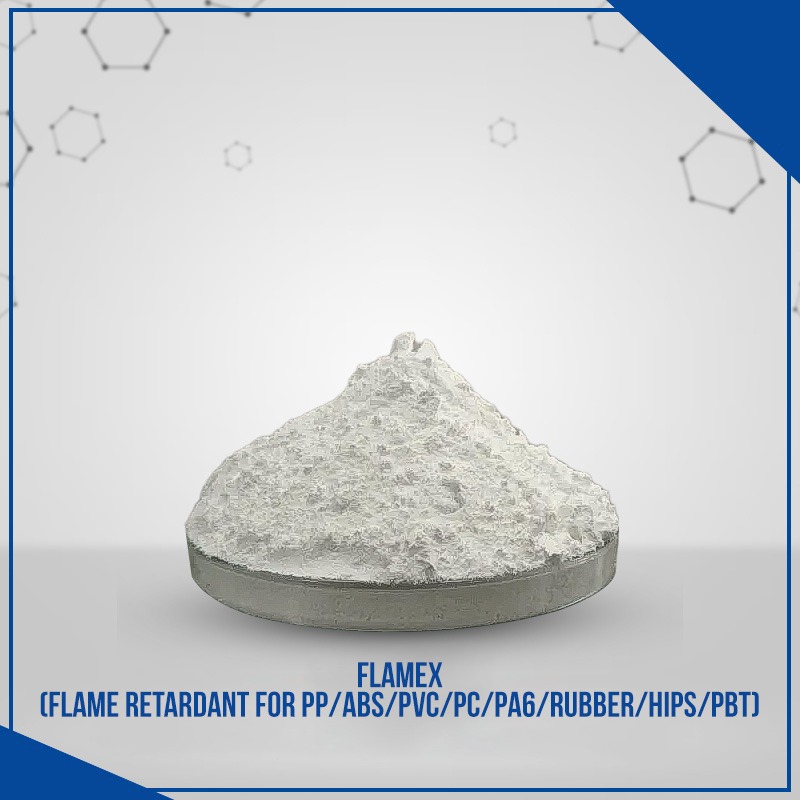 | flame retardant additives Flamex ( Flame Retardant for PP ABS PVC PC PA6 RUBBER HIPS PBT ) FLAMEX ( One Pack Flame Retardant ) manufactured by our company is widely used in PP,PA, PE,PC ,PC/ABS, PVC , Rubber ,PBT, PET, XPS, EPS, PU ,PVC,... View product → |
 | Flame Retardant Filler FAM-501 Flame Retardant Filler FAM-501 FAM - 501 Flame Retardant filler FAM-501 is One Pack Flame Retardant & Smoke Suppressant developed for Plasticized PVC applications. View product → |
Frequently asked questions
What fire performance should you specify before choosing an additive?
Record whether the product must self-extinguish, resist ignition, limit flame spread, reduce heat release or smoke density, control toxic or corrosive gases, and prevent flaming drips. Include resin, thickness, orientation, conditioning, surface finish and mounting geometry.
How do you match a flame retardant additive to a polymer?
Check compatibility with the resin, melt-processing temperature, residence time, shear conditions and additives already in the formulation. Reject options that decompose, volatilise or react within the processing window.
Why use a concentration ladder instead of one universal dosage?
Test a planned series of concentrations because performance, mechanical properties, surface appearance, viscosity and cost change with loading. Select the lowest concentration that meets the defined fire-performance target.
What storage checks matter for additives in Ahmedabad?
Inspect packaging, seals and batch details, then control exposure to heat and humidity. Check moisture pickup before processing and confirm that storage conditions have not caused caking, contamination or degraded dispersion.
What evidence should a supplier provide before approval?
Request test reports tied to your application, including the resin, additive loading, specimen thickness, conditioning method, orientation, mounting geometry and named test method. Generic ratings without these details are insufficient.
Related products
| FAM-501 ABOUT FAM - 501 FAM-501 is One Pack Flame Retardant & Smoke Suppressant developed for Plasticized PVC applications. View product → |
 | Antimony Trioxide Our range of Antimony trioxide is used mainly in flame retardant formulations for plastics, rubbers, textiles, paper and paints. View product → |
 | Zinc Borate ZINC BORATE is a highly effective multifunctional flame retardant synergist being used as a flame retardant and smoke suppressant in a wide range of... View product → |
 | Aluminium Trihydrate (ATH) is a very finely grounded product having a uniform and controlled particle size distribution. View product → |