

An ABS housing can pass a flame test at one wall thickness and fail at another, while the same additive package changes impact strength, flow, colour, smoke and processing stability. You will be able to define the fire target, compare additive chemistries, set a defensible validation plan and identify the supplier data needed before compounding in Ahmedabad.
Key takeaways
- Define the ABS grade, wall thickness, and UL 94 target before selecting additives.
- Compare brominated, phosphorus, and mineral systems by fire performance and trade-offs.
- Control additive loading, drying, mixing temperature, and residence time during trials.
- Test flame, mechanical, appearance, smoke, and electrical results on the same formulation.
Start with the ABS grade, wall thickness and required fire classification
Specify the finished part’s target before choosing a flame-retardant additive: for example, UL 94 V-0 at 1.5 mm, not simply “flame resistant.” V-0 limits afterflame to 10 seconds per application, prohibits flaming drips, and requires the specimen to stop burning before the clamp; a plaque that passes at 3.2 mm can fail at 0.8 mm.
| Grade or design | Why the requirement changes | What to confirm |
|---|---|---|
| Standard ABS for ABS injection moulding | The additive must preserve melt flow, surface finish and dimensional stability through thin gates and ribs. | UL 94 classification at the thinnest molded wall |
| High-impact ABS | A high additive level can reduce impact strength, elongation and weld-line toughness. | Notched-impact retention after molding and conditioning |
| Heat-resistant ABS | The package must survive higher processing and service temperatures without migration, discoloration or loss of flame performance. | UL 94 after heat aging, plus heat-deflection performance |
| ABS extrusion | Residence time, die temperature and shear can change dispersion, viscosity and output stability. | Classification and appearance from the extruded wall thickness |
| Glass-filled ABS | Glass changes flow, stiffness, surface behavior and burning at the fiber-rich surface. | Test the actual glass content, orientation and thickness |
Part geometry matters because vents, cable openings, corners, internal bosses and ignition-source proximity change fire spread. If the component is electrical, add the required glow-wire, hot-wire or IEC 60112 tracking test; UL 94 alone does not establish those results. Specify the exact resin grade, filler level and wall thickness the additive must qualify.
Compare brominated, phosphorus and mineral-based additive systems by trade-off
Choose the chemistry against the required UL 94 class, wall thickness and ABS grade—not a generic “flame-retardant” claim. Injection-moulding, extrusion, high-impact, heat-resistant and glass-filled ABS can respond differently at the same loading.
| System | Strength | Trade-off to check |
|---|---|---|
| Brominated flame retardant + antimony trioxide | Efficient gas-phase action; a practical route to thin-wall UL 94 V-0 | More package can reduce impact strength, heat-aging margin, colour stability and melt flow. Confirm PBB/PBDE limits for RoHS markets. |
| Phosphorus-based | Can reduce reliance on bromine and antimony; useful for halogen-free ABS specifications | It is not a drop-in replacement. Higher loading, viscosity change, impact loss or migration under heat and humidity can prevent the same V-0 result. |
| Mineral-based, such as aluminium hydroxide or magnesium hydroxide | Low-halogen or halogen-free route with no organic bromine | High loading can raise density, reduce elongation and impact strength, dull the surface and restrict flow. Decomposition temperature must suit ABS processing. |
Treat red phosphorus as a specific formulation choice, not proof that a compound is safer or low-smoke. Define restricted elements and analytical limits for halogen-free ABS, then test smoke, corrosion and mechanical retention.
For parts contacting coatings, adhesives or electronics, compare a low-migration or polymer-bound additive through extraction, blooming and post-aging tests. Include recycled ABS as a separate qualification: unknown legacy additives and thermal history can change colour, impact, smoke and UL 94 results.
Set loading and compounding controls before you run the first trial
Lock the ABS grade, additive chemistry and target loading before changing screw speed or mould temperature. A high-impact grade may preserve toughness better than a general-purpose grade; extrusion, heat-resistant and glass-filled grades need separate trials because their melt flow, fibre orientation and heat history change the result.
- Define the flame-retardant loading as phr, where 100 parts means 100 parts of ABS resin. Screen a supplier-approved starting window, such as 10, 15 and 20 phr, rather than transferring a loading from HIPS or polypropylene. Record the resulting weight percent because fillers and synergists alter the calculation.
- If using a masterbatch, record its active concentration and masterbatch let-down ratio. A 20% let-down of a 50% active masterbatch supplies 10% active additive; it is not 20 phr of active chemistry.
- Set the brominated additive-to-antimony trioxide ratio, smoke-suppressant level and pigment package as fixed variables. Increasing the package can lower impact strength, elongation, heat-deflection margin and colour stability while increasing density or melt flow.
- Specify ABS drying and processing controls: drying temperature and time, maximum pellet exposure, cylinder-temperature window, mould temperature, screw speed and maximum residence time. Moisture causes splay and bubbles; excessive residence can darken the compound or reduce effectiveness. Validate the additive supplier’s limits against the ABS resin supplier’s limits.
- Keep virgin and recycled ABS separate. Recycled feedstock needs independent checks for UL 94, impact, colour, smoke and restricted substances because its prior additives and thermal history are unknown.
Retain a control plaque from unmodified ABS and record batch numbers, moisture, torque, melt pressure and part weight for every trial.
Validate mechanical, appearance, smoke and electrical performance together
A V rating from a plaque is only a screening result. Mold the ABS component at its production wall thickness, using the intended gate, weld lines, molding temperature, residence time and regrind percentage, then test parts from the actual process window.
| Test | What it reveals | Finished-part check |
|---|---|---|
| UL 94 V-0, UL 94 V-1, UL 94 V-2 | Afterflame, afterglow and dripping | Test thin walls, ribs, corners and weld lines, not only flat plaques |
| UL 94 5VA 5VB | Higher ignition and surface-burning resistance | Expose the enclosure face, vent region and cable-opening area |
| ASTM D256, ASTM D638 and ASTM D648 | Impact, tensile retention and heat-deflection margin | Compare flame-retardant parts with unmodified ABS after heat aging |
| ASTM E662 or ISO 5659-2 | Smoke density, separate from flame rating | Test the selected smoke-suppressant package in the final colour and thickness |
| IEC 60695 glow-wire tests and IEC 60112 CTI | Ignition resistance and tracking behavior | Test terminals, bosses and surfaces near energized components |
Check colour, gloss, surface deposits and dimensional change after molding and aging. A brominated package that reaches UL 94 V-0 can still reduce impact strength, alter melt flow or produce blooming; extraction and post-aging checks expose that failure.
Request results for the exact ABS grade and thickness, including parts with weld lines and production regrind. A passing UL 94 result does not prove compliance with glow-wire, hot-wire or tracking requirements, and it does not predict smoke from an assembled enclosure.
Use supplier documentation and local handling controls to make the formulation repeatable
Request a technical data sheet for the exact additive grade, plus its safety data sheet, certificate of analysis and change-notification policy. The technical data sheet should state recommended ABS grades, particle size, bulk density, moisture specification, decomposition temperature, compatible synergists and validated loading range.
- Ask for a retained-sample procedure, lot number format and test methods for every certificate of analysis.
- Require molded plaques or parts at your target wall thickness, with the stated UL 94 result and processing window.
- Ask whether the grade has been tested after drying, high-shear compounding, extended residence time and regrind addition.
- For Niknam Chemicals Pvt. Ltd, request this ABS-specific evidence rather than relying on a product name or a generic RoHS statement.
Keep sealed bags or drums in a dry, shaded store away from walls, floor moisture, dust and incompatible chemicals. Ahmedabad’s heat and seasonal humidity make moisture control part of the formulation: record opening dates, reseal unused material, quarantine damaged packs and preserve lot traceability.
Test a formulation again after conditioned storage; humidity and heat can shift impact, blooming and flammability results.
At production, verify additive and ABS moisture against their supplier limits, then use the documented drying temperature and maximum residence time. Do not treat the additive’s decomposition temperature as a molding setpoint. Record hopper-dryer conditions, lot numbers, let-down ratio, melt temperature, residence time and regrind percentage for each batch.
Requalify after any supplier, particle-size, packaging or formulation change.
Related product
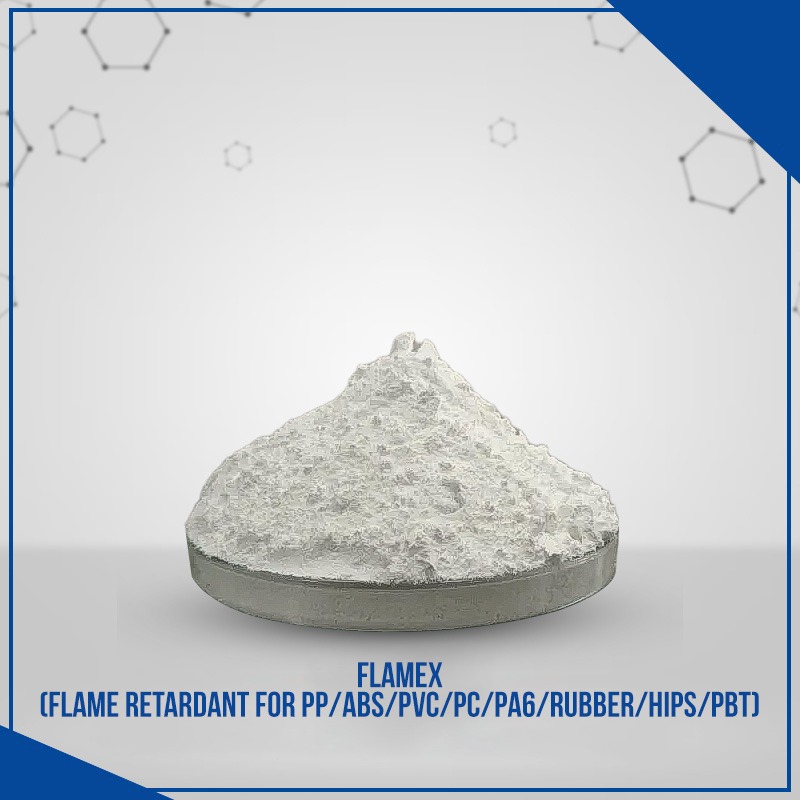 | flame retardant additives Flamex ( Flame Retardant for PP ABS PVC PC PA6 RUBBER HIPS PBT ) FLAMEX ( One Pack Flame Retardant ) manufactured by our company is widely used in PP,PA, PE,PC ,PC/ABS, PVC , Rubber ,PBT, PET, XPS, EPS, PU ,PVC,... View product → |
Frequently asked questions
How do you choose a flame-retardant additive for ABS?
Start with the ABS grade, finished-part wall thickness, and required classification, such as UL 94 V-0 at 1.5 mm. Then compare brominated, phosphorus, and mineral-based systems against mechanical, appearance, smoke, and electrical requirements.
What should you control during the first ABS compounding trial?
Set the additive loading, drying conditions, barrel-temperature profile, screw speed, feed rate, and residence time before processing. Record actual settings and batch details so you can reproduce the formulation.
Which trade-offs matter when comparing brominated, phosphorus, and mineral additives?
Compare each system for required flame classification, loading level, impact and tensile retention, colour and surface appearance, smoke behaviour, electrical properties, processing stability, and handling requirements.
How do you validate an ABS flame-retardant formulation?
Test the target wall thickness for the required fire classification, then evaluate mechanical strength, appearance, smoke, and electrical performance together. Review supplier technical documents and batch records before approving the formulation.