
Choosing a flame-retardant chemical for an Ahmedabad plastics operation requires more than matching an additive to a resin name. You need to balance loading, processing temperature, smoke performance, mechanical properties, moisture exposure and the exact test specimen thickness before approving a formulation or supplier.
Key takeaways
- Match the additive system to polymer polarity, melt temperature, wall thickness and fire test.
- Set loading through trial batches that measure flow, impact strength and flame performance together.
- Compare suppliers using formulation data, processing guidance, test reports and batch traceability.
- Check fire, smoke and compliance results against your exact polymer, thickness and end-use standard.
Match the flame-retardant chemistry to the polymer and process
PP and PE need a system that survives polyolefin processing without destroying impact strength or flow. Select flame retardant chemicals for plastics by polymer polarity, melt temperature, wall thickness and end-use fire test—not by active ingredient alone.
| Polymer | Suitable approach | Process fit and cautions |
|---|---|---|
| PP | Phosphorus-nitrogen intumescent, or magnesium hydroxide at high loading | Injection moulding and extrusion; screen for plate-out, torque and reduced elongation. |
| PE | Intumescent polyolefin system, magnesium hydroxide, or halogen-synergist package | For wire, cable and sheets, check melt flow and mineral dispersion; a PE flame retardant made for one grade may fail in another. |
| PVC | PVC flame retardant additive, with antimony trioxide for selected chlorinated systems | Rigid and flexible compounds need separate plasticiser compatibility checks; control smoke and corrosive gases. |
| ABS | Brominated system with antimony trioxide, or a compatible phosphorus package | Use an ABS carrier; the wrong concentrate can cause stress cracking, gloss loss or poor impact. |
| PC | Phosphorus-based oligomeric or reactive-compatible system | Avoid low-temperature minerals that release water; protect impact strength and transparency. |
| PA6 | Reactive-compatible phosphorus, melamine-based, or mineral-supported system | Dry resin and additive; moisture and poor dispersion quickly reduce strength. |
| PBT | Phosphorus-based system, sometimes with synergists or glass-fibre-compatible chemistry | Validate hydrolysis, flow and fibre interface during injection moulding. |
| Rubber | Aluminium trihydroxide, magnesium hydroxide, or halogen-synergist chemistry | Match the cure system and compression-moulding temperature; high mineral loading can reduce elongation. |
ATH begins significant dehydration near 180–200 °C, while magnesium hydroxide decomposes near 330–350 °C. Qualify the actual resin, carrier, screw setup, colour package and target thickness before production trials.
Set loading levels without sacrificing processability
Start with the lowest flame retardant loading that reaches the required classification, then increase it in measured steps. A mineral flame retardant often needs about 40–65 wt% in the finished compound, depending on the polymer, particle treatment and target result.
Set a phr range that brackets the trial instead of selecting one loading by name alone. Excess loading raises torque, reduces melt flow, weakens the part and roughens the surface.
Control the particle properties as closely as the chemistry:
- Fine particles with a narrow size distribution disperse more evenly and reduce visible surface defects; excessive fines can increase viscosity.
- Surface treatment improves polymer wetting and reduces agglomeration, but an incompatible treatment can reduce adhesion and impact performance.
- Dry, deagglomerated powder prevents voids and unstable feeding. Moisture becomes especially damaging when the additive releases water during processing.
Keep temperature and residence time inside the additive’s usable window. The ATH decomposition temperature 180–200 °C means aluminium trihydroxide can release water too early in a hot melt, causing voids, bubbles or unstable output. Magnesium hydroxide decomposes around 330–350 °C, but its higher required loading still reduces flow and elongation.
Match any masterbatch carrier to the actual resin grade; a polypropylene carrier can disperse poorly in polyamide or polyester. Check torque, melt pressure and moulded surface during the trial, not after production begins.
Choose the right compounding and forming route
A polypropylene masterbatch is not a universal carrier: in polyamide, ABS, PVC or polyester it can disperse poorly, cause plate-out, stress cracking or reduce impact strength. Trial flame retardant compounding with the production resin, colour package, screw layout and target wall thickness, not with a laboratory substitute.
- Dry hygroscopic resins such as PA6, PBT and some ABS to the supplier’s moisture limit. Dry mineral fillers and concentrates when moisture could create bubbles, voids or silver streaks.
- Feed the carrier and flame retardant through a gravimetric feeder; side-feed high mineral loads after polymer melting. Premix only when it does not cause dust segregation.
- Use distributive mixing for uniform additive concentration and enough dispersive mixing to break agglomerates. Excessive shear, melt temperature or residence time can degrade the polymer or additive.
- Check torque, die pressure, strand appearance and ash dispersion before approving the batch. ATH begins significant dehydration near 180–200 °C; magnesium hydroxide decomposes near 330–350 °C but often needs 40–65 wt%, reducing flow and toughness.
| Route | Addition and dispersion | Main processing control |
|---|---|---|
| Injection moulding | Compound pellets first; use a moderate-shear screw and dry the resin | Avoid long residence time, gate blockage and burn marks |
| Extrusion; wire and cable compounds | Twin-screw compound, then strand or underwater pelletise; side-feed high filler | Control moisture, torque, die pressure and surface roughness |
| Sheets and films | Use a finely dispersed, low-agglomerate concentrate | Excess filler causes haze, pinholes, weak welds and tear loss |
| Foams | Compound before foaming and verify nucleation compatibility | Water release or poor dispersion creates voids and unstable cell size |
| Compression moulding | Blend uniformly, preform or pelletise, then charge the mould consistently | Uneven loading produces local burn-through and variable thickness |
Qualify suppliers with formulation data, not product names
Do not approve a trial from a product name or active-content percentage alone. Ask every flame retardant supplier Ahmedabad manufacturers consider for data tied to your resin grade, wall thickness, processing temperature and target fire classification.
1. Request a technical data sheet and certificate of analysis showing active content, particle-size distribution, bulk density, moisture specification, ash, thermal stability and lot-to-lot limits. Fine particles can improve dispersion but raise viscosity and dust; agglomerates create weak points and inconsistent burning.
2. For a concentrate, demand masterbatch carrier compatibility with the actual polymer. A polypropylene carrier can disperse poorly in PA6, ABS, PVC or polyester, causing plate-out, stress cracking or impact loss. Ask for recommended let-down ratio, colour-package interactions and dispersion photographs or microscopy.
3. Obtain processing guidance: drying temperature and time, addition point, screw type, kneading-zone location, maximum melt temperature, residence-time limit and torque expectation. Request water-resistance results after conditioning for ammonium-polyphosphate systems, not only an initial UL 94 result.
4. Require formulation-level evidence at the proposed loading, including tensile strength, impact, elongation, melt flow, surface appearance, smoke and repeat fire-test results. For ATH or magnesium hydroxide systems, check whether the formulation uses roughly 40–65 wt% mineral and whether filler moisture or coupling treatment changes the result.
Niknam Chemicals Pvt. Ltd can be assessed on the same evidence: request a resin-specific trial formulation rather than accepting a broad polymer-use list. For antimony trioxide, confirm the halogen system, smoke controls, density increase and regulatory documentation because it is a synergist, not a standalone solution.
Related products
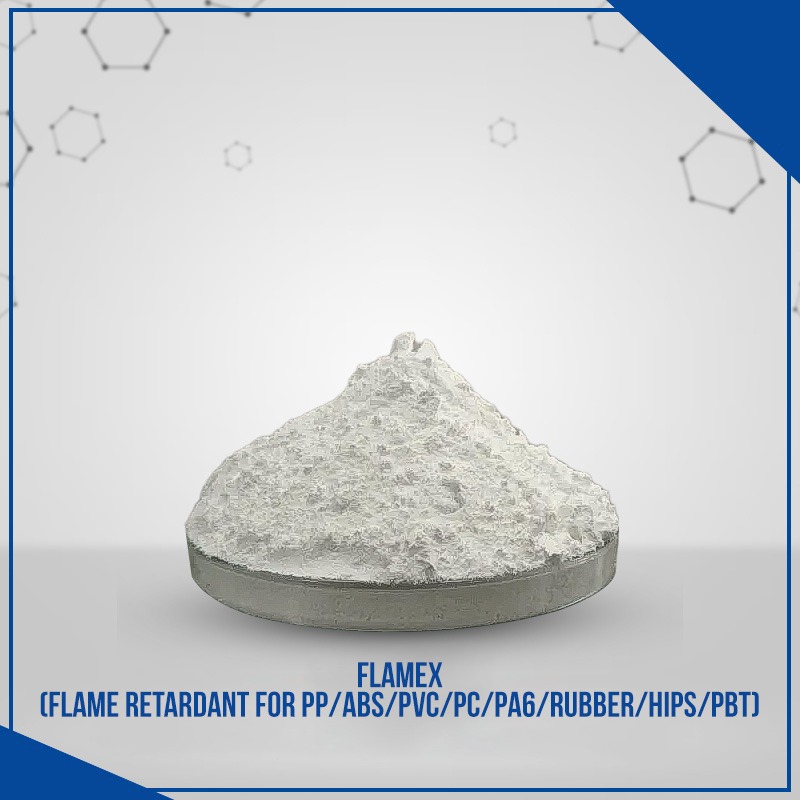 | flame retardant additives Flamex ( Flame Retardant for PP ABS PVC PC PA6 RUBBER HIPS PBT ) FLAMEX ( One Pack Flame Retardant ) manufactured by our company is widely used in PP,PA, PE,PC ,PC/ABS, PVC , Rubber ,PBT, PET, XPS, EPS, PU ,PVC,... View product → |
 | Flame Retardant Filler FAM-501 Flame Retardant Filler FAM-501 FAM - 501 Flame Retardant filler FAM-501 is One Pack Flame Retardant & Smoke Suppressant developed for Plasticized PVC applications. View product → |
Read fire, smoke and compliance results correctly
A single UL 94 V-0 result proves only that a specified specimen met vertical-burning limits at a stated thickness. It does not prove low smoke, low heat release, ignition resistance, ageing stability, or approval of a finished cable, appliance, vehicle or building component.
| Test | What it tells you | What it does not prove |
|---|---|---|
| UL 94 V-0 | Afterflame time, flaming drips and vertical-burning behaviour | Real-fire heat release, smoke toxicity or assembly compliance |
| Limiting oxygen index ISO 4589-2 | Minimum oxygen concentration that sustains candle-like downward burning | UL 94 V-0 performance, ignition resistance or heat-release rate |
| ASTM E662 smoke density | Specific optical density under flaming and non-flaming conditions | Toxicity, corrosivity or acceptability for a building, transport or electrical product |
| ISO 5660-1 cone calorimetry | Ignition time, peak and total heat release, mass loss and smoke-related data under a stated heat flux | Compliance with an end-use standard by itself |
Use ISO 5660-1 cone calorimetry to compare formulations exposed to a defined radiant heat source; a good UL 94 V-0 rating can still accompany an undesirable peak heat-release rate. Treat smoke as a separate qualification: “halogen-free” does not mean low-smoke or non-toxic, and ASTM E662 smoke density does not establish toxicity.
Fix the product standard before choosing chemistry. Your test plan may also need glow-wire performance, electrical properties, ageing, toxicity, heat release or sector-specific BIS, UL or IEC requirements. Test the final thickness, colour, processing history and assembly, not only a laboratory plaque.
Frequently asked questions
How do you match flame-retardant chemistry to a plastic polymer?
Start with polymer polarity, melt temperature, wall thickness and the required end-use fire test. A system suitable for polar engineering plastics may not disperse or perform well in PP or PE.
How can you set flame-retardant loading without losing processability?
Run controlled trial batches and measure melt flow, impact strength, dispersion and fire performance at each loading. Stop increasing dosage when processing losses outweigh the fire-test improvement.
Which processing route should you use for flame-retardant plastics?
Select compounding and forming conditions that provide uniform dispersion without excessive heat history. Review extrusion, injection moulding or other route-specific temperature, shear and residence-time limits.
What should you request from a flame-retardant chemical supplier?
Request formulation data, recommended loading ranges, polymer compatibility, processing limits, fire and smoke test reports, safety documents and batch traceability—not only a product name.
How should you interpret fire, smoke and compliance results?
Check the test method, specimen thickness, polymer grade, additive loading and conditioning details. Results apply only when those conditions match your component and required standard.
Related products
| FAM-501 ABOUT FAM - 501 FAM-501 is One Pack Flame Retardant & Smoke Suppressant developed for Plasticized PVC applications. View product → |
 | Antimony Trioxide Our range of Antimony trioxide is used mainly in flame retardant formulations for plastics, rubbers, textiles, paper and paints. View product → |
 | Zinc Borate ZINC BORATE is a highly effective multifunctional flame retardant synergist being used as a flame retardant and smoke suppressant in a wide range of... View product → |
 | Aluminium Hydroxide ALUMINIUM HYDROXIDE is a Super Fine Precipitated Special ATH. View product → |