
A flame-retardant package is only suitable when it matches the polymer, processing temperature, part geometry and fire test that govern the finished application. By the end, you will be able to compare ATH, magnesium hydroxide, synergists and one-pack systems, define a useful supplier specification, and identify evidence that supports a real performance claim.
Key takeaways
- Define the finished part’s ignition, electrical, mechanical and service-temperature risks first.
- Match flame-retardant chemistry to the polymer, processing temperature and residence time.
- Control loading, dispersion and compounding before comparing trial results.
- Require fire-test evidence from parts matching your final thickness and design.
Define the application before choosing a flame-retardant chemical
High-performance plastics qualify when the finished part must retain electrical, mechanical, dimensional or fire performance under demanding service conditions. Identify the part before selecting chemistry: an electrical enclosure, cable insulation, connectors, appliance housing, transport interior or structural component each faces a different ignition and failure risk.
| Part | Performance target | Evidence to define |
|---|---|---|
| Electrical enclosures | Self-extinguishing after ignition; limited dripping | UL 94 V-0, V-1 or V-2 at the moulded wall thickness; use 5VA or 5VB when plaque burning and penetration matter |
| Cable insulation | Flame resistance without unacceptable smoke or loss of insulation | Cable-specific flame-spread or bundle test, limiting oxygen index and smoke or heat-release data; a plastic-coupon UL 94 rating is not cable-bundle proof |
| Connectors | Flame extinction, glow-wire resistance and dimensional stability | UL 94 rating plus IEC 60695-2-12 glow-wire flammability index or IEC 60695-2-13 glow-wire ignition temperature |
| Railway interiors or structural parts | Controlled flame spread, smoke and toxicity | The applicable EN 45545-2 hazard level and product category, not merely a UL 94 V-0 claim |
Record the target wall thickness, resin grade, colourant, glass-fibre content, moulding history and test orientation. UL 94 results change with these variables, and the rating does not specify smoke toxicity, room-scale flame spread or heat release. Treat those as separate performance targets.
For high-performance plastics, also set mechanical and processing limits: impact strength, tensile strength, dielectric insulation, surface appearance, maximum melt temperature and residence time. A formulation that passes a small plaque test but warps the connector, weakens cable insulation or loses dielectric strength does not meet the application.
Match the chemistry to the polymer and processing window
Choose the chemistry that survives your polymer’s processing temperature without sacrificing flow, impact strength or the required fire result.
| Option | Processing and polymer fit | Choose it when |
|---|---|---|
| ATH (aluminium trihydrate) | Decomposes at roughly 180–220 °C and releases about 34.6% chemically bound water | Use it in lower-temperature PVC, EVA or polyolefin systems with controlled residence time |
| Magnesium hydroxide (MDH) | Decomposes around 300–340 °C; higher loading can reduce melt flow, elongation and impact strength | Use it for higher-temperature polyolefin or engineering-thermoplastic processing |
| Antimony trioxide | Gas-phase synergist used with halogen donors; it is not a complete flame-retardant system alone | Choose it when a halogenated package meets the fire target and smoke, corrosion and regulatory constraints |
| Halogen-free phosphorus/nitrogen package | Can change dripping, afterglow, smoke and required loading compared with a halogenated system | Use it when RoHS, customer policy, smoke or end-of-life requirements rule out the incumbent package |
| Char or smoke-control approach | Zinc stannate, zinc hydroxystannate, molybdates and selected metal oxides affect smoke or char differently by polymer | Add it when smoke density or heat release matters beyond a UL 94 rating |
Treat “halogen-free” as a specification, not a guarantee. EU RoHS limits PBB and PBDE to 0.1% in homogeneous materials within scope; bromine or chlorine can still enter through pigments, recycled content or the base polymer.
Validate every substitution in the finished polymer—PP, ABS, PVC, PC, PA6, PBT or rubber—with the target thickness and processing residence time. A UL 94 pass does not prove low smoke.
Set loading, dispersion and compounding controls before trials
Start trials with a formulation window, not a single dosage. Flame-retardant loading must be high enough to meet the fire target, but excess mineral or phosphorus additive raises melt viscosity, torque and density while reducing impact strength, elongation and weld-line strength.
1. Set a low, nominal and high loading for the chosen polymer grade, then record torque, melt pressure, tensile strength, impact strength and UL 94 results at each point. Do not transfer a loading from ABS to PA6, PBT or polypropylene without testing.
2. Control moisture before compounding. Dry hygroscopic polymers and moisture-sensitive additives to documented limits, use sealed storage, and record Karl Fischer or loss-on-drying results. Water can create voids, hydrolyse polyamides or polyesters, and cause colour and mechanical variation. Encapsulated red phosphorus needs specified moisture protection and storage conditions.
3. Specify median particle size, particle-size distribution and surface treatment. Fine, treated mineral hydroxide disperses more evenly and can retain strength at the same fire rating, while agglomerates weaken weld lines and create local failure points. Check dispersion in a polished microtome section, not by appearance alone.
4. Lock the processing temperature, residence time, screw configuration and feed sequence before comparing grades. Excessive shear can damage sensitive packages, while insufficient shear leaves agglomerates.
Keep ATH below sustained exposure to its roughly 180–220 °C decomposition range, and record the synergist ratio because changing antimony trioxide or a phosphorus/nitrogen balance can alter dripping, afterglow, smoke and corrosion.
Require test evidence that represents the finished part
A UL 94 V-0 result on a 1.5 mm plaque does not prove that a 0.8 mm connector will self-extinguish. Require specimens moulded from the production polymer grade, colour, glass-fibre level, additive loading and processing history, at the finished-part thickness.
Request the test configuration and raw observations: conditioning, orientation, ignition source, specimen dimensions, number of specimens, afterflame and afterglow times, flaming drips, penetration and failures. UL 94 results can change with thickness, moulding history, resin grade and specimen direction; “UL 94 compliant” alone is insufficient.
Your evidence package should include:
- UL 94 V-0, V-1 or V-2 results for the exact thickness and orientation. Treat the rating as a material screen, not proof of room-scale flame spread, smoke toxicity or cable-bundle performance.
- IEC 60695-2-12 glow-wire flammability index and IEC 60695-2-13 glow-wire ignition temperature, with the applied temperatures, specimen thickness and failure observations.
- Cone calorimeter results at a stated heat flux and conditioning state, including peak heat-release rate, total heat release, time to ignition, effective heat of combustion and smoke-production rate.
- The application test when it governs acceptance: FMVSS No. 302 for vehicle interiors, or the applicable EN 45545-2 hazard level and product category for railway components.
- Results linked to the batch, formulation, additive loading, moisture and specimen preparation used in production.
Compare suppliers only when thickness, heat flux, conditioning and reporting basis match.
Build a procurement specification for Manesar production
Approve a grade only against a written acceptance sheet. A certificate saying “flame retardant” or “UL 94 compliant” cannot control variation between lots, polymers or moulding conditions.
- State the resin grade, glass-fibre content, intended additive loading range and maximum melt temperature. Include the exact fire-test specimen thickness, colour, conditioning procedure and moulding history.
- Request a moisture specification in percent, the test method, packaging format and maximum storage time. Tight limits matter for polyamides and moisture-sensitive red-phosphorus systems.
- Specify particle-size distribution, surface treatment, ash or active-content method, colour value and permitted lot-to-lot variation. Ask for representative retained-sample data, not only a typical value.
- Require batch traceability from certificate of analysis to drum, production date and raw-material lot. Reject documents that identify only a product family.
- Request test reports using your resin and loading, including UL 94 classification at the specified thickness. For engineering decisions, compare cone-calorimeter peak heat-release rate, total heat release, time to ignition and smoke-production rate under identical heat flux and conditioning.
- Obtain the current substance declaration, SVHC status and REACH compliance basis, including any exemption or authorization supporting a restricted substance. An SDS alone does not establish this.
- Record storage, handling and compounding limits, including encapsulation for red phosphorus and residence-time controls.
A Manesar chemical supplier such as Niknam Chemicals Pvt. Ltd should be evaluated on this evidence package, not on a catalogue name. For ATH grades, check that the process stays clear of its approximate 180–220°C decomposition range.
Related products
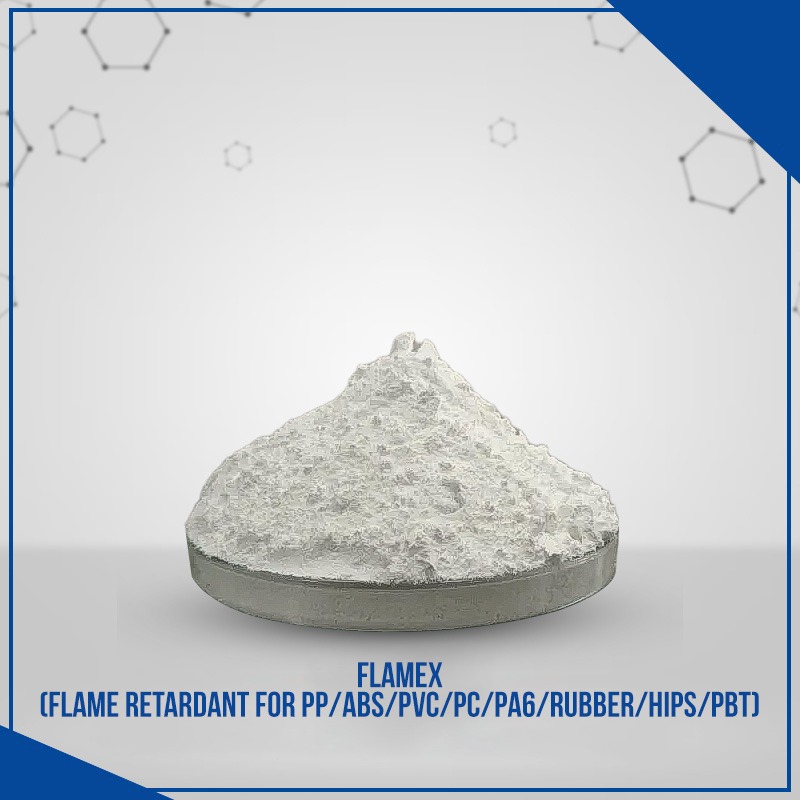 | flame retardant additives Flamex ( Flame Retardant for PP ABS PVC PC PA6 RUBBER HIPS PBT ) FLAMEX ( One Pack Flame Retardant ) manufactured by our company is widely used in PP,PA, PE,PC ,PC/ABS, PVC , Rubber ,PBT, PET, XPS, EPS, PU ,PVC,... View product → |
 | Flame Retardant Filler FAM-501 Flame Retardant Filler FAM-501 FAM - 501 Flame Retardant filler FAM-501 is One Pack Flame Retardant & Smoke Suppressant developed for Plasticized PVC applications. View product → |
Frequently asked questions
How do you choose a flame-retardant chemical for a high-performance plastic?
Define the finished part first, including its polymer, thickness, ignition risk, service temperature and required electrical or mechanical performance. Then compare chemistries compatible with that application.
Why must flame-retardant chemistry match the polymer and processing window?
Different polymers and additives tolerate different temperatures, residence times and shear conditions. Check thermal stability, migration, moisture sensitivity, viscosity effects and compatibility before compounding.
What controls should be set before a flame-retardant trial?
Specify additive loading, drying conditions, feeder accuracy, dispersion method, screw configuration, melt temperature, residence time and sampling procedure before running the trial.
What fire-test evidence should a plastics buyer request?
Request results from finished parts that match the production polymer, additive loading, thickness, geometry and processing conditions. Do not rely only on powder-level data or tests on unrelated plaques.
Related products
| FAM-501 ABOUT FAM - 501 FAM-501 is One Pack Flame Retardant & Smoke Suppressant developed for Plasticized PVC applications. View product → |
 | Antimony Trioxide Our range of Antimony trioxide is used mainly in flame retardant formulations for plastics, rubbers, textiles, paper and paints. View product → |
 | Zinc Borate ZINC BORATE is a highly effective multifunctional flame retardant synergist being used as a flame retardant and smoke suppressant in a wide range of... View product → |
 | Aluminium Trihydrate (ATH) is a very finely grounded product having a uniform and controlled particle size distribution. View product → |