
A polypropylene enclosure, connector housing, battery part or vehicle component needs more than an additive name: its flame target depends on wall thickness, resin grade, reinforcement, processing route and conditioning. By the end, you will be able to compare halogenated and halogen-free systems, set a realistic starting loading, define compounding controls and ask for evidence that applies to your finished part.
Key takeaways
- Specify the component test standard, thickness, colour and end-use conditions.
- Compare halogenated, mineral and intumescent systems against smoke, cost and processing limits.
- Set additive loading through trials; do not transfer a formulation certificate to the molded part.
- Inspect moisture, dispersion, colour, dimensions and flame-test records before approval.
Which polypropylene components need flame retardancy, and what must the specification say?
Electrical enclosures, terminal blocks, connector housings, switchgear covers, appliance components, battery trays and covers, charging-equipment parts, under-hood vehicle components and protective housings are industrial polypropylene components that commonly need flame performance. A formulation certificate is not approval of a tested compound, and a tested compound is not approval of the molded component.
Turn “flame-retardant PP” into a qualification brief that states:
- Resin form: PP homopolymer, PP random copolymer, PP impact copolymer, talc-filled PP, calcium-carbonate-filled PP or glass-fibre-reinforced PP.
- Exact wall thickness, colour, reinforcement level, recycled-content percentage, molding process, conditioning and end-use environment.
- Required result: UL 94 V-0, V-1 or V-2 at the specified thickness under IEC 60695-11-10; glow-wire testing under IEC 60695-2-11; or the named automotive or electrical customer specification.
| Resin or construction | What changes | Qualification risk |
|---|---|---|
| PP homopolymer | Higher stiffness and simpler baseline | Thin walls can fail despite a thicker plaque passing |
| PP random copolymer | Better clarity and impact balance | Additive compatibility and colour require checking |
| PP impact copolymer | Better impact resistance | Flame performance can shift with rubber phase |
| Talc-filled PP | Higher stiffness and dimensional stability | Melt flow, impact and char behaviour change |
| Calcium-carbonate-filled PP | Lower cost and altered density | Polymer-to-additive ratio can reduce performance |
| Glass-fibre-reinforced PP | High strength and heat resistance | Fibres can create flame-propagation paths |
UL 94 is a small-flame screening test, not proof of heat-release rate, smoke toxicity, flame spread or large-assembly fire behaviour. Requalify after changes to resin, pigment, additive lot, recycled content, wall thickness or molding conditions.
How do halogenated, mineral and intumescent systems change the PP trade-offs?
A halogenated flame retardant usually delivers flame inhibition at lower loading than a mineral package, preserving melt flow and reducing density. The trade-off is a separate review of smoke, combustion-product corrosion, colour stability, customer restrictions, recycling compatibility and the need for an antimony compound synergist.
| Option | Main trade-off | Effects to check |
|---|---|---|
| Halogenated | Lower loading and better flow | Smoke, corrosivity, colour, restrictions and recyclability |
| Mineral | Halogen-free PP with high loading | Density, flow, impact strength and elongation |
| Intumescent | Lower loading through protective char | Moisture, dispersion, residence time and surface quality |
Aluminium trihydrate releases water near typical PP processing temperatures, so it can generate voids or surface defects during molding. Magnesium hydroxide tolerates higher temperatures but often needs roughly 50–60 wt%, increasing density while reducing melt flow, impact strength and elongation.
Intumescent systems combine an acid source, carbon source and blowing source; ammonium polyphosphate commonly supplies the acid source. Poor drying, excessive residence time or poor dispersion can cause discoloration, gas generation, rough surfaces and lost flame performance.
Flame retardancy is not the same as smoke suppression. Zinc borate, molybdate compounds, metal oxides and mineral fillers can support char formation or reduce smoke without automatically improving UL 94, and they may alter colour, viscosity or impact performance.
Check these outputs on the selected PP grade and molded geometry:
- Tensile strength, impact strength and elongation, including weld lines and low-temperature conditioning.
- Density and melt flow after compounding.
- Colour stability, surface quality and recycling compatibility.
- UL 94 performance separately from smoke and combustion-product data.
What loading and processing route suit the component?
Do not set flame-retardant loading from a 3.0 mm plaque alone. Fix the supplier, PP grade, target test and part thickness first, then confirm an illustrative starting range in weight percent with the supplier.
| Option | Starting window after confirmation | Main trade-off |
|---|---|---|
| Halogenated package | 5–15 wt% | Lower loading and better flow; review smoke, corrosion, colour and recycling |
| Magnesium hydroxide | 50–60 wt% | Halogen-free route; higher density, lower flow, impact and elongation |
| Intumescent package | 15–30 wt% | Lower mineral burden; requires compatible acid, carbon and blowing sources, with tight moisture and thermal control |
A formulation that passes at 3.0 mm can fail in a thin rib or clip because flame-retardant loading changes the polymer-to-additive ratio. Melt flow falls, filling becomes harder, weld-line strength declines, and screw and barrel wear increases. Test impact and elongation on the actual geometry or a representative thin plaque.
Use injection molding or extrusion only within the PP grade’s melt-processing window. Treat ATH with special caution because it releases water near PP processing temperatures. For every ammonium-polyphosphate system, document maximum thermal exposure, including residence time and shear. Compression molding needs separate cure, residence-time and surface checks; masterbatch production needs carrier-resin compatibility and dispersion checks.
Build the trial matrix around:
- Loading, melt flow and density
- Tensile strength, impact and elongation
- Plaque thickness, ribs, clips, weld lines and molded-part performance
- Screw torque, pressure, surface quality and dimensional stability
How should you compound, dry and inspect flame-retardant PP?
A sound compounding procedure preserves the laboratory formulation through feeding, melting and molding; poor dispersion can turn a passing plaque into a failing component. Use dry blending only after checking powder flow, particle-size compatibility and segregation risk.
- Feed PP pellets through the main loss-in-weight feeder. Add carrier resin there when it is a compatible pellet or masterbatch.
- Premix flame retardant, synergist and pigment, then use a powder loss-in-weight feeder or side feeder after the PP has melted. Add a solid processing aid with this premix; inject a liquid aid downstream through a metered port.
- Keep the twin-screw sequence consistent: PP and carrier at the throat, powders after melt formation, then downstream processing aid before vacuum venting. Do not side-feed powders into an unmelted polymer bed.
- Use separate calibrated feeders for powders and pellets when bulk density or flow differs; feeder bridging causes fluctuating additive concentration.
| Carrier-resin masterbatch | Benefit | Risk |
|---|---|---|
| Compatible PP carrier | Stable feeding and less dust | Adds dilution and a second melt history |
| Incompatible carrier | Easier powder handling | Weakens dispersion, impact or weld lines |
| High-loading masterbatch | Accurate low-rate dosing | Overloads the feeder or limits final formulation |
Dry hygroscopic ingredients and ammonium-polyphosphate-containing systems to the supplier’s documented moisture limit. Record dryer temperature and time, then control the interval from drying to feeding; excessive residence time, shear or heat can generate gas, discoloration, deposits and lost flame performance.
Inspect particle-size distribution, agglomerates, torque and pressure trends, pellet appearance, ash or burn-off, plaque microscopy, weld lines, mold deposits, streaks, bubbles and bloom. Requalify after changing resin supplier, pigment, additive lot, mold temperature, injection speed or recycled content.
How do you qualify a supplier and the finished PP part in Manesar?
Approve a supplier only after you can trace its additive data to the exact PP grade and molded part. A product name, generic formulation certificate or unrelated polymer result is not proof of UL 94 V-0.
1. Request the exact additive identification, recommended loading range, particle-size distribution, surface-treatment details, moisture limit, processing-temperature limit, carrier-resin information and compatibility guidance for the selected PP grade.
2. Require test reports stating specimen thickness, conditioning, colour, reinforcement, molding method, laboratory standard and result. Distinguish a formulation certificate, a tested compound and approval of the finished molded component.
3. For electrical parts, request the applicable glow-wire evidence under IEC 60695-2-10, IEC 60695-2-11, IEC 60695-2-12 or IEC 60695-2-13 when the customer specification requires it. Glow-wire performance is separate from UL 94.
4. Review smoke separately. Read ASTM E662 results with the flaming or non-flaming condition, specimen thickness and optical-density method; do not treat optical smoke density as a universal toxicity ranking or a substitute for component fire testing.
Run the candidate compound in the actual part, including thin walls, weld lines, clips, ribs and gates. Check flammability, smoke, dimensions, impact and appearance after the specified conditioning.
Set requalification triggers for a resin supplier, pigment, additive lot, recycled-content percentage, wall thickness, mold temperature or injection speed change. Niknam Chemicals Pvt. Ltd belongs in this comparison only after it supplies PP-specific formulation and test data for those conditions.
Related product
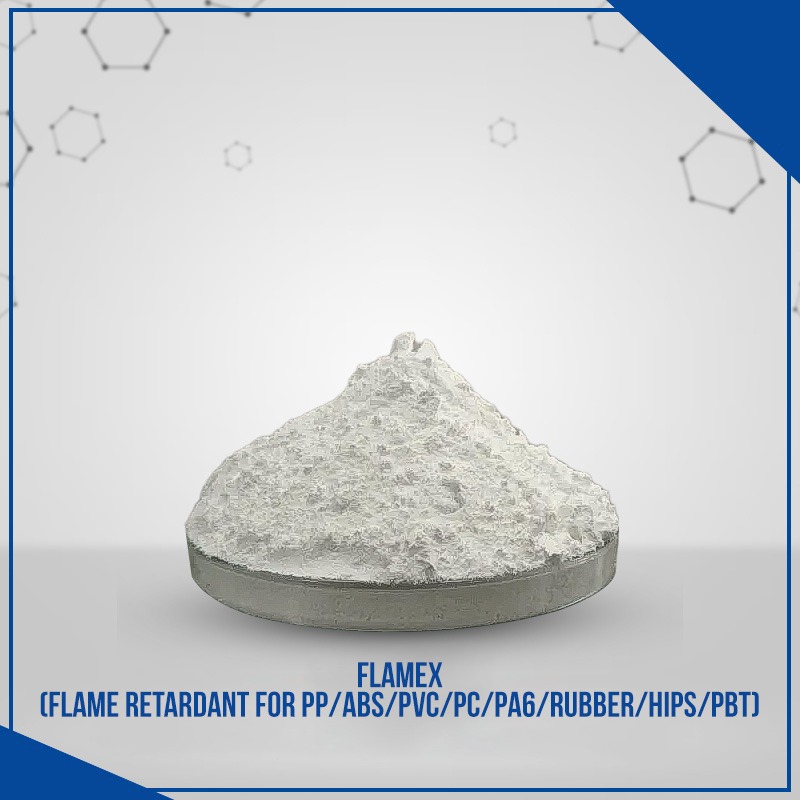 | flame retardant additives Flamex ( Flame Retardant for PP ABS PVC PC PA6 RUBBER HIPS PBT ) FLAMEX ( One Pack Flame Retardant ) manufactured by our company is widely used in PP,PA, PE,PC ,PC/ABS, PVC , Rubber ,PBT, PET, XPS, EPS, PU ,PVC,... View product → |
Frequently asked questions
Which polypropylene components need flame retardancy?
Electrical enclosures, terminal blocks, connector housings, switchgear covers, appliance parts, battery trays, charging-equipment parts, under-hood components and protective housings can require flame performance. Specify the test method, part thickness and acceptance class for the finished component.
How do halogenated, mineral and intumescent systems differ in polypropylene?
Halogenated systems can provide strong flame performance at lower loading but require review of smoke, corrosive gases and regulatory requirements. Mineral systems can improve stiffness and heat resistance while increasing density and affecting impact strength. Intumescent systems form a protective char but demand careful dispersion, loading and processing control.
What should a polypropylene flame-retardant specification include?
State the resin grade, additive chemistry, target loading, colour, part thickness, processing window, required flame test and acceptance class. Include smoke, mechanical, electrical, dimensional and environmental requirements when the application needs them.
How should flame-retardant polypropylene be compounded and inspected?
Control additive feeding, melt temperature, residence time, shear and dispersion during compounding. Dry materials when the supplier's technical data requires it, then inspect moisture, pellet uniformity, colour, contamination, molded dimensions and test records.
How do you qualify a flame-retardant PP supplier and finished part in Manesar?
Request a technical data sheet, safety data sheet, certificate of analysis, batch traceability, recommended processing conditions and test reports. Validate the actual molded part at its thinnest section and confirm that the report identifies the tested material, specimen thickness, method and conditioning.