
Choosing a flame-retardant chemical starts with the polymer, processing temperature and failure mode—not the additive name on a supplier list. By the end, you will be able to narrow the chemistry, set up a practical compounding trial and verify flame, smoke, electrical and mechanical performance before production approval.
Key takeaways
- Match ATH to lower-temperature plastics; use MDH or phosphorus systems for higher melt temperatures.
- Set additive loading, premixing time and extrusion conditions before the first production trial.
- Check moisture, heat history and recycled content because each can change fire performance.
- Test flame, smoke, electrical and mechanical properties before approving an additive package.
Match the flame-retardant chemistry to the plastic and process
PP needs a PP flame retardant that survives its melt temperature: use MDH, phosphorus or an intumescent package when loading, colour and impact retention permit. ATH releases water at about 180–220 °C, so it suits lower-temperature processing, not many high-temperature thermoplastics.
MDH decomposes around 300–350 °C, widening the processing window but increasing cost, density and loading.
| Polymer | Suitable starting approach | Main constraint |
|---|---|---|
| PP | MDH, phosphorus or intumescent | High mineral loading raises viscosity and reduces impact |
| ABS | Halogen–antimony or phosphorus | Colour, density and surface appearance can suffer |
| PVC | Halogen–antimony, zinc borate or molybdenum trioxide | Smoke, plasticiser compatibility and electrical properties |
| PC | Phosphorus or selected nitrogen/phosphorus systems | Hydrolysis, colour and melt stability |
| PA6 | Reactive phosphorus, phosphinate or nitrogen/char system | Drying and mechanical-property retention |
| PBT | Phosphinate, phosphorus or halogen–antimony system | Hydrolysis, flow and glass-fibre interaction |
| Rubber | Mineral, phosphorus or halogen–antimony package | Cure chemistry, flexibility and compression set |
Halogen–antimony systems inhibit flame reactions in the gas phase. Phosphorus and nitrogen chemistries can inhibit vapours or build protective char; intumescents expand into insulating char. Mineral fillers reduce heat release through dilution, while zinc borate and molybdenum trioxide can reduce smoke or strengthen residue. Neither zinc borate nor antimony trioxide is a universal one-for-one replacement.
Choose a one-pack additive when accurate weighing, fast feeding and batch consistency matter more than independent optimisation. Choose a multi-component system when you need control over loading, synergy, colour, density and cost; validate each ratio in the actual process.
Set loading, premixing and extrusion conditions before the first trial
A supplier’s starting dosage is a screening point, not a production recipe. Record the target polymer, additive active content, moisture level, required UL 94 class, and total flame retardant loading for plastics before calculating the let-down ratio.
| Screening point | Purpose | Record at each point |
|---|---|---|
| Low | Check flow and minimum effective loading | Viscosity, die pressure, flow, tensile strength and impact retention |
| Medium | Test performance near the technical-data-sheet starting value | Same process and mechanical results |
| High | Find the performance ceiling and processing penalty | UL 94 result, pressure, dispersion and property loss |
Use a controlled plastic compounding procedure:
- Dry PA6, PBT and hygroscopic phosphorus grades to the supplier’s moisture limit; wet resin causes voids, hydrolysis and unstable flame results.
- Premix powders in a tumble blender, then use gravimetric feeding for repeatable resin-to-additive ratios.
- Add concentrate through a controlled side feed or main feed, matching the let-down ratio to the concentrate’s active content.
- Set screw shear and residence time to disperse particles without damaging encapsulation or overheating phosphorus or nitrogen additives.
- Check dispersion in cut pellets or microscopy, and keep the melt temperature below the additive’s decomposition or volatilisation limit.
High mineral loading raises viscosity, injection pressure, die pressure and mould wear. Particle-size distribution, surface treatment and coupling-agent choice can preserve flow and impact retention; changing only the flame retardant dosage will not solve poor dispersion.
Control heat, moisture and recycling risks at the Manesar plant
Use the Manesar plant’s measured thermal history—not a supplier certificate—as the qualification baseline. Record barrel-zone temperature, melt temperature, screw speed, residence time, back pressure, drying temperature and moisture before comparing results. Set the extrusion temperature for flame retardants below the additive’s degradation or dehydration range.
| Process or risk | Control | Warning sign |
|---|---|---|
| Extrusion and injection | Limit heat and residence time; check melt temperature, screw shear and back pressure | Colour change, gas, plate-out or bloom |
| ATH-filled compound | Keep processing below ATH dehydration, roughly 180–220 °C | Voids, pressure change or lost flame performance |
| Encapsulated additive | Use enough shear for dispersion without breaking the coating | Migration, electrical-insulation loss or uneven burning |
Excessive heat can volatilise or decompose phosphorus and nitrogen additives. Excessive shear can damage encapsulation or alter dispersion, while mineral fillers can raise pressure and mould wear.
For ammonium polyphosphate moisture stability, use sealed storage, dry the material, and test encapsulated or surface-treated grades when humid storage, migration resistance or electrical durability matters; basic or nucleophilic ingredients can destabilise incompatible grades.
Run separate virgin and recycled plastic flame retardant trials. Recycled resin brings prior heat history, contamination, pigment, weld lines and additive carryover that can change flame and smoke results.
Before production release:
- Verify moisture after drying, not only the dryer setting.
- Retain sealed samples with supplier lot, internal batch, machine settings and processing date.
- Repeat checks after recycling and conditioning for bloom, migration and insulation loss.
Build a fire, smoke, electrical and mechanical test plan
An additive certificate does not prove that your moulded part is safe; test the finished formulation at its thinnest and most failure-prone geometry, using production-equivalent resin, pigment, recycled content and weld lines.
- Fire: run UL 94 V-0, V-1 or V-2 at the actual specimen thickness, in the required vertical or horizontal orientation, after recording conditioning temperature, humidity and duration. Record every afterflame time, afterglow time, ignition event and flaming drip. Use IEC 60695-11-10 when its vertical or horizontal method is specified. Run ASTM D2863 LOI to measure the oxygen concentration supporting combustion, but do not treat a high LOI as proof of a UL 94 pass.
- Smoke and fire growth: specify ASTM E662 smoke density and report flaming and non-flaming optical-density results separately. For transport parts, identify the EN 45545-2 hazard level and product category before selecting the acceptance limit. Use a cone calorimeter when small-scale burning hides a trade-off; record time to ignition, peak heat-release rate, total heat release and smoke-production rate.
- Electrical: test comparative tracking index (CTI), dielectric strength, arc resistance and glow-wire performance when the product standard demands them. A vertical-burning pass cannot compensate for tracking or glow-wire failure.
- Durability and mechanics: repeat testing after humidity, heat aging, UV, reflow or soldering, automotive-fluid exposure and extraction. At each thickness, record afterflame, afterglow, dripping, tensile strength, impact, flow and colour. Release the formulation only when the aged, production-representative part meets every applicable limit.
Qualify a supplier and approve the right additive package
Approve a flame-retardant chemical only after comparing documents, processing evidence and finished-part results. Your flame retardant supplier qualification file should identify the polymer, grade, target loading and production machine, not merely the additive name.
Ask each supplier for:
- A technical data sheet, safety data sheet, certificate of analysis for flame retardants, batch number, active-content basis, recommended loading and storage conditions.
- Particle-size distribution, moisture limit, decomposition temperature and maximum processing-temperature guidance.
- The polymer, specimen thickness, orientation, conditioning protocol and test laboratory behind every UL 94 or smoke result. A V-0 result on a thick plaque does not prove V-0 in a thinner ribbed part containing pigment or recycled resin.
- Evidence for smoke suppressant chemicals for plastics, including the test method and whether the result covers flaming, non-flaming or both conditions.
Compare package formats before selecting one for regular production.
| Option | Compare on | Main approval question |
|---|---|---|
| One-pack additive | Dosing error, feeder accuracy, dispersion time, inventory burden | Does simpler feeding outweigh density or cost per finished kilogram? |
| Separate synergists | Loading control, density, inventory, dispersion and aging | Can your feeders hold each component within its tolerance? |
| Either package | Viscosity, impact retention and smoke after aging | Does the finished compound remain compliant after conditioning? |
For Manesar manufacturing industries, run the candidate through the actual extruder or injection machine, recording drying, melt temperature, residence time, screw shear and injection history. Niknam Chemicals Pvt. Ltd can enter that comparison only when its package meets those written criteria. Approve it after a production-representative trial and retained-sample review.
Related products
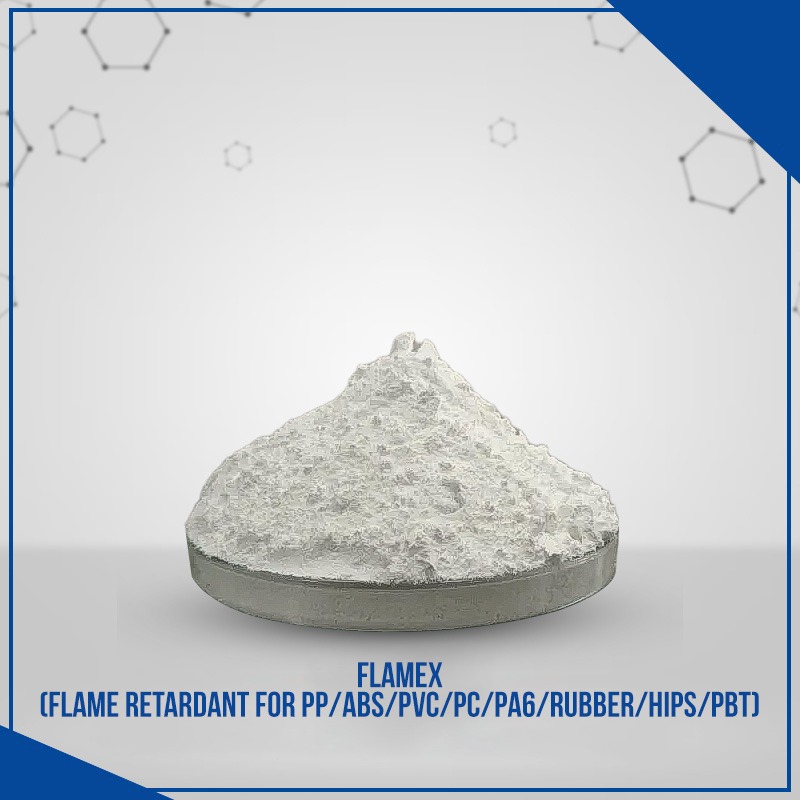 | flame retardant additives Flamex ( Flame Retardant for PP ABS PVC PC PA6 RUBBER HIPS PBT ) FLAMEX ( One Pack Flame Retardant ) manufactured by our company is widely used in PP,PA, PE,PC ,PC/ABS, PVC , Rubber ,PBT, PET, XPS, EPS, PU ,PVC,... View product → |
 | Flame Retardant Filler FAM-501 Flame Retardant Filler FAM-501 FAM - 501 Flame Retardant filler FAM-501 is One Pack Flame Retardant & Smoke Suppressant developed for Plasticized PVC applications. View product → |
Frequently asked questions
How do you match flame-retardant chemistry to a plastic?
Check the plastic’s melt-processing temperature, required loading, colour limits, impact target and smoke requirements. ATH releases water at about 180–220 °C, while MDH, phosphorus and intumescent systems suit different temperature and performance constraints.
What should you set before the first flame-retardant trial?
Define additive loading, premixing procedure, feeder settings, extrusion temperature profile, screw speed and residence time before running the trial.
Which production risks can reduce flame-retardant performance?
Control excessive heat history, moisture and changes in recycled content. These factors can alter dispersion, decomposition behaviour, smoke output and mechanical strength.
Which tests should a plastic flame-retardant programme include?
Plan fire, smoke, electrical and mechanical testing. Select the method according to the finished product, then compare results against its required rating and performance limits.
How should you qualify a flame-retardant supplier?
Request consistent technical data, batch traceability, safety documentation, processing guidance and test support. Approve the complete additive package only after trials confirm fire, smoke, electrical and mechanical performance.
Related products
| FAM-501 ABOUT FAM - 501 FAM-501 is One Pack Flame Retardant & Smoke Suppressant developed for Plasticized PVC applications. View product → |
 | Antimony Trioxide Our range of Antimony trioxide is used mainly in flame retardant formulations for plastics, rubbers, textiles, paper and paints. View product → |
 | Zinc Borate ZINC BORATE is a highly effective multifunctional flame retardant synergist being used as a flame retardant and smoke suppressant in a wide range of... View product → |
 | Aluminium Trihydrate (ATH) is a very finely grounded product having a uniform and controlled particle size distribution. View product → |