

Flame-retardant ABS is a formulation and processing decision, not a matter of adding one chemical to any resin. By the end, you will be able to define the ABS grade, set a trial plan, choose the right automotive or electrical tests, and judge whether supplier data is strong enough for approval.
Key takeaways
- Compare packages at the target ABS grade, wall thickness, colour and moulding cycle.
- Set additive loading, mixing sequence and trial controls before production compounding.
- Keep ABS dry and control melt temperature, residence time and regrind percentage.
- Build a part-level evidence pack linking test results to the Manesar supplier batch.
Match the flame-retardant package to the ABS grade and end use
Start with the ABS resin grade, because the same flame-retardant package can pass in a general-purpose grade and fail in high-impact ABS. Compare candidates at the intended wall thickness, colour and moulding cycle rather than accepting a pellet datasheet rating.
| ABS formulation | Flame-retardant chemistry to compare | Main decision point |
|---|---|---|
| Injection-moulding ABS | Brominated aromatic additive with antimony trioxide | Strong UL 94 performance, but excess antimony can raise density, reduce impact and worsen appearance |
| High-impact ABS | Lower-impact-loss brominated package versus a phosphorus-based system | Compare weld-line strength, not only nominal flame class |
| Electrical ABS | Brominated package versus phosphorus or reactive chemistry | Check CTI under IEC 60112; UL 94 does not replace tracking data |
| Filled ABS or PC/ABS | Package validated for the actual filler or polymer blend | Recheck flow, phase compatibility, colour and flame performance |
| Recycled-content ABS | Additive package versus reactive flame retardant | Test after the planned heat history; migration, volatilisation and nonuniform dispersion can change performance |
Ask for bromine and antimony content, recommended loading, density, melt-flow data and results at the actual part thickness. A flame retardant ABS formulation containing brominated additives also needs substance-specific documentation: EU RoHS limits PBB and PBDE to 0.1% in homogeneous material, but “RoHS-compliant” does not identify the chemistry or cover every jurisdiction.
Do not select a package solely because it reaches V-0. Pigments, recycled resin and mineral synergists can reduce impact or CTI, while glow-wire performance requires separate evidence.
Set loading and compounding controls before the first production trial
Start with a three-point ABS flame-retardant loading matrix, not a single “safe” dose. Screen 10, 15 and 20 weight percent of the complete additive package in the finished compound, including synergists; confirm the supplier’s active-content basis before weighing.
Retain an unmodified ABS control and reject any loading that achieves flame performance only by sacrificing impact, flow or surface quality.
1. Use the same ABS grade, pigment package and pellet moisture target in every batch. Record each ingredient in weight percent, including antimony trioxide, zinc stannate or zinc hydroxystannate, and processing aid.
2. Dry-blend pellets with minor solid additives, then feed the polymer through the main gravimetric feeder. Add a poorly flowing mineral synergist through a calibrated side feeder after the ABS has melted, unless the supplier’s screw design specifies another position.
3. Use twin-screw compounding with enough kneading length for complete dispersion, but avoid excessive shear that raises melt temperature or residence time. Record feeder rates, screw speed, torque, melt pressure and output for every trial.
4. Check dispersion in pellet cross-sections and molded plaques. Look for agglomerates, streaks, black specks, gloss differences and mold plate-out; measure MFR, notched Izod impact and tensile properties against the control.
5. Mold plaques and the intended part at the target thickness and color. Recheck impact, flow and appearance after the planned regrind percentage, because repeated heat history can make additive distribution nonuniform.
Choose the lowest loading that passes the required flame test with stable part-level properties. Excess antimony or mineral synergist can raise density, increase viscosity and weaken toughness.
Control drying, temperature, residence time and regrind
Moisture, melt heat and time in the barrel determine whether a flame-retardant ABS compound survives pelletising and moulding. Use ABS drying at the resin supplier’s specified temperature and duration; 80–85°C for 2–4 hours is a common starting point, but confirm moisture before processing. Wet resin causes splay, bubbles, hydrolysis and erratic flame performance.
| Condition | Control | Failure sign |
|---|---|---|
| ABS drying | Measure moisture after drying; keep hoppers sealed and dry regrind ABS separately | Silver streaks, voids or brittle parts |
| Processing temperature | Many ABS grades run near 230–260°C melt temperature; validate the lowest setting that fills the part | Discoloration, odour, fuming or mould plate-out |
| Residence time | Match shot size to barrel capacity, avoid long idle periods and purge before colour or material changes | Dark specks, viscosity drift or unstable flame results |
| Regrind ABS | Set a documented percentage limit and revalidate after each heat history | Uneven dispersion, lower impact or inconsistent V-0 results |
Keep the screw and die hot enough for complete dispersion, not hotter. Excessive processing temperature or residence time can volatilise additive components, generate corrosive gases and leave deposits on vents or the mould. Inspect vents and parting lines during the trial; blocked vents raise burn marks and short-shot risk.
Treat regrind as a separate formulation input, not as virgin resin. Record its source, number of heat histories, drying cycle and percentage, then test impact, appearance and flame performance at the intended part thickness. Purge the machine after extended stoppages and collect the first stable shots for inspection.
Use the test that matches the automotive or electrical requirement
Choose the test named in the customer or product standard; a UL 94 V-0 result alone does not clear an automotive or electrical part.
| Test | What it measures | Evidence to request |
|---|---|---|
| UL 94 | Vertical burning, including afterflame and dripping classifications such as V-0 | Report for the exact ABS grade, colour and specimen thickness |
| FMVSS 302 | Horizontal burn rate for vehicle interior materials; the limit is 102 mm/min | Automotive interior report identifying the part material and thickness |
| ISO 3795 | Horizontal burning behaviour using an automotive interior-material method | ISO 3795 report, with specimen preparation and burn rate |
| IEC 60695-2-11 glow-wire testing | Ignition and flame behaviour of the finished product exposed to a heated wire | End-product report at the specified wire temperature, thickness and locations |
| CTI under IEC 60112 | Resistance to tracking across a contaminated wet surface | CTI result for the actual compound, colour and moulded surface |
Ask for the complete report, not a datasheet claim: test standard and edition, laboratory, conditioning, specimen thickness, colour, material identification, result and failure observations. For glow-wire, verify the test on the finished geometry; a V-0 plaque cannot prove that ribs, openings or terminals will pass.
For electrical parts, request the product standard’s creepage and clearance requirements alongside CTI data. For automotive parts, request FMVSS 302 or ISO 3795 evidence as specified, not a substituted UL result. Specify smoke density or toxicity testing separately because flame classification does not measure smoke.
Qualify the Manesar supplier with a part-level evidence pack
Approve the ABS formulation only after the supplier links every claim to your moulded part, resin grade, colour and thickness. A datasheet showing V-0 is not enough: loading changes can reduce impact, weld-line strength and melt flow, while a UL 94 result does not prove glow-wire, CTI, smoke or automotive compliance.
1. Request the current technical data sheet, SDS, COA for the offered lot, specification limits, batch traceability and a written composition or regulatory disclosure. The RoHS compliance statement must identify restricted substances, including PBB and PBDE at the 0.1% homogeneous-material limit; “RoHS-compliant” alone does not identify the chemistry or cover every jurisdiction.
2. Obtain sealed additive samples from at least two lots, plus compounded ABS pellets and injection-moulded plaques or production-intent parts. Specify the ABS grade, additive loading, colour, nominal wall thickness, gate design and regrind percentage so the samples represent your process.
3. Require reports on the actual part or matching plaques for UL 94 at each thickness, impact, tensile or weld-line strength, elongation, melt flow, heat ageing, humidity ageing and regrind. Request glow-wire results under the applicable IEC 60695-2-10, -2-11, -2-12 or -2-13 method, and CTI to IEC 60112 where electrical insulation is involved.
4. Ask for separate smoke-density or toxicity data when the customer specifies smoke performance; FMVSS 302 or ISO 3795 does not establish it.
For a Manesar source such as Niknam Chemicals Pvt. Ltd, make lot-specific COA review and part-level trial approval conditions of purchase, not paperwork collected after production starts.
Related products
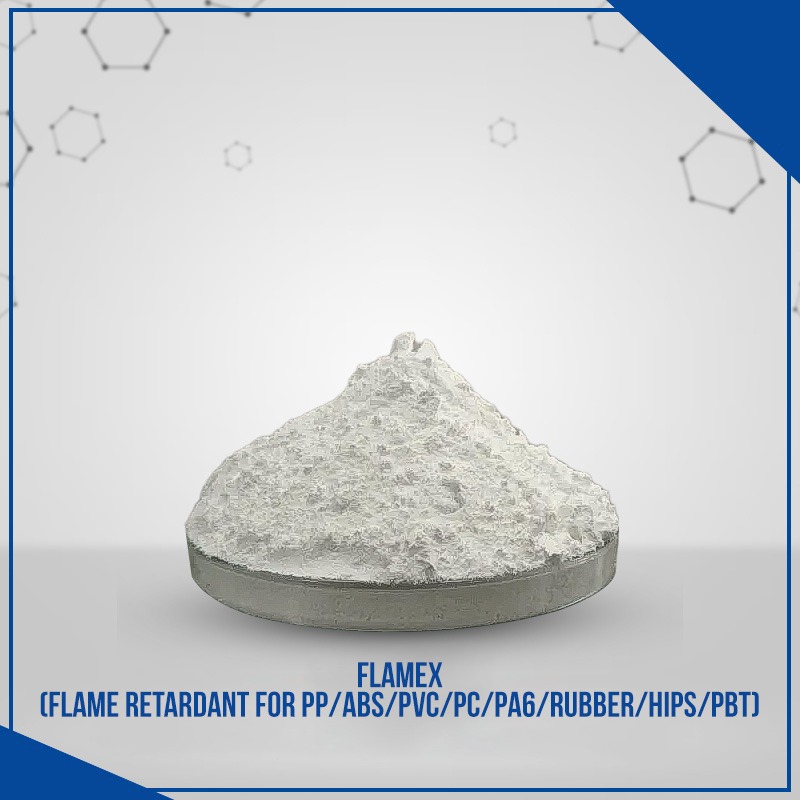 | flame retardant additives Flamex ( Flame Retardant for PP ABS PVC PC PA6 RUBBER HIPS PBT ) FLAMEX ( One Pack Flame Retardant ) manufactured by our company is widely used in PP,PA, PE,PC ,PC/ABS, PVC , Rubber ,PBT, PET, XPS, EPS, PU ,PVC,... View product → |
 | Antimony Trioxide Our range of Antimony trioxide is used mainly in flame retardant formulations for plastics, rubbers, textiles, paper and paints. View product → |
Frequently asked questions
How do you match a flame-retardant package to an ABS grade?
Compare the package in the intended ABS grade, including high-impact or general-purpose resin, target wall thickness, colour and moulding cycle. A rating in one grade does not prove performance in another.
What compounding controls should you set before the first trial?
Define the additive loading, dosing accuracy, mixing sequence, feed rate, screw speed, melt-temperature window and sample plan before the trial. Record the resin and additive batch numbers with each run.
How should you control ABS drying, temperature, residence time and regrind?
Dry ABS to the resin supplier’s specified moisture limit, then keep the melt within the agreed temperature window. Limit residence time and set a documented regrind percentage because moisture, heat history and repeated processing can change performance.
Which tests apply to flame-retardant ABS for automotive and electrical parts?
Use the test named by the end-use specification, such as UL 94 for vertical flammability, glow-wire testing under IEC 60695-2-11 for relevant electrical products, or the vehicle maker’s required part and material tests. Test the finished part at its specified thickness.
What evidence should you request from a Manesar flame-retardant chemical supplier?
Request the technical data sheet, safety data sheet, certificate of analysis, batch traceability, recommended processing conditions and test reports. Link those records to the compounded lot and finished-part results.
Related product
 | Zinc Borate ZINC BORATE is a highly effective multifunctional flame retardant synergist being used as a flame retardant and smoke suppressant in a wide range of... View product → |