
A flame-retardant additive that passes a small laboratory flame test can still fail after extrusion, injection moulding, humidity conditioning or electrical testing. By comparing polymer fit, processing temperature, loading, smoke performance, compliance evidence, supply consistency and total production cost, you can narrow the options before committing to a full qualification run.
Key takeaways
- Match the additive to your resin, melt temperature and required fire test.
- Set loading, processing temperature and dispersion targets before the first trial.
- Compare flame, smoke, mechanical and electrical results on the same formulation.
- Request batch traceability, specifications, test reports and compliance documents from the supplier.
Match the additive to your polymer and Manesar process
Choose the additive family by resin, melt temperature and the fire result you need, not by “halogen-free” or powder cost alone. Flame retardant additive selection starts with polymer compatibility: a package that passes UL 94 V-0 in a rigid specimen can fail in a thin wall, cable insulation or flexible part.
| Family | Best resin and process fit | Fire, smoke and processing trade-off |
|---|---|---|
| ATH or magnesium hydroxide | Polyolefin cable compounds, EVA and some rubber systems; extrusion compounding in Manesar | High loading can reduce tensile strength, raise viscosity and abrade screws; check endothermic-release temperature against the melt profile |
| APP-based intumescent | Polypropylene, polyamide and selected coatings; injection moulding or extrusion | Requires an intact acid-source, carbon-source and blowing-agent char; specify moisture resistance, particle size and surface treatment |
| Phosphorus or phosphorus-nitrogen | Polyamide, polyester and engineering thermoplastics | Efficient loading can support UL 94 V-0, but smoke, migration, electrical loss and hydrolysis require testing |
| Halogenated system with synergist | PVC, ABS and other resins needing high flame performance at lower loading | Check smoke, corrosive gases, colour, customer restrictions and end-of-life requirements |
For injection moulding, compare additive decomposition onset with barrel temperature, residence time and shear; degradation can cause gas, plate-out or mould deposits. For wire and cable, include volume resistivity, dielectric loss, tracking and heat-humidity ageing. Confirm dispersion microscopy, melt-filtration pressure and screen-pack life before approving a grade for production.
Set loading, temperature and dispersion before the first trial
Start with a conservative loading ladder and production-representative processing conditions, not the highest flame retardant dosage that passes a bench test. Excess filler can raise melt viscosity, reduce impact strength and overload screws, screens and pelletizers before you know whether the fire performance justifies it.
1. Choose three loadings around a target, such as target minus 10 percentage points, target and target plus 10 percentage points.
For ATH or magnesium hydroxide cable and polyolefin compounds, the useful range is often about 40–65 wt%, but confirm the actual requirement with tensile, impact and flow results rather than treating that range as a recipe.
2. Set temperature from the additive’s decomposition window. ATH decomposition temperature begins at approximately 200–220 °C, so keep the melt and residence time below that onset where the polymer permits. Magnesium hydroxide generally decomposes near 330–350 °C; select a magnesium hydroxide processing temperature that melts the resin without creating unnecessary thermal exposure.
3. Copy production conditions into the first plaque or cable trial: identical polymer grade, drying cycle, screw configuration, throughput, residence time and conditioning. Check dispersion microscopy, because agglomerates, moisture or excessive shear can cause failure despite the correct nominal dosage.
4. Change one variable per trial. If a halogen-containing system uses an antimony trioxide synergist, test its ratio separately instead of increasing it alongside the primary retardant; excess synergist can affect colour, density, cost and mechanical performance.
Record melt pressure, screen changes, dust and torque during each run. A formulation that passes the flame test but damages equipment is not a safe starting point.
Compare fire, smoke, mechanical and electrical results together
A UL 94 V-0 result does not prove that a finished cable, housing or moulded part will control fire growth, smoke or electrical failure. Compare the additive package in specimens made at production thickness, then check whether fire performance survives the properties your customer actually uses.
| Test or result | What it reveals | Decision use |
|---|---|---|
| UL 94 V-0, V-1 and V-2 | Afterflame, afterglow and flaming drips on small conditioned specimens | Screen vertical-burning behaviour; do not treat the rating as end-product certification |
| Limiting oxygen index | Oxygen concentration needed to sustain burning | Compare ignition and burning tendency, while recognising that it does not reproduce a real fire |
| Cone calorimetry | Time to ignition, heat-release rate, total heat released, mass loss and smoke production | Compare fire growth using identical thickness, irradiance, orientation and conditioning |
| IEC 60754-1 | Halogen acid gas evolved during combustion | Verify corrosivity for low-smoke, zero-halogen cable specifications |
| IEC 61034-2 | Smoke density during combustion | Verify smoke visibility requirements; a UL 94 result does not replace it |
| Mechanical testing | Tensile strength, elongation, impact or flexural strength after processing and aging | Reject packages that pass fire screening but embrittle, weaken or crack the product |
| Electrical testing | Volume and surface resistivity, dielectric strength, dielectric loss and tracking after heat and humidity aging | Detect ionic impurities, moisture uptake or migration that could cause insulation failure |
Test the final formulation, not just a powder plaque. For an intumescent system, inspect char continuity after burning: cracking, slumping or washout can turn a passing small-flame result into application failure. Compare baseline and treated samples at the same loading, colour, thickness and conditioning history.
Verify the supplier, material specification and compliance file
Do not approve a flame-retardant powder, masterbatch or one-pack additive from a trade name and brochure alone. Match the paperwork to the exact grade, lot and intended polymer.
1. Request a current certificate of analysis for the supplied batch. It should state active-content assay, ash or inorganic content, moisture, colour, bulk density and the particle-size distribution D50 D90. Ask for the test methods and acceptance limits, not only pass/fail wording.
2. Request the technical data sheet, safety data sheet and a retained sample from the same lot. Confirm decomposition or endothermic-release temperature, recommended processing range, drying conditions, storage life and any stated compatibility limits. Excess moisture can cause bubbles, hydrolysis or unstable electrical results.
3. Require moisture and batch traceability from the drum or bag to the manufacturer’s production record. The label should show a lot number, manufacture date, net weight and retest or expiry date. Ask how the supplier handles nonconforming lots and formulation changes.
4. Obtain RoHS and REACH documentation for the exact grade, supported by a CAS-numbered composition. RoHS evidence must address homogeneous-material limits, including 0.1% for lead, mercury, hexavalent chromium, PBB and PBDE, and 0.01% for cadmium. Check current ECHA Candidate List, restriction and authorisation entries; “halogen-free” is not a substitute.
If you are evaluating a one-pack grade from Niknam Chemicals Pvt. Ltd, request these records for each proposed formulation rather than accepting a certificate issued for a different additive. Add a written change-control commitment, because an unannounced carrier, synergist or particle-size change can alter dispersion, melt filtration and fire-test results.
Related products
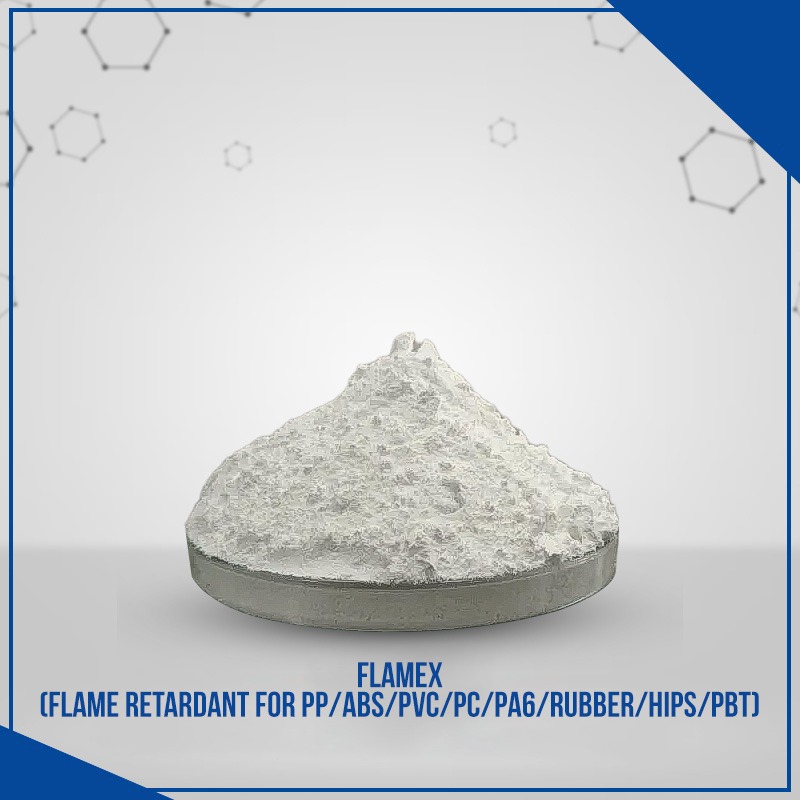 | flame retardant additives Flamex ( Flame Retardant for PP ABS PVC PC PA6 RUBBER HIPS PBT ) FLAMEX ( One Pack Flame Retardant ) manufactured by our company is widely used in PP,PA, PE,PC ,PC/ABS, PVC , Rubber ,PBT, PET, XPS, EPS, PU ,PVC,... View product → |
 | Flame Retardant Filler FAM-501 Flame Retardant Filler FAM-501 FAM - 501 Flame Retardant filler FAM-501 is One Pack Flame Retardant & Smoke Suppressant developed for Plasticized PVC applications. View product → |
Use a pilot plan that reveals the real cost of the choice
A three-stage flame-retardant pilot validation exposes costs that a quotation hides: processing losses, maintenance, requalification and supply interruptions. Judge the candidate by cost per finished kilogram, not by additive price per kilogram.
1. Screen at the intended throughput and loading. Record melt-filtration pressure, screen-pack life, pellet dust and dispersion microscopy results. Examine the screw, barrel and die after the run; coarse or hard inorganic particles can accelerate wear even when the compound passes its fire test.
2. Run a production-length trial with normal drying, residence time and cooling conditions. Weigh additive, polymer, rejects, purge material, energy and filter changes, then add scheduled maintenance and downtime to the batch cost. A heavily loaded ATH or magnesium hydroxide compound can raise viscosity and shorten equipment service intervals.
3. Release the grade only after repeat batches meet fire, smoke, mechanical and electrical limits after heat and humidity aging. Record the requalification tests triggered by a formulation, site, particle-size distribution or manufacturing change. This prevents a later supplier substitution from invalidating customer approvals.
Use a written specification covering identity, purity, moisture, particle-size distribution, packaging and batch release tests. Require supplier change control with advance notice, retained samples and a defined reapproval process for every additive grade.
Also confirm capacity, lead time, safety stock and a qualified second source; the cheapest formulation fails its economic test if one delayed shipment stops your line.
Frequently asked questions
How do you match a flame retardant additive to a polymer and process?
Start with the resin, processing melt temperature and required fire result. Check compatibility with the polymer, part thickness, flexibility and manufacturing process before choosing an additive family.
What should you set before the first flame retardant trial?
Define additive loading, processing temperature and dispersion requirements. Record the target fire test, specimen thickness and processing conditions so trial results can be compared.
Which results should you compare when selecting a flame retardant?
Compare fire performance and smoke generation with mechanical strength, flexibility, electrical properties and processing behaviour. A formulation that passes one fire test can still fail its end-use requirements.
What supplier documents should you verify?
Ask for the material specification, batch number, certificate of analysis, safety data sheet, test reports and compliance records. Confirm that the documents identify the supplied grade and match your intended application.
Related products
| FAM-501 ABOUT FAM - 501 FAM-501 is One Pack Flame Retardant & Smoke Suppressant developed for Plasticized PVC applications. View product → |
 | Antimony Trioxide Our range of Antimony trioxide is used mainly in flame retardant formulations for plastics, rubbers, textiles, paper and paints. View product → |
 | Zinc Borate ZINC BORATE is a highly effective multifunctional flame retardant synergist being used as a flame retardant and smoke suppressant in a wide range of... View product → |
 | Aluminium Trihydrate (ATH) is a very finely grounded product having a uniform and controlled particle size distribution. View product → |