
A flame-retardant chemical succeeds only when its mechanism, decomposition temperature, dosage and test method match the resin and production process. By the end, you will be able to narrow the chemistry for each polymer, set a defensible laboratory starting point and compare fire, smoke, processing and compliance evidence before approving a formulation.
Key takeaways
- Match the additive to polymer type, processing temperature, and final-use requirements.
- Start with supplier-recommended loading, then check melt flow, strength, colour, and dispersion.
- Separate flammability, smoke, and regulatory tests; one result cannot replace the others.
- Request the batch number, certificate of analysis, safety data sheet, and test reports before acceptance.
How flame retardants interrupt burning in plastic
A flame retardant does not make plastic noncombustible. It interrupts ignition, slows heat release, or stops the flame from feeding itself by changing what happens in the polymer and above its surface.
- Dilution reduces the concentration of combustible polymer gases. Mineral fillers and some additives replace part of the resin, so less fuel reaches the flame.
- Endothermic cooling absorbs heat as a component decomposes or releases bound water. The surface cools, decomposition slows, and ignition becomes harder.
- Char formation creates an insulating carbon-rich barrier. A continuous char blocks heat and oxygen from reaching fresh polymer; cracks or poor dispersion let flame pass through.
- Gas-phase inhibition interferes with flame radicals above the surface. Halogenated systems use this route, while some phosphorus compounds act in the gas phase, the condensed phase, or both.
Intumescent systems combine an acid source, carbon source and blowing source. Heating expands the package into char foam, but an unbalanced ratio, weak plasticizer-like liquid component or poor dispersion leaves a thin, cracked shield.
An additive flame retardant remains physically blended and can migrate, bloom or leach after heat, oil or cleaning-agent exposure. A reactive flame retardant bonds into the polymer, improving permanence while potentially changing melt processing, mechanical properties and recycling.
A synergist strengthens another package rather than replacing it. Antimony trioxide needs a compatible halogen source; zinc stannate and zinc hydroxystannate support smoke suppression and protective residue formation, especially in PVC. Smoke requires separate verification: ISO 5659-2 measures smoke density, while UL 94 does not rate smoke obscuration or toxicity.
Match the chemistry to the polymer and its processing window
A PP flame retardant that survives compounding at 180–230°C may fail in PA6 processed above 240°C. Match decomposition temperature, compatibility and mechanism to the resin, not just the target UL 94 class.
| Polymer | Chemistry that usually fits | Processing-window watchpoint |
|---|---|---|
| PP | Phosphorus–nitrogen intumescent packages, often with a char-forming co-component; mineral synergists can support the system | Poor dispersion leaves weak spots, while high loading raises viscosity and reduces impact strength |
| ABS | Brominated additive systems with antimony trioxide, or selected phosphorus systems | Check melt stability and colour; antimony trioxide is a synergist, not a complete ABS flame retardant |
| PVC | Metal hydroxides, zinc stannate or zinc hydroxystannate as synergists; antimony trioxide works with a halogen source | A PVC smoke suppressant does not automatically control hydrogen chloride or toxicity; keep compounding below the grade’s degradation limit |
| PC/ABS | Phosphorus esters or suitable phosphorus oligomers; reactive options improve permanence | Excess additive can lower heat resistance, impact strength or weld-line performance |
| PA6 | Metal phosphinates, red phosphorus or phosphorus–nitrogen packages | Moisture and residence time matter; hydrolysis and additive degradation can damage properties |
| PBT | Metal phosphinates and phosphorus systems, often with glass-fibre-compatible support | Validate flow, hydrolysis resistance and electrical tracking after drying |
| PE | Intumescent phosphorus–nitrogen systems or mineral-filled packages | Low melt viscosity and weak polarity make dispersion and additive retention difficult |
| Rubber | Aluminium trihydrate, magnesium hydroxide, phosphorus or halogen–antimony systems selected for the elastomer | Respect cure temperature; fillers can alter cure rate, tensile strength and elongation |
ABS flame retardant and PC/ABS flame retardant selections require separate trials because the same phosphorus chemistry can behave differently in each matrix. Test compounded plaques, not powder labels.
Set a starting loading without sacrificing processability
Start with a three-point screening plan, not a single “recommended” flame retardant dosage. For an unknown mineral formulation, test 20, 40 and 60 phr, where phr means parts per 100 parts of polymer; use 5, 10 and 15 phr for a conventional additive system when the supplier’s technical data supports that range.
| Material | Starting screen | Main risk to check |
|---|---|---|
| ATH | 20, 40, 60 phr | Higher torque, poor surface finish and reduced elongation |
| MDH | 20, 40, 60 phr | High melt viscosity, weak impact performance and difficult screw filling |
| Phosphorus or halogenated package | 5, 10, 15 phr | Migration, blooming, smoke and loss of mechanical strength |
Treat these as laboratory screening points, not production recipes. Raise or lower the flame retardant dosage after comparing fire-test results with processing data at each step.
Record extruder torque, motor load, die pressure, throughput, melt temperature and melt viscosity. A formulation that reaches the target fire rating but causes unstable pressure, incomplete screw fill or a rough die surface is not production-ready.
Measure tensile strength, elongation at break, flexural strength, impact strength and density against the unfilled resin. Increasing ATH loading or MDH loading can reduce toughness; MDH also releases about 31% of its mass as water and decomposes near 330–350°C, but its high viscosity can still limit output.
Check particle drying, surface treatment, dispersion and mixing sequence before rejecting a loading that fails.
Use the right fire, smoke and compliance tests
A test result proves only the property, specimen, thickness and exposure used in that test; it does not certify an entire product. Compare formulations with matched geometry and conditioning, then use the test tied to the claim.
| Test | What the result supports | What it does not support |
|---|---|---|
| UL 94 V-0 | Small plastic specimens meet vertical-burning criteria: each afterflame is no more than 10 seconds, five specimens total no more than 50 seconds, and flaming drips do not ignite the indicator. | A general building, cable or finished-product fire classification; the result is specific to specimen thickness and geometry. |
| Limiting oxygen index | The minimum oxygen concentration that supports combustion in the defined laboratory setup. | Direct prediction of wall, cable, enclosure or finished-product fire performance. |
| ISO 5660-1 cone calorimetry | Comparative ignition time, heat-release rate, total heat release and mass loss under a specified heat flux. | Replacement for the classification test required for the finished product. |
| ISO 5659-2 smoke density | Smoke obscuration from a specimen exposed to thermal radiation. | Smoke toxicity, corrosive-gas emissions or a UL 94 flame rating. |
Treat smoke as a separate qualification target. UL 94 provides no smoke-toxicity or smoke-obscuration rating. For PVC, a flame-test pass does not justify “low-smoke” or “low-toxicity”: decomposition can release hydrogen chloride, while combustion can generate carbon monoxide and other toxic products. Measure those claims separately.
Build a Delhi-ready qualification process for incoming chemicals
A production release should follow a written specification, not a supplier’s product name. For Delhi storage and compounding, control heat and humidity because hygroscopic phosphate additives, fillers and treated mineral powders can gain moisture before they reach the hopper.
1. Request the current technical data sheet, safety data sheet, certificate of analysis, batch number, manufacturing date, country of origin, recommended packaging, storage limits and retest period. Specify active-content assay, moisture specification, bulk density and particle-size distribution, including the test methods and acceptance limits.
2. Inspect every delivery for an intact moisture barrier, legible batch marking, caking, contamination and damaged seals. Quarantine any container that fails inspection. Draw a representative sample from each batch, retain a sealed reference sample and record the sampling date, operator and container numbers.
3. Test moisture by Karl Fischer titration or the method named in the specification; verify assay, bulk density and particle-size distribution against the certificate. Record results in a batch-release log rather than filing the certificate alone.
4. Compound the chemical in the actual resin at the proposed loading. Check melt torque, screw fill, dispersion, surface appearance, tensile strength, elongation, impact and the required fire test after conditioning.
5. Obtain a RoHS compliance declaration and supporting homogeneous-material test report when selling into EU RoHS markets. Check the 0.1% limits for lead, mercury, hexavalent chromium, PBBs and PBDEs, and the 0.01% cadmium limit, including stated exemptions.
For a supplier such as Niknam Chemicals Pvt. Ltd, use this same qualification gate for every grade and batch; a familiar supplier does not replace incoming verification. Document approval, deviations, corrective actions and the exact resin, loading, drying cycle and compounding temperature used.
Related products
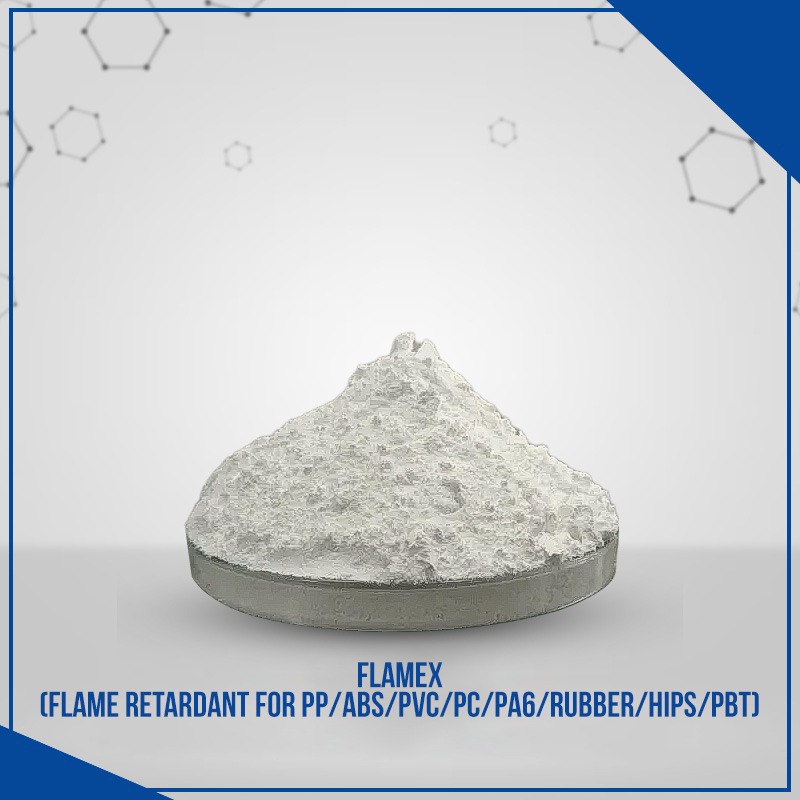 | flame retardant additives Flamex ( Flame Retardant for PP ABS PVC PC PA6 RUBBER HIPS PBT ) FLAMEX ( One Pack Flame Retardant ) manufactured by our company is widely used in PP,PA, PE,PC ,PC/ABS, PVC , Rubber ,PBT, PET, XPS, EPS, PU ,PVC,... View product → |
 | Flame Retardant Filler FAM-501 Flame Retardant Filler FAM-501 FAM - 501 Flame Retardant filler FAM-501 is One Pack Flame Retardant & Smoke Suppressant developed for Plasticized PVC applications. View product → |
Frequently asked questions
How do flame retardants interrupt burning in plastic?
They interrupt ignition, slow heat release, form a protective char or surface layer, dilute combustible gases, or suppress flame reactions above the polymer.
How do you match a flame retardant to a plastic polymer?
Check compatibility with the polymer, decomposition temperature, processing window, moisture sensitivity, dispersion needs, and effects on mechanical and electrical properties.
How do you set a starting flame-retardant loading?
Use the supplier’s tested formulation as the starting point, then compound trial batches and measure flow, strength, colour, dispersion, flame performance, and smoke.
Which tests should you use for fire, smoke, and compliance?
Select tests for the product’s end use, such as UL 94 for plastics flammability, limiting oxygen index for ignition behaviour, smoke testing, and documented regulatory checks.
How can Delhi manufacturers qualify incoming flame-retardant chemicals?
Verify the purchase specification, container seal, batch number, certificate of analysis, safety data sheet, appearance, moisture, identity, and performance through retained-sample testing.
Related products
| FAM-501 ABOUT FAM - 501 FAM-501 is One Pack Flame Retardant & Smoke Suppressant developed for Plasticized PVC applications. View product → |
 | Aluminium Hydroxide ALUMINIUM HYDROXIDE is a Super Fine Precipitated Special ATH. View product → |
 | Antimony Trioxide Our range of Antimony trioxide is used mainly in flame retardant formulations for plastics, rubbers, textiles, paper and paints. View product → |
 | Aluminium Trihydrate (ATH) is a very finely grounded product having a uniform and controlled particle size distribution. View product → |