
A flame-retardant package that passes UL 94 in one PP specimen can fail when wall thickness, colour, reinforcement, processing temperature or conditioning changes. You will be able to match the additive type and loading strategy to your PP application, define the evidence to request, and screen processing, mechanical and outdoor-ageing risks before approving a formulation.
Key takeaways
- Start with the finished PP part, thinnest wall and required fire test.
- Compare additives for flame spread, smoke, regulatory and processing priorities.
- Set loading, temperature and dispersion limits before compounding trials.
- Demand formulation-level test data, then validate it under Delhi service conditions.
Start with the finished PP part and its required fire test
A polypropylene flame retardant is not chosen until you define the finished part, its thinnest wall and the fire test it must pass. Treat the PP application, not the resin grade alone, as the starting point.
UL 94 V-0 at 1.5 mm is a different target from V-2 at 3.0 mm, glow-wire testing, or a building reaction-to-fire requirement.
Before comparing packages, record:
- The part’s use, geometry, minimum wall thickness, moulding method and expected service temperature.
- The exact test method, specimen thickness, classification and end-product standard named by the customer.
- Whether smoke density, heat release, combustion toxicity, electrical-contact corrosion or dripping matters alongside flame rating.
- The complete formulation: PP grade, pigment, glass or mineral reinforcement, impact modifier and processing conditions.
- Mechanical and appearance limits, including tensile strength, impact retention, colour, density and acceptable mould-filling behaviour.
| Part or product | Define before comparison | Relevant evidence |
|---|---|---|
| Injection-moulded housings | Wall thickness, gate design, electrical use and enclosure standard | UL 94 V-0, V-1 or V-2 at the specified thickness; IEC 60695 glow-wire testing when required |
| Extruded sheet | Thickness range, orientation, exposed surface and installation environment | The buyer’s vertical-burning or reaction-to-fire test, plus smoke data if specified |
| Cable accessories | Insulation geometry, voltage duty and end-product test | The applicable electrical flame test, not an assumed UL 94 substitution |
| Automotive or appliance components | Heat, impact, ageing and location within the assembly | Product-standard flame test, with ASTM E1354 or ISO 5659-2 when heat release or smoke is a design constraint |
Match additive chemistry to fire, smoke and regulatory priorities
Choose the chemistry by the failure you must prevent, not by a UL 94 label alone. A halogenated flame retardant can deliver V-0 at lower loading, preserving mould filling and toughness, but smoke, corrosive combustion products, contact corrosion, antimony restrictions and end-of-life rules need separate checks.
| Option | Main advantage in PP | Main trade-off |
|---|---|---|
| Halogenated flame retardant | Efficient flame inhibition at relatively low loading; useful for thin electrical housings and appliance components | Smoke and corrosive gases can increase; antimony-containing synergists raise density, affect colour and may breach customer specifications |
| Mineral flame retardant | Halogen-free flame retardant route with useful smoke or glowing control from selected hydroxides, zinc borate or metal phosphates | Higher loading can increase density and melt viscosity, reduce impact strength and hinder mould filling |
| Phosphorus-based | Supports flame inhibition or char formation without halogens; suitable where halogen-free status matters | Colour, hydrolysis stability, migration, cost and long-term mechanical retention require formulation-level testing |
| Intumescent PP system | Forms an insulating char that limits heat and flame spread; useful where smoke and halogen restrictions dominate | Requires compatible acid, carbon and gas-forming components; expansion, surface appearance and processing stability can be difficult |
For cable accessories, switchgear and housings, test the finished formulation to the specified UL 94 class and thickness or IEC 60695 glow-wire requirement. For transport or building parts, add the named smoke or heat-release method; UL 94 does not measure either.
Request ISO 5659-2 smoke data and ASTM E1354 cone-calorimeter results when smoke is a design constraint. A V-0 pass alone proves too little.
Set loading and processing limits before running a trial
Set dosage against the required classification at the stated wall thickness, not against a supplier’s generic “effective” level. Express flame retardant loading in both phr (parts per hundred parts of PP resin) and weight percent; weight percent equals additive mass divided by total compound mass, multiplied by 100.
Screen the supplier’s minimum effective concentration, then test higher increments until the fire rating passes without unacceptable density, flow or impact loss.
| System | Dosage and trade-off | Processing check |
|---|---|---|
| Aluminium trihydrate | Often needs substantial loading; decomposition around 180–220°C can overlap the process | Use TGA and a residence-time trial; watch for water release, foaming and pressure changes |
| Magnesium hydroxide | Commonly requires about 40–60 weight percent, which can reduce toughness and elongation | Its roughly 300–330°C decomposition range offers more thermal margin, but check torque and mould filling |
| Phosphorus or intumescent | Lower loading may preserve flow, colour and toughness, but compatibility and expansion must be proven | Check residue, plate-out, melt stability and fire performance after moulding |
Run TGA on the additive and compound, then reproduce the intended barrel profile within the PP processing temperature 180–240°C range. Hold material for the planned residence time, including start-up and stoppage conditions. Record torque, melt pressure, foaming, die build-up, plate-out, colour shift and odour.
Mould specimens afterward and repeat the target fire test, tensile and impact checks; a stable TGA curve alone does not prove survival through compounding.
Demand formulation-level data from the additive supplier
Request a signed, formulation-specific data pack before approving the package. Results from a different PP grade, wall thickness or additive loading do not predict your finished part. If Niknam Chemicals Pvt. Ltd is being evaluated as the supplier, ask for the same evidence for the proposed PP grade and exact package.
1. State the target classification: UL 94 V-0, UL 94 V-1 or UL 94 V-2, tested at the finished part’s minimum wall thickness and in the required orientation. Require specimen conditioning, polymer grade, additive loading, after-flame time, afterglow time and dripping observations.
2. Request a loading curve in phr or weight percent, including the minimum effective concentration and results at nearby loadings. Compare additive type—halogenated, phosphorus-based, mineral or intumescent—with density, colour, melt-flow change and expected mould-filling impact.
3. Require processing evidence from compounding and moulding: barrel-temperature range, residence-time limit, drying requirement, torque or motor-load change, dispersion photographs and signs of plate-out or degradation.
4. Ask for ASTM E1354 cone calorimetry results showing heat-release rate, total heat release and smoke yield; UL 94 alone does not measure fire growth or smoke. Add ISO 5659-2 smoke-density data when smoke is a design constraint.
5. Demand tensile strength, elongation and impact retention after the specified heat, humidity and UV ageing, plus density and colour change. Treat ASTM D2863 limiting oxygen index as a ranking tool, not a pass/fail substitute for the required fire test.
Related product
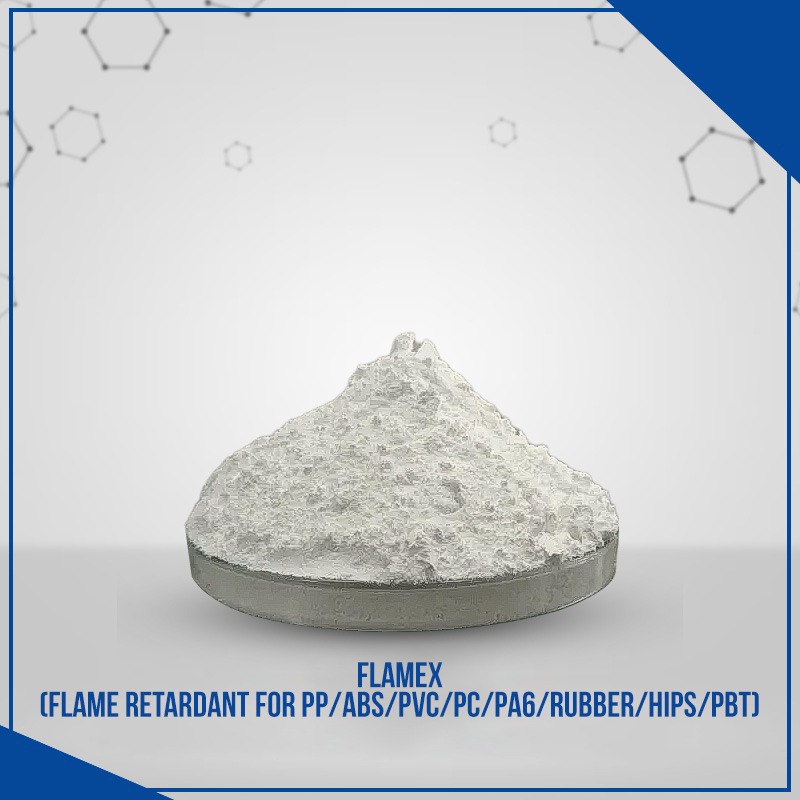 | flame retardant additives Flamex ( Flame Retardant for PP ABS PVC PC PA6 RUBBER HIPS PBT ) FLAMEX ( One Pack Flame Retardant ) manufactured by our company is widely used in PP,PA, PE,PC ,PC/ABS, PVC , Rubber ,PBT, PET, XPS, EPS, PU ,PVC,... View product → |
Validate the compound against Delhi service conditions and part performance
A rooftop PP housing that passes its initial flame test can still fail after Delhi summer heat, monsoon humidity, ultraviolet exposure or dust contamination. Choose the additive against retained performance at the part’s minimum wall thickness, not against a resin-only result.
| Condition | Validation | Effect on additive choice |
|---|---|---|
| Heat | Run thermal ageing PP testing at the customer’s specified temperature and duration; check after-flame, colour and dimensional stability. | Reject packages that bloom, degrade or lose flame performance after ageing. |
| Humidity | Condition moulded parts through the specified humidity cycle, then repeat fire and mechanical tests. | Favour compatible grades with low extraction and migration; inspect for surface deposits. |
| UV exposure | Use ASTM G154 UV exposure with an agreed cycle, followed by flame and impact testing. | Do not treat one cycle as outdoor-life prediction; select a UV-stable package if embrittlement or fading appears. |
| Smoke | Test the finished formulation using ISO 5659-2 smoke density when smoke is restricted. | Do not accept an additive’s smoke claim without formulation-level data. |
| Electrical heat | Apply the required IEC 60695 glow-wire test, not a substituted UL 94 result. | Match the package to the end-product standard and specimen thickness. |
Mechanical requirements decide the practical loading limit. High mineral or intumescent loading can raise melt viscosity and reduce impact toughness, while a poorly compatible additive can weaken weld lines or transfer onto adjacent parts. Compare tensile and impact retention after ageing, mould-filling torque and surface condition before approval.
If outdoor durability and toughness conflict with the required rating, choose a higher-efficiency, better-compatible package rather than simply increasing dosage.
Frequently asked questions
Why should you start with the finished polypropylene part?
The part’s geometry, thinnest wall and required fire test determine the additive performance you need.
How do you match additive chemistry to application priorities?
Compare chemistries against flame performance, smoke generation, regulatory requirements and effects on processing.
What limits should you set before a formulation trial?
Define additive loading, processing temperature, residence time, dispersion requirements and acceptable effects on PP properties.
What data should a flame-retardant additive supplier provide?
Request formulation-level fire-test results, loading, PP grade, specimen thickness, processing conditions and test method.
How should you validate a PP flame-retardant compound in Delhi?
Test the finished part under local service temperatures, humidity, dust exposure and required mechanical-performance conditions.