
Polypropylene appears in door panels, instrument-panel substrates, battery trays and electrical protection parts, but each location presents a different combination of heat, ignition, smoke and mechanical risk. By the end, you will be able to map a PP part to the right fire test, translate an OEM specification into a formulation target and compare additive packages without sacrificing processability.
Key takeaways
- Specify each PP part by ignition risk, smoke consequence and finished-part construction.
- Test the complete part after paint, adhesive, foam backing, film and ageing.
- Use FMVSS 302, ISO 3795 and UL 94 results for different specification decisions.
- Validate additive loading against melt flow, impact strength and production consistency.
Where flame-retardant PP is used in Delhi automotive manufacturing
A polypropylene part needs flame-retardant protection when its location, ignition source or smoke consequence creates a vehicle-safety risk. The vehicle maker’s interior-material specification determines the target, not a generic “automotive-grade PP” label. The same compound can pass as a plaque yet fail after paint, adhesive, foam backing, decorative film or ageing is added.
| Part or location | Main fire risk | Requirement driver |
|---|---|---|
| Instrument-panel substrates | Nearby wiring, displays and heater ducts can ignite the part; passenger-compartment smoke is also critical. | Controlled horizontal burning and low-smoke finished-part performance. |
| Door-trim carriers and consoles | Harnesses, switches and connectors create local electrical ignition points behind enclosed trim. | Flame resistance after skins, adhesives, films and foam are applied. |
| Seat components and seat backs | A fire can spread across large interior surfaces and expose occupants to smoke. | The finished trim assembly must meet the specified burn rate and afterflame limits. |
| Pillar trims and luggage-compartment trim | Enclosed cavities can trap heat and allow flame travel through the cabin or cargo area. | Interior burn performance at the production thickness and construction. |
| Battery trays, fuse boxes and cable ducts | Electrical faults, arcing and hot debris can ignite polymer near power circuits. | Flame resistance, insulation and dimensional stability after heat and vibration. |
| Fan shrouds, air-intake housings and HVAC parts | Hot surfaces, airflow and under-hood fluids intensify ignition and flame spread. | Elevated-temperature, fluid, vibration and flame exposure—not only an interior test. |
EV battery covers and module barriers require separate hot-gas, direct-flame and thermal-propagation qualification; a UL 94 rating alone does not prove cell-to-cell protection. Recycled PP also demands lot identification and revalidation because unknown additives and contamination change burning, smoke and impact results.
Match each PP part to its actual fire and smoke requirement
Part location, heat exposure, electrical function, passenger-compartment smoke, and finished-part construction determine the PP requirement; a generic automotive-grade label does not.
| Part or setting | Actual concern | Material and validation focus |
|---|---|---|
| Instrument-panel substrates, door-trim carriers and seat components | Passenger-compartment flame spread and smoke | Meet the vehicle’s interior burn limit after specified humidity, heat and UV conditioning; assess the finished trim, not only a flat plaque. |
| Battery trays | Hot surfaces, electrical isolation and possible battery-event exposure | Combine flame resistance, insulation and dimensional stability. A material rating does not prove resistance to cell-to-cell thermal propagation; pack testing must separately cover hot gases, direct flame, venting and propagation. |
| Under-hood covers | Sustained heat, fluids, vibration and ignition near engines or electrical equipment | Use a formulation that retains strength and dimensions after thermal ageing and fluid exposure, rather than one selected only for an interior horizontal-burn result. |
| Fuse boxes | Arc or local electrical ignition inside an enclosed housing | Check insulation, enclosure geometry, glow-wire performance when specified, and resistance to ignition after ageing. |
| Cable ducts | Wire protection, abrasion and heat from nearby power components | Balance flame resistance with impact strength, flexibility, low dripping and secure fit around bends and clips. |
| Air-handling parts | Flame spread through ducts and smoke movement into the cabin | Control both burning and smoke generation, including the effect of thin walls, seams, ribs and moulded joints. |
The finished construction changes the test outcome. Glass fibre, inserts, bosses, weld lines and wall-thickness changes can create a result that a uniform specimen misses. Delhi-NCR specifications should connect fire acceptance to heat, humidity, dust, UV and fluid exposure.
Turn FMVSS 302, ISO 3795 and UL 94 results into a material specification
A pass/fail statement is incomplete without the specimen and test setup. Write the vehicle-maker requirement as a controlled test target, because a PP plaque that passes one orientation can fail a finished trim part or a different method.
Specify all of these fields:
- Method: FMVSS 302 or ISO 3795 horizontal burning rate; do not substitute one for the other without customer approval.
- Specimen: exact thickness, width, length, moulding direction, glass-fibre content and surface condition.
- Conditioning: temperature and humidity before testing, plus thermal ageing, humidity, UV and fluid exposure when the part sees Delhi-NCR service conditions.
- Burn direction: horizontal for FMVSS 302 and ISO 3795; vertical for the UL 94 vertical burning test.
- Ignition: burner type, flame height, flame-application time and the point at which timing begins.
- Result: for FMVSS 302, require a rate no higher than 102 mm/min or self-extinguishment before 51 mm, if that is the customer’s stated criterion.
- UL result: identify the required class from the UL 94 horizontal burning test or vertical method, then record each afterflame time, total afterflame, afterglow and flaming-drip result.
State whether the result applies to neat compound, glass-filled compound, plaque or finished moulded part. Use the finished part when ribs, weld lines, inserts, coatings or thickness changes affect burning; otherwise justify a defined worst-case plaque. A UL 94 V-0 result does not prove FMVSS 302 compliance.
Choose the PP additive package and calculate a controlled starting load
Start with the vehicle maker’s fire target, the PP grade and the finished-part thickness—not a familiar additive percentage. Halogenated flame-retardant systems suit thin parts when low loading and retained melt flow matter, but screen the exact substances against the OEM restricted-substance list.
Halogen-free mineral systems suit applications prioritising residue and smoke control, although high loading can damage impact, elongation, weld lines and flow. Intumescent packages for PP commonly combine ammonium polyphosphate, a carbon source and a spumific component; moisture, dispersion and compounding heat history can decide whether they work consistently.
| Option | Main advantage | Main risk |
|---|---|---|
| Halogenated system | Lower loading and good flow retention | Substance-specific compliance and corrosive smoke concerns |
| Halogen-free mineral system | Heat absorption and protective residue | High loading reduces impact and melt flow |
| Intumescent package for PP | Char barrier with low-halogen design | Poor dispersion causes part-to-part burn variation |
Calculate each batch on total compound mass: additive mass = target percentage × batch mass ÷ 100, with PP making up the balance. For a 100 kg trial at 20% total package, weigh 20 kg package and 80 kg PP; this arithmetic does not prove that 20% passes.
- Use the supplier’s validated range as the starting window, then mould identical plaques at multiple package levels.
- Test each level for the specified UL 94, ISO 3795 or FMVSS 302 result, plus oxygen-index testing when used for screening.
- Specify smoke density and gas toxicity separately from flame performance.
- Identify recycled PP by lot and revalidate after any source change; unknown prior additives and contamination can change ignition, dripping, smoke and impact.
Protect melt flow, impact strength and production consistency after flame-retardant loading
Set the acceptance window before molding trials: melt flow rate (MFR), tensile and impact strength, weld-line impact, shrinkage, warpage, burn result, smoke density and injection-molding cycle time. Test plaques and production-thickness parts at the same flame-retardant loading; a thin plaque can pass while a ribbed trim part burns or distorts differently.
Run a controlled molding study across barrel temperature, mold temperature, injection speed, back pressure and cooling time. Record fill pressure, weight, visible specks, color, surface gloss and weld lines. Excessive mineral loading can preserve fire performance while reducing flow, impact strength and dimensional consistency.
Validate the finished part after paint, adhesive, foam backing, film or other surface treatment. Repeat fire and smoke testing after the specified heat, humidity, fluid and thermal-ageing sequence; compare impact, elongation, color, shrinkage and warpage against unaged parts. Smoke suppression is a separate acceptance line, not a conclusion drawn from UL 94.
- Lock the approved resin source, additive lot, dosage, MFR and moisture limit.
- Identify recycled PP by supplier, grade, lot and prior-use history; revalidate after any source, molecular-weight or contamination change.
- Compare phosphorus-based additives with zinc borate and antimony synergists at equal processing conditions, then select the lowest loading that meets fire, smoke, mechanical and dimensional limits.
Niknam Chemicals Pvt. Ltd can help you compare additive lots through this same compound-and-part validation rather than approving a powder from its datasheet alone.
Related product
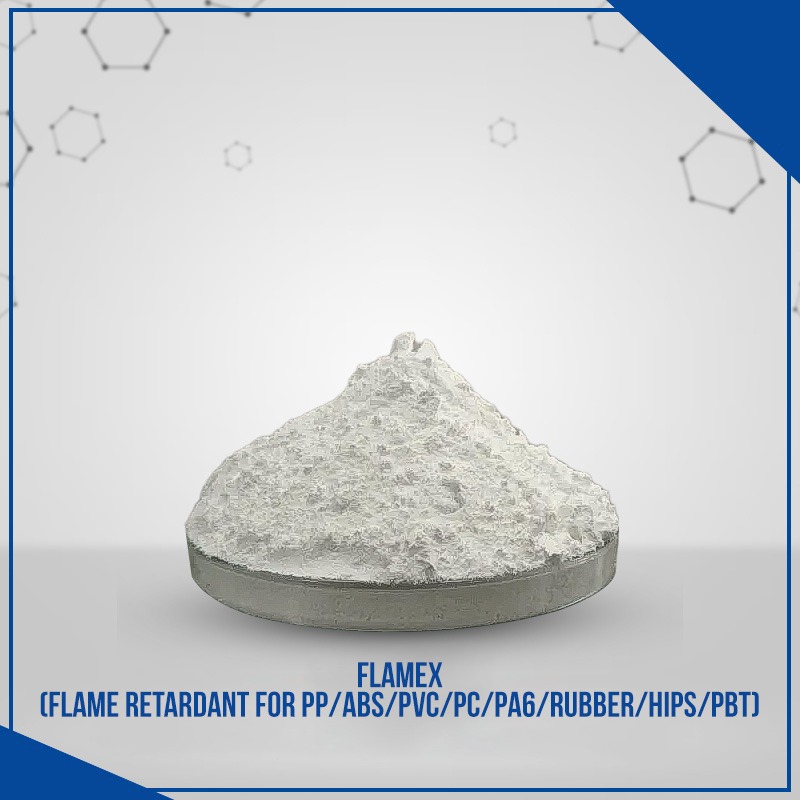 | flame retardant additives Flamex ( Flame Retardant for PP ABS PVC PC PA6 RUBBER HIPS PBT ) FLAMEX ( One Pack Flame Retardant ) manufactured by our company is widely used in PP,PA, PE,PC ,PC/ABS, PVC , Rubber ,PBT, PET, XPS, EPS, PU ,PVC,... View product → |
Frequently asked questions
Where is flame-retardant polypropylene used in Delhi automotive manufacturing?
It is used for PP components near ignition sources or where flame spread and smoke affect vehicle safety, including selected interior and electrical-adjacent parts. Confirm the vehicle maker’s part specification before choosing the compound.
How do FMVSS 302, ISO 3795 and UL 94 differ?
FMVSS 302 and ISO 3795 assess horizontal flame behaviour for vehicle interior materials, while UL 94 classifies burning behaviour under a different vertical or horizontal laboratory method. Do not use one result as a substitute for another.
How should you set a starting flame-retardant loading in polypropylene?
Use the additive supplier’s tested concentration range, then calculate loading against the total compound mass and validate plaques and finished parts. Recheck melt flow, impact strength, colour, smoke and processing stability.
How can flame-retardant loading affect polypropylene production?
It can change melt flow, impact strength, colour, smoke generation and dosing consistency. Control drying, feeder accuracy, dispersion, extrusion temperature and lot-to-lot testing before approving production.