
ABS flame-retardant selection depends on resin grade, wall thickness, processing conditions and the fire test required for the finished part. By the end, you will be able to compare one-pack systems, halogenated synergist packages and mineral additives, then write a purchase specification that covers performance, processing and compliance.
Key takeaways
- Record ABS grade, measured MFR, wall thickness, moulding method, and exposure first.
- Choose chemistry against the ABS grade and end-use fire-risk geometry.
- Test fire performance at the actual wall thickness, not on additive alone.
- Specify loading, processing conditions, test methods, and batch controls for repeatable supply.
Match the Flame-Retardant Chemistry to the ABS Grade and Application
Start with the ABS resin grade, its measured melt-flow rate and the fire-risk geometry—not the additive catalogue. A high-impact ABS for electrical enclosures needs a different balance from heat-resistant ABS or engineering plastics for injection moulding. Record the MFR test condition, wall thickness, moulding method and end-use exposure before choosing chemistry.
| Option | Fit for ABS and processing | Best application |
|---|---|---|
| One-pack brominated package | Simplest dosing and consistent dispersion; confirm colour, odour, smoke and the required synergist | Thin-wall injection-moulded housings where V-0 is the priority |
| Halogenated system with antimony trioxide | Strong flame inhibition at comparatively practical loading, but raises density and can affect colour and smoke | Low- to medium-flow ABS used for switches, connectors and electrical enclosures |
| Halogen-free phosphorus system | More formulation-sensitive in neat ABS; compatibility, higher loading or a char-forming co-additive may be necessary | Applications demanding halogen-free material, after testing impact, flow and thin-wall burning |
| Mineral additive with zinc borate or another synergist | Increases modulus and density, but can reduce melt flow and weld-line toughness | Rigid, thicker engineering parts where stiffness and smoke control matter |
Match loading to ABS melt flow: low-flow grades offer more residence time and shear history, while high-flow grades expose dispersion and sag problems quickly. Control drying, barrel temperature, residence time, screw speed, mould temperature and regrind during trials.
Do not accept “brominated flame retardant” as a compliance description. Obtain the exact substance identity and concentration; DecaBDE triggers EU REACH restrictions with defined exemptions and dates, so exported electrical parts require a documented regulatory review.
UL 94 alone does not prove CTI, dielectric strength, volume resistivity, arc resistance or low smoke; test IEC 60112 and request smoke and corrosivity data where people or sensitive electronics are exposed.
Set a Trial Loading Without Sacrificing ABS Performance
Do not substitute equal weight percent of one system for another. A halogenated package with an antimony trioxide synergist package, a one-pack formulation and a mineral additive deliver different flame and smoke performance at different loadings.
| Option | Comparison | When it fits |
|---|---|---|
| One-pack system | Pre-balanced flame retardant and synergist package; simplest dosing, with consistent colour and fewer feeding errors | You need a defined let-down ratio and rapid plant trials |
| Halogenated package | High-efficiency route, often using brominated additive plus antimony trioxide; changing the bromine-to-antimony ratio affects UL 94, density, colour, smoke and electrical properties | You need strong flame performance at moderate loading |
| Mineral additive | Usually requires higher weight percent and can raise viscosity, density and wear; zinc borate can reduce smoke and afterglow but may lower impact or lose V-0 | Smoke suppression or char promotion matters more than minimum additive loading |
Use the supplier’s recommended loading level as the centre of a three-point trial, with lower and higher points that stay within the stated processing window. Mold every point at the required wall thickness; a formulation that passes at 3.0 mm can fail at 1.5 mm.
Before compounding, request:
- The recommended loading level in weight percent for your exact ABS grade, melt-flow range and process.
- The let-down ratio if the product is a concentrate, plus whether the stated loading refers to active chemical or total package.
- The bromine-to-antimony ratio, zinc borate level and antimony trioxide content in an antimony trioxide synergist package.
- UL 94 results at your actual thickness, alongside melt flow, impact, colour, smoke and electrical-property data.
Specify the Fire Test and Wall Thickness Together
UL 94 V-0, UL 94 V-1 and UL 94 V-2 prove how a specified ABS specimen behaves during a vertical burning test. They do not approve a complete electrical product.
V-0 requires the shortest permitted afterflame performance and no flaming drips that ignite the cotton indicator; V-1 allows longer afterflaming but still excludes igniting drips; V-2 permits those flaming drips.
Write the classification beside the wall thickness: for example, “UL 94 V-0 at 1.5 mm,” not simply “V-0 ABS.” The same formulation can pass at 3.0 mm and fail at 1.5 mm because the thinner section has less combustible mass and a higher surface-area-to-volume ratio.
Ask for the report covering your moulded thickness, resin grade, conditioning and specimen orientation.
Add IEC 60695-11-10 when the customer or product specification calls for its horizontal or vertical flame method. Its results resemble UL 94 HB and V methods, but edition, specimen geometry, conditioning and acceptance criteria must match before you treat them as equivalent.
Add glow-wire testing when a heated part, connector, terminal block or enclosure must meet IEC 60695-2-11. A V-0 compound can still fail a 650 °C or 750 °C glow-wire requirement.
Request these results as separate evidence:
- UL 94 classification with specimen thickness
- IEC 60695-11-10 result where specified
- Glow-wire temperature and ignition result where applicable
- CTI data under IEC 60112, because UL 94 establishes neither tracking resistance nor dielectric strength
Validate Flow, Strength, Smoke and Electrical Properties on Moulded Parts
A V-0 plaque can hide a weak moulded component. Validate the actual part because flame-retardant loading can dilute ABS, hinder dispersion or migrate to the surface, reducing impact strength and ductility at notches, screw bosses and weld lines. Record melt-flow rate after drying and compare it with the unmodified grade.
| Property | What to check on moulded parts | Typical effect of excessive or poorly matched loading |
|---|---|---|
| Impact and tensile strength | Notched impact, tensile strength and elongation | Mineral additives raise modulus and density but can reduce impact and weld-line toughness; incompatible systems reduce tensile properties. |
| Melt flow and weld lines | MFR, filling pressure, weld-line impact and knit-line appearance | Higher viscosity causes short shots, weak welds and greater injection pressure. |
| Surface and dimensions | Gloss, plate-out, sink, warpage, shrinkage and part weight | Migration damages finish; filler loading changes shrinkage and dimensional stability. |
| Smoke and afterglow | Smoke density, visible afterglow and residue | Zinc borate can support smoke suppression and char formation, but may increase viscosity and reduce impact. |
| Electrical performance | Comparative tracking index, dielectric strength, volume resistivity and arc resistance | Fillers and ionic packages can lower electrical performance; measure IEC 60112 CTI, not just flame rating. |
Run IEC 60695-2-11 glow wire testing on the finished part at the specified 650 °C or 750 °C. A UL 94 V-0 result does not prove glow-wire ignition resistance or electrical safety. Recheck CTI after colour, moulding and conditioning changes.
Turn the Delhi Purchase into a Reproducible Material Specification
Specify each delivery against documents and measurements, not a product name alone. Keep the same specification for every replenishment so a formulation change cannot hide behind a new label.
- Identify the additive, carrier resin, recommended phr, density, melt-flow value, colour limits, drying condition and processing window.
- Record the regulatory identifier for every flame-retardant substance, including CAS number where available; “halogen-free” alone is not an identity.
- Require a supplier test report showing UL 94 or IEC 60695-11-10 results, specimen thickness, conditioning and test edition. Add glow-wire data for the intended application.
- Request CTI, smoke data where relevant, and mechanical retention after ageing, rather than relying on an unqualified V-0 claim.
- Obtain a RoHS and REACH declaration that names restricted substances and concentrations. Check specifically for PBB, PBDE and decaBDE rather than accepting “brominated flame retardant.”
- Require the supplier to confirm that the tested formulation and production lot match, with the batch number printed on the certificate and packaging.
- At receipt, inspect the seal, label, colour and pellet or powder condition; measure moisture, density and melt flow against the agreed limits.
- Store a retained sample and log drying time and temperature. Delhi storage humidity can produce splay, bubbles and inconsistent burning before moulding begins.
For a Delhi purchase from Niknam Chemicals Pvt. Ltd, use this same evidence request for each additive or synergist, then approve it only after a moulded ABS sample meets the specified wall-thickness result.
Related products
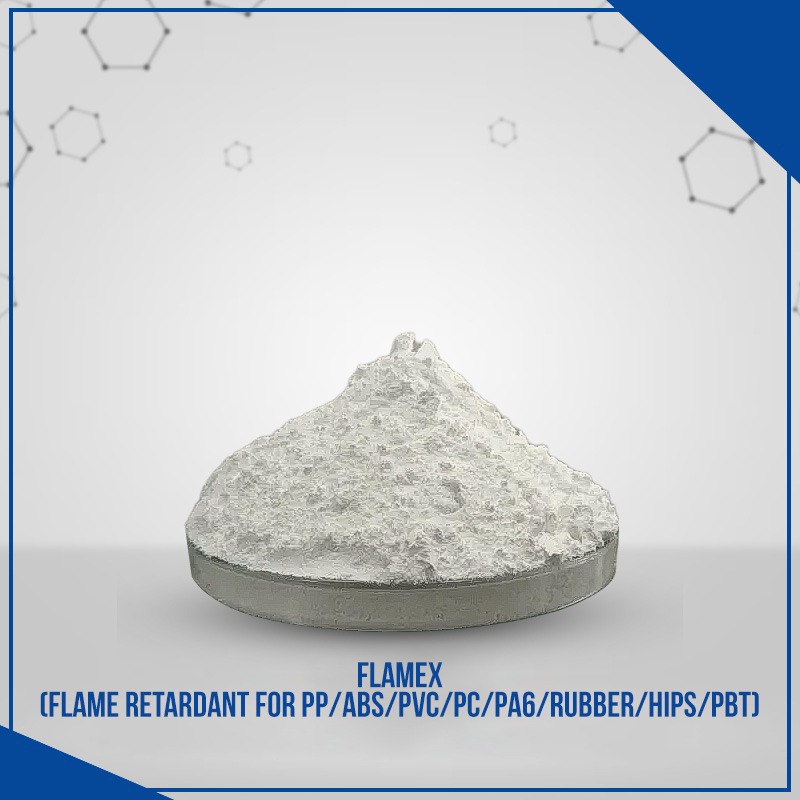 | flame retardant additives Flamex ( Flame Retardant for PP ABS PVC PC PA6 RUBBER HIPS PBT ) FLAMEX ( One Pack Flame Retardant ) manufactured by our company is widely used in PP,PA, PE,PC ,PC/ABS, PVC , Rubber ,PBT, PET, XPS, EPS, PU ,PVC,... View product → |
 | Antimony Trioxide Our range of Antimony trioxide is used mainly in flame retardant formulations for plastics, rubbers, textiles, paper and paints. View product → |
Frequently asked questions
What information should you record before choosing a flame retardant for ABS?
Record the ABS grade, measured melt-flow rate and test condition, wall thickness, moulding method, and end-use exposure.
How do you set a trial loading for flame-retardant ABS?
Start trials against the selected ABS grade and application, then compare fire performance with flow, impact strength, heat resistance, and appearance.
Why must wall thickness be specified with the fire test?
Fire-test results depend on specimen thickness, so specify the target wall thickness alongside the named test method.
What properties must you validate on moulded ABS parts?
Validate flame performance, smoke, melt flow, strength, mould filling, dimensional results, and electrical properties on representative parts.
What belongs in a reproducible ABS material specification?
Document the resin grade, additive chemistry, loading range, processing conditions, test method, wall thickness, acceptance limits, and batch identification.
Related products
 | Zinc Borate ZINC BORATE is a highly effective multifunctional flame retardant synergist being used as a flame retardant and smoke suppressant in a wide range of... View product → |
 | Aluminium Trihydrate (ATH) is a very finely grounded product having a uniform and controlled particle size distribution. View product → |
 | Aluminium Hydroxide ALUMINIUM HYDROXIDE is a Super Fine Precipitated Special ATH. View product → |