
Adding flame retardant to ABS can improve ignition resistance and vertical-burning performance while changing impact strength, flow, heat resistance, smoke, colour and surface quality. By the end, you will be able to match an additive package to an ABS grade and process, set up a controlled trial, and judge supplier data against the actual wall thickness and service conditions in Delhi.
Key takeaways
- Match the additive chemistry to ABS grade, part geometry and processing temperature.
- Set additive loading during compounding, not after moulding defects appear.
- Test flame response alongside toughness, heat resistance, elongation and surface quality.
- Require batch data, safety documents and processing guidance before supplier approval.
What a Flame-Retardant Package Changes in ABS
Adding a flame-retardant package improves ABS flame-retardant performance by delaying ignition, shortening afterflame time and controlling dripping behaviour. It does not improve every property: the same formulation can reduce toughness, elongation, heat resistance or surface quality.
| System | Likely benefit | Common deterioration |
|---|---|---|
| Brominated plus antimony trioxide | Strong ignition resistance, short afterflame time and reliable vertical ratings | Higher density, opacity, smoke, lower impact strength and poorer surface finish when overdosed |
| Aromatic phosphate | Easier melt flow and mould filling | Lower Vicat softening temperature, HDT and creep resistance; possible loss of impact strength |
| Halogen-free phosphorus | Reduced halogen content and altered smoke or corrosion profile | Larger changes in melt flow, colour, heat resistance and impact strength; not a drop-in replacement |
A tensile result can hide the main failure. Notched Izod impact and elongation often fall because the additive disrupts rubber-modified ABS morphology or forms a weak dispersed phase; heat ageing and low-temperature service expose that loss.
Phosphate plasticisation can also leave a part vulnerable inside hot enclosures, rooftop equipment and dark housings where the surface exceeds Delhi’s ambient temperature.
Electrical housings require more than a burning classification. Check comparative tracking index under IEC 60112, dielectric strength and volume resistivity after conditioning; ionic residues or conductive smoke suppressants can reduce tracking resistance.
Qualify the exact colour, wall thickness, glass-fibre content, impact modifier and moulding conditions. Pigments and fillers alter ignition, dripping, smoke and afterflame results, so a black V-0 grade is not automatically equivalent to an unpigmented grade.
Choose the Chemistry for the Grade, Part and Process
Choose by the finished part, not by additive loading or price per kilogram. Compare each package at the same wall thickness, colour, glass-fibre content, impact modifier and flame rating; a black V-0 part is not automatically equivalent to an unpigmented grade.
| System | Main advantage | Main trade-off | Suitable starting use |
|---|---|---|---|
| Brominated plus antimony trioxide synergist | High-efficiency vertical burning performance at practical loading | Higher density and opacity; overdosing can reduce impact strength and surface quality | Electrical housings and compact injection moulding ABS parts needing V-0 |
| Brominated without antimony | Lower density and less opacity than a synergised package | Usually needs more flame retardant and may lose rating at thin walls | Parts where appearance or weight limits antimony use |
| Mineral systems | Low smoke contribution, rigidity and lower material cost | High loading can raise viscosity, screw wear, deposits and moulding sensitivity | Thick, rigid housings where flow and impact demands are moderate |
| Halogen-free phosphorus | No halogenated flame retardant; some grades improve melt flow | Can lower Vicat softening temperature, HDT, creep resistance, impact strength or colour stability | Applications prioritising halogen-free specifications and moderate thermal load |
Aromatic phosphorus additives can act as plasticizers. That helps fill thin sections at lower injection pressure, but a dark enclosure on rooftop equipment can exceed ambient temperature enough to expose its heat-resistance loss.
Qualify the selected chemistry with the actual resin and additive colour, then control drying and barrel residence time from supplier data. Moisture or overheating can cause splay, bubbles, molecular-weight loss and discoloration.
Set the Loading and Compounding Window Before Moulding
Start with a small formulation matrix, not a single target. Record total flame retardant loading percentage as a percentage of the finished compound, then compare 8%, 10% and 12% package levels against the required UL 94 result, impact strength, flow and appearance.
Keep the brominated flame retardant-to-antimony ratio fixed during this first screen; change the ratio only after identifying the lowest effective total loading.
1. Confirm the ABS resin and every additive’s drying instructions. Use the resin supplier’s ABS drying conditions rather than copying a generic recipe, and dry moisture-sensitive or hydrolysable additives separately when their data sheet requires it. Wet pellets produce splay and bubbles; moisture also lowers molecular weight and impact strength.
2. Premix the flame retardant, synergist, stabiliser and colourant by controlled weight before feeding. Use twin-screw compounding with gravimetric feeders, and avoid long feed interruptions that leave material cooking in the barrel.
3. Set melt temperature and residence time from the narrowest thermal limit in the package. Start at the lowest temperature that gives stable melting and dispersion, then check strand colour, torque and pressure. Excess heat or residence time can degrade ABS or the flame retardant, causing discoloration and weaker performance.
4. Pelletise, dry the compound if required, and mould test bars at the intended wall thickness. Retain samples from each loading and check impact after heat ageing, not only initial flammability. A higher dosage that reaches V-0 but causes brittle parts, plate-out or screw wear is not a successful process window.
Test the Finished Part at Delhi’s Real Conditions
A pass at one thickness does not prove a pass at another. Mould and condition finished parts at the minimum specified wall thickness, using the production colour, glass-fibre content, impact modifier and cycle; then test samples after conditioning at the highest service temperature.
| Test family | What to run | What failure reveals |
|---|---|---|
| Fire | UL 94 HB V-2 V-1 V-0, IEC 60695-2-12 glow-wire flammability index, and IEC 60695-2-13 glow-wire ignition temperature | Burning, dripping or ignition at the specified thickness |
| Fire and smoke | limiting oxygen index, cone calorimetry and smoke optical density | A V-0 result can still conceal high heat release or unacceptable smoke |
| Mechanical and heat | ISO 527 tensile, ISO 180 or ISO 179 impact, ISO 75 HDT and ISO 306 Vicat | Brittle impact failure, strength loss, softening or creep at service temperature |
| Electrical | IEC 60112 comparative tracking index, IEC 60243 dielectric strength and IEC 60093 volume resistivity | Tracking or insulation loss after heat and humidity conditioning |
| Ageing | IEC 60068-2-2 dry heat, IEC 60068-2-30 damp heat and ISO 4892-2 xenon exposure, followed by the tests above | Colour change, embrittlement, cracking or loss of fire and electrical performance |
Run the fire tests on the actual minimum wall, not a thicker laboratory plaque. Repeat key measurements after heat, humidity and ultraviolet exposure; ionic residues or conductive smoke suppressants can reduce tracking performance even when UL 94 improves.
Include dark housings and hot enclosures in the thermal assessment. A phosphate system that improves flow can lower Vicat, HDT and creep resistance, turning a passing formulation into a distorted part at elevated Delhi service temperatures.
What to Require from an Additive Supplier Before Approval
Approve an additive only after the supplier provides a representative sample, traceable batch records and an ABS flame retardant technical data sheet. The sheet must state recommended loading, active content and particle size, moisture, density, thermal stability, processing temperature and residence-time limits.
Request these documents before compounding:
- Safety Data Sheet, Certificate of Analysis and lot-to-lot specification, including ash, moisture and appearance.
- RoHS-style substance declaration covering the complete additive package, including PBB, PBDE, lead, mercury, cadmium, hexavalent chromium and restricted customer substances.
- Processing guidance for drying, premixing, extrusion and storage; wet material can cause splay, bubbles and impact loss.
- Evidence from the actual ABS grade and colour, not a generic resin.
Compare suppliers using the same qualification lot and part geometry:
| Evidence or test | Compare | Cost implication |
|---|---|---|
| UL 94 initial and conditioned at minimum wall | Rating, afterflame, dripping | Rejects and requalification |
| CTI IEC 60112 after conditioning | Tracking performance; check dielectric strength and volume resistivity separately | Electrical-part acceptance |
| Melt flow, impact retention, Vicat or HDT | Property loss after processing and ageing | Scrap, cycle changes and warranty risk |
| Colour, plate-out and smoke data | Surface defects and enclosed-equipment exposure | Cleaning, rejection and extra ventilation |
Niknam Chemicals Pvt. Ltd should be asked for the same batch-level evidence when its additive is shortlisted.
Calculate acceptable-part cost as resin cost plus additive price multiplied by loading, compounding and drying energy, colourant, scrap, testing and rejected-part allowance. A cheaper kilogram fails the comparison if it needs higher dosage or produces conditioned-test failures.
Related product
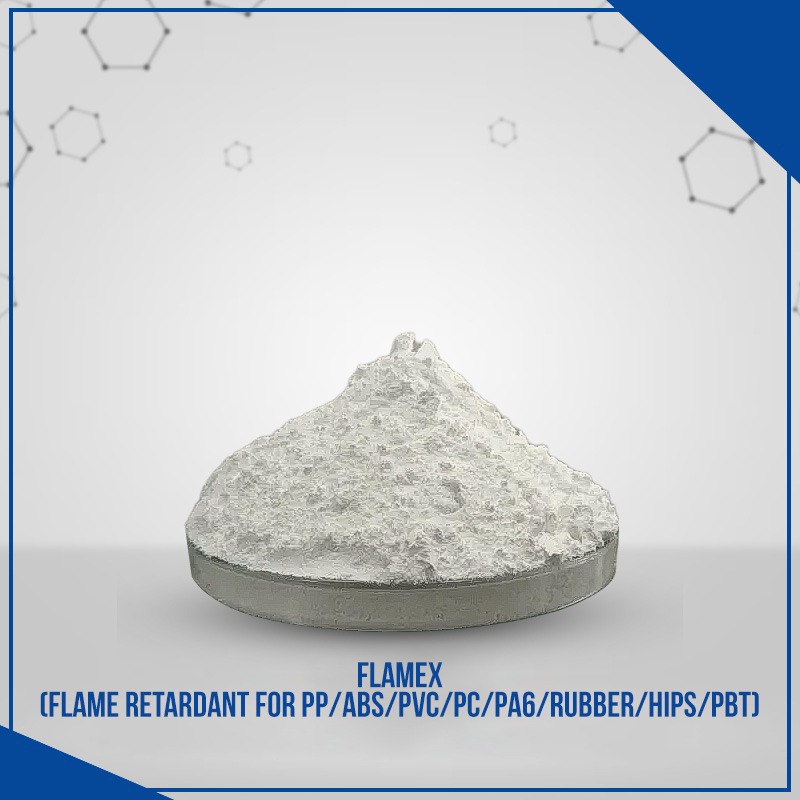 | flame retardant additives Flamex ( Flame Retardant for PP ABS PVC PC PA6 RUBBER HIPS PBT ) FLAMEX ( One Pack Flame Retardant ) manufactured by our company is widely used in PP,PA, PE,PC ,PC/ABS, PVC , Rubber ,PBT, PET, XPS, EPS, PU ,PVC,... View product → |
Frequently asked questions
What properties can a flame-retardant package change in ABS?
It can delay ignition, shorten afterflame time and control dripping, while reducing toughness, elongation, heat resistance or surface quality.
How do you choose flame-retardant chemistry for ABS?
Match the chemistry to the ABS grade, part design and processing conditions, then check its effect on the finished part.
When should you set flame-retardant loading?
Set loading and the compounding window before moulding, because excessive or poorly dispersed additive can create processing and surface defects.
What should you test in finished ABS parts in Delhi?
Test flame response and inspect mechanical, thermal and surface performance under the temperatures and conditions the part will face in Delhi.
What should an additive supplier provide before approval?
Request technical data, batch identification, safety documentation, recommended loading, processing limits and test evidence for the intended ABS formulation.