
Polypropylene mouldings do not become reliably flame-retardant simply because an additive is mixed into the resin. You will be able to specify the PP grade, compare one-pack and multi-component systems, set up a compounding trial, and demand test evidence that matches your component by the end.
Key takeaways
- Start with PP grade, wall thickness, geometry and the required fire test.
- Compare additive chemistry before requesting a target loading.
- Control compounding temperature and residence time to limit PP heat history.
- Test the finished moulded component, not only the resin certificate.
Start with the PP grade, part geometry and fire test
Before choosing a polypropylene flame retardant, establish the PP grade, part geometry, wall thickness and required fire test. Unmodified PP commonly has a limiting oxygen index of only 17–18%, below atmospheric oxygen, so passing a horizontal-burn test does not prove inherent flame resistance.
| PP grade | Key behaviour |
|---|---|
| Homopolymer PP | Higher stiffness; lower impact tolerance and a different additive response |
| Random copolymer PP | Better clarity and impact balance; lower stiffness |
| Impact copolymer PP | Rubber phase improves impact strength but can alter burning and dispersion |
| Talc-filled PP | Higher stiffness and dimensional stability; mineral content changes flow and loading |
| Glass-fibre-reinforced PP | Higher strength and heat resistance; fibres affect orientation, wicking and flame spread |
| Recycled PP | Variable polymer history, contamination, moisture and additive content; verify each feedstock |
Define the target test before requesting a formulation. UL 94 V-0 is thickness- and specimen-specific: each flame application permits no more than 10 seconds of afterflame, five specimens together no more than 50 seconds, no burning material may ignite the cotton indicator, and afterglow must not exceed 30 seconds.
Test the intended wall thickness, ribs, weld lines, gates, pigment and flow direction.
Do not substitute standards. IEC 60695-2-12 measures GWFI on plaques; IEC 60695-2-13 measures GWIT. ASTM E662 reports smoke optical density in flaming and non-flaming modes, not toxicity. A supplier’s certificate is inadequate if its resin, thickness or geometry differs from your moulded component.
Compare additive chemistry before asking for a loading
Compare the package architecture before discussing price or loading. A one-pack additive simplifies feeding and reduces weighing errors; a custom package lets you tune flame performance, colour, impact and processing, but demands controlled premixing and compatibility checks. For either option, the supplier must identify whether it is halogenated, halogen-free, intumescent, mineral-based or a synergist blend.
Ask for a PP-specific starting range for the FLAMEX loading in weight percent or phr. “Suitable for plastics” is not a flame retardant dosage for PP. For a halogen-free flame retardant PP formulation, demand data on the same PP grade and target wall thickness.
| Option | Main action | Principal trade-off |
|---|---|---|
| APP intumescent | Forms an insulating char | Needs correct acid, carbon and blowing sources; poor dispersion reduces protection |
| Halogen plus antimony trioxide | Vapour-phase flame inhibition | Depends on the specific halogen chemistry and antimony ratio |
| Mineral hydroxides | Endothermic decomposition and dilution | Higher loading raises viscosity and density and reduces toughness |
An intumescent package must contain an acid source, carbon source and blowing source. Ammonium polyphosphate alone is incomplete; PP systems often add pentaerythritol and a nitrogen-containing blowing component.
Aluminium trihydroxide decomposes at roughly 200–230 °C, while magnesium hydroxide decomposes at roughly 330–350 °C. Antimony trioxide is synergistic with particular halogens, not interchangeable with them. Request separate smoke data: UL 94 V-0 proves neither low smoke nor low toxicity.
Build the compounding route around PP heat history
Validate the route on the production PP grade, because APP-containing compounds can lose performance through moisture, poor dispersion or excessive residence time. Store resin and additive sealed, dry and within the supplier’s temperature limits; dry PP only when its grade or contamination requires it, and obtain a specific APP drying condition rather than guessing.
1. Confirm whether the additive is supplied as powder, concentrate or ready-to-use pellet. For a masterbatch, record the carrier resin and use the stated let-down ratio. Premix resin, additive and any masterbatch uniformly before feeding.
2. Validate twin-screw compounding with a written window covering PP processing temperature, residence time, screw speed, screw configuration, feed location and shear history. Record barrel-zone temperatures, pelletising conditions and regrind percentage. Moisture can impair APP dispersion and electrical performance; prolonged heat and shear can damage the package.
3. Pelletise, then validate masterbatch dilution and final PP injection moulding separately. Record mould temperature, back pressure and injection speed, and inspect for specks, deposits, plate-out, poor weld lines, short shots and altered flowability before approval.
4. Do not transfer settings between processes. Injection moulding, compression moulding and extrusion-before-moulding impose different heat, shear and residence-time histories; qualify each route independently.
Use the supplier’s powder-handling, drying and processing instructions as trial controls, not as a substitute for component evidence. Reject production approval when dispersion, surface cleanliness or flow changes remain unexplained.
Validate the finished component, not just a resin certificate
Prove the package on plaques and finished parts made from the production PP grade, at the intended additive loading, wall thickness and moulding conditions. A resin certificate cannot predict behaviour at ribs, gates or weld lines.
If the target is UL 94 V-0 PP, test the required thickness and both relevant orientations rather than accepting a result from a thinner plaque.
- Compare against an untreated control for tensile strength, elongation, impact strength and flowability, such as melt-flow rate.
- Test weld-line strength, surface appearance, sink or warp, and dimensional stability after moulding.
- Repeat the checks after heat ageing and humidity conditioning at the customer’s specified temperatures, duration and humidity.
- Inspect plaques, parts and tooling for migration, bloom and mould deposits; use surface-extraction checks to reveal poorly bound additive.
- Recheck paint adhesion and electrical-insulation performance after conditioning and extraction, because surface deposits can cause coating failure or insulation changes.
If smoke matters, specify ASTM E662 smoke with flaming or non-flaming mode, specimen thickness and conditioning stated on the report. ASTM E662 reports specific optical density; it does not certify smoke toxicity or fire safety.
For electrical and electronic parts, obtain a separate restricted-substances declaration and analytical verification. RoHS restricts PBB and PBDE to 0.1% by weight in homogeneous materials, and UL 94 passage does not establish RoHS compliance. Confirm whether the customer requires UL 94, IEC 60695-2-12 GWFI or IEC 60695-2-13 GWIT; these results are not interchangeable.
Use a Delhi supplier comparison that protects production decisions
For a flame retardant additive supplier Delhi comparison, request documents and trial evidence before discussing price. A PP additive technical data sheet must name the recommended PP grade, starting loading in phr and weight percent, processing window, storage conditions and compatibility limits. Also obtain the safety data sheet, certificate of analysis and batch number.
- Request plaques at two or more loadings, made with your PP grade, and record the exact UL 94 specimen thickness.
- Reject any certificate naming a different resin, formulation or specimen thickness; UL 94 V-0 results do not transfer automatically to your component.
- Ask how batch-to-batch composition is controlled and whether technical support covers twin-screw compounding and injection moulding.
- Require drying instructions, melt-temperature limits, residence-time limits, screw configuration, feed location and regrind limits.
Niknam Chemicals Pvt. Ltd belongs in the same documented comparison as every other candidate, not in a separate approval path. Test its proposed package against custom APP, halogen-synergist and mineral formulations using identical PP, mould settings and test methods.
| Option | Compare beyond additive price | Production consequence |
|---|---|---|
| One-pack package | Trial time, mixing effort and pelletising losses | Faster route, but verify dispersion |
| Custom APP or mineral system | Drying, compounding and density change | More process work or heavier parts |
| Halogen-synergist system | Mould cleaning and rejected parts | Deposits or requalification risk |
Approve only after supplier paperwork and moulded component validation agree, including component-level fire results, appearance and requalification cost.
Related product
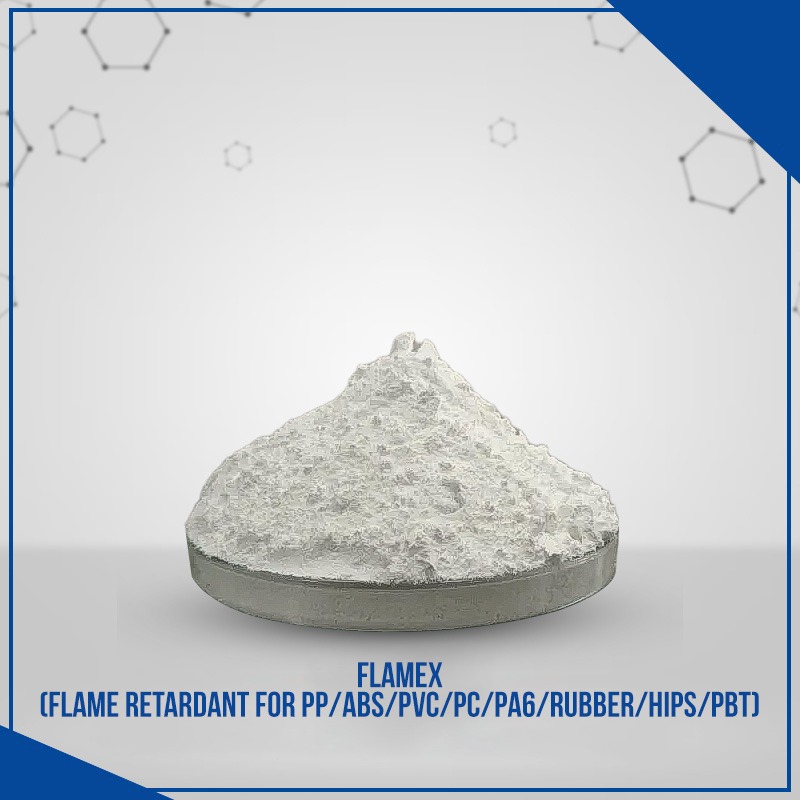 | flame retardant additives Flamex ( Flame Retardant for PP ABS PVC PC PA6 RUBBER HIPS PBT ) FLAMEX ( One Pack Flame Retardant ) manufactured by our company is widely used in PP,PA, PE,PC ,PC/ABS, PVC , Rubber ,PBT, PET, XPS, EPS, PU ,PVC,... View product → |
Frequently asked questions
What should you define before selecting a flame retardant for polypropylene?
Record the PP grade, part geometry, wall thickness and required fire test before comparing additives.
Why compare flame-retardant chemistry before asking for a loading?
Chemistry affects compatibility, processing behaviour, appearance, mechanical performance and the loading needed to meet the fire test.
How should you plan compounding for flame-retardant PP?
Build the compounding route around polypropylene’s heat history, including processing temperature, residence time and the additive’s thermal stability.
Why test the finished moulded component instead of relying on a resin certificate?
Moulding changes thickness, flow orientation, dispersion and surface condition, so the finished part can perform differently from the certified resin.
What should you compare when choosing a Delhi supplier?
Compare technical documentation, batch traceability, application support, sample evaluation and consistency of supply before making a production decision.