
A flame-retardant powder does not receive a meaningful pass or fail result by itself: the finished resin formulation, molded thickness, conditioning and test method determine the outcome. By the end, you will be able to match each fire-performance claim to the right standard, specify comparable laboratory samples and challenge supplier evidence before approving a formulation.
Key takeaways
- Match each fire-performance claim to its specific test method.
- Test the finished part at its intended thickness, not the additive alone.
- Compare additive loadings only under identical processing conditions.
- Verify laboratory reports, supplier evidence and aged-part performance.
Match the fire-performance claim to the correct flammability test
Request the test named by the product specification, performed on the finished plastic part at its intended specimen thickness. A UL 94 result belongs to the complete formulation, not to the flame-retardant powder alone.
| Standard | Orientation and measurement | Use the result for |
|---|---|---|
| UL 94 | Vertical and horizontal orientation; HB, V-0, V-1 and V-2 classifications | A part-specific flame classification |
| ASTM D635 | Horizontal burning; measures burning rate and whether the flame reaches a reference mark | Horizontal-burning screening |
| ASTM D3801 | Vertical burning; records afterflame, afterglow and flaming drips | Vertical-burning comparison |
| IEC 60695-11-10 | Horizontal and vertical flame tests on plastics | International equivalent-style flame testing |
| ISO 4589 | Limiting oxygen index (LOI): oxygen concentration supporting candle-like combustion | Oxygen-demand comparison |
| ASTM D2863 | Limiting oxygen index under its specified apparatus and conditions | LOI measurement; not a UL 94 substitute |
UL 94 HB does not qualify a part for UL 94 V-0. UL 94 V-0, UL 94 V-1 and V-2 ratings still contain different afterflame and dripping requirements; V-2 permits flaming drips that ignite cotton. Report polymer grade, color, processing history and specimen thickness with the rating.
For electrical enclosures, UL 94 V-0 does not prove resistance to a glowing connection. Request the product standard’s IEC 60695-2-series glow-wire test when ignition from hot parts is a hazard.
Measure smoke, heat release and ignition as separate performance questions
A flame rating answers whether a specimen stops burning under a defined flame; it does not prove low smoke, delayed ignition or safe emissions. Measure each hazard separately, because a formulation can pass a flame test while producing dense smoke or corrosive gases.
| Method | What it reveals | Important boundary |
|---|---|---|
| ASTM E662 | Optical smoke density under flaming and nonflaming smoke density exposure | Measures obscuration, not toxicity or corrosivity |
| ISO 5659-2 | Smoke generation under a specified exposure condition | Not interchangeable with ASTM E662; specify thickness and acceptance limit |
| ASTM E1354 and ISO 5660-1 | Cone calorimetry questions including time to ignition, heat-release rate, peak heat-release rate and total heat release | Match the imposed radiant heat flux, orientation, thickness and backing |
| FTIR or gas chromatography/mass spectrometry | Identifies combustion gases and potentially hazardous species | Required when emissions composition matters |
| IEC 60695-2 series | Glow-wire ignition and flammability behaviour | Addresses electrical-heat ignition, not smoke safety |
Use ASTM E1354 or ISO 5660-1 to compare fire growth, then use ASTM E662 or ISO 5659-2 for smoke. A smoke suppressant can reduce visible smoke while increasing toxic or corrosive products, so pair smoke-density data with FTIR or gas chromatography/mass spectrometry when the end use demands emissions control.
Glow-wire testing remains separate: a UL 94 V-0 result does not prove resistance to a glowing connection.
Build and report the specimen so the result can be compared
Use complete formulation testing on the finished molded plastic, not the additive powder. Record the polymer grade; additive loading in phr and weight percent; filler and pigment content; plasticizer; glass or mineral reinforcement; specimen dimensions; end-use thickness; and color. A loading transferred from another resin is not a valid comparison.
The laboratory record must state:
- Molding temperature, screw configuration, residence time and shear, because processing changes dispersion, dripping and char formation.
- Moisture conditioning and elevated-temperature UL 94 preconditioning, including the exposure duration and temperature.
- The method edition and acceptance classification, such as UL 94 V-0, V-1 or V-2.
- Afterflame and afterglow times for each specimen, whether flaming drips occurred, and whether a cotton indicator ignited.
- The specimen orientation and thickness tested, especially when the end-use part is thinner than the laboratory bar.
Report the actual dimensions and conditioning history alongside the result. A V-2 classification permits flaming drips that ignite the cotton indicator, so do not present it as equivalent to V-0 for an enclosure or electrical application.
If the report omits formulation or molding history, you cannot tell whether the rating belongs to the additive package or to one narrowly processed specimen.
Compare additive loadings only after controlling processing and thickness
A 30% package is not automatically better than a 20% package. Test both at equal specimen thickness and against the same performance target, then document the loading calculation as weight percent of the total formulation or phr against resin.
| Factor | Hold constant | What goes wrong if changed |
|---|---|---|
| Formulation | Polymer polarity and melt viscosity, pigments, fillers, plasticizer type and migration, additive compatibility | Dispersion, dripping and measured rating change |
| Processing | Melt temperature, residence time, screw configuration and moisture | Poor dispersion or particle agglomeration can mimic additive weakness |
| Thermal fit | Aluminium hydroxide decomposition temperature and magnesium hydroxide decomposition temperature against the formulation window | Premature decomposition creates porosity, poor surface finish or insufficient activity |
| Specimen | Equal thickness, orientation, molding history and surface finish | A thinner or better-finished bar can appear superior |
Use the same commercial resin, colorant and molding cycle for both packages. Check compound cross-sections for agglomerates, and record melt temperature rather than barrel settings alone. A package that needs a higher loading to reach the target is less efficient, but efficiency is meaningful only after processing and thickness are controlled.
Audit the laboratory result and supplier evidence before approval
A fire-performance claim is not approval evidence until the tested material, method and supplied batch are traceable. Require documents from both the laboratory and additive supplier before releasing the formulation.
1. Obtain the raw test report from an ISO/IEC 17025-accredited laboratory. It must show the standard, report revision, method edition and exposure condition, plus specimen dimensions, conditioning, flame application, observations and classification such as UL 94 V-0, V-1 or V-2.
2. Demand a formulation-specific report using plaques or bars molded from the commercial formulation at the actual production thickness. A neat resin-and-additive blend can hide dispersion, processing and compatibility failures.
3. Match the tested material to the shipment through the supplier’s certificate of analysis. Check the batch number, purity, active-content data, particle-size data and moisture content against the approved purchase specification.
4. Request the safety data sheet separately; it describes hazards and handling, not fire performance. For an additive from Niknam Chemicals Pvt. Ltd, ask the supplier to identify the exact batch used in testing and disclose any change in composition or manufacturing site.
Reject a report that names only a product family, omits thickness, or uses a different formulation from the one you will mold. That claim is not transferable.
Related products
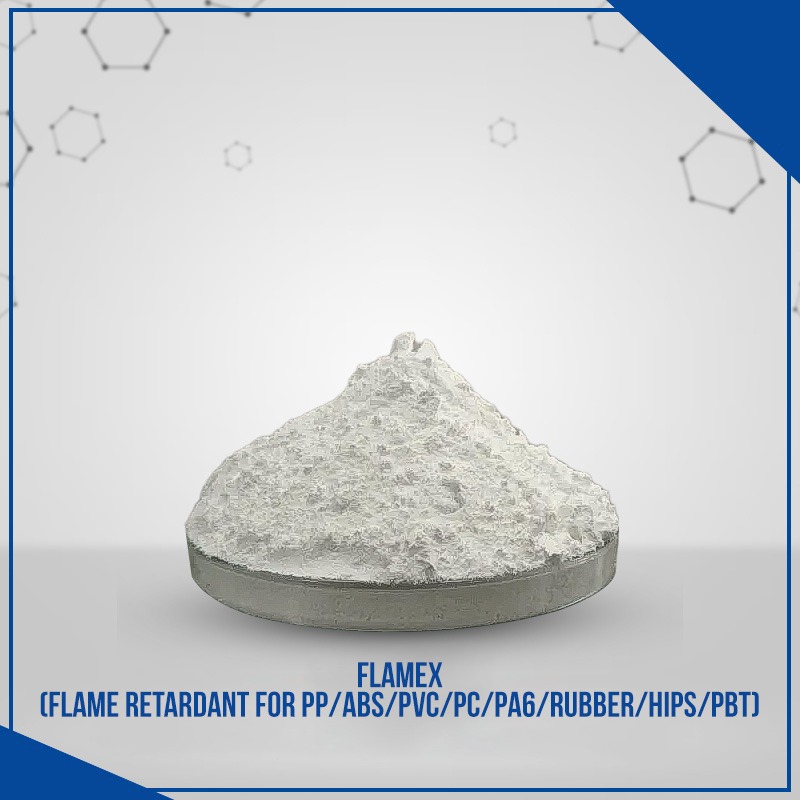 | flame retardant additives Flamex ( Flame Retardant for PP ABS PVC PC PA6 RUBBER HIPS PBT ) FLAMEX ( One Pack Flame Retardant ) manufactured by our company is widely used in PP,PA, PE,PC ,PC/ABS, PVC , Rubber ,PBT, PET, XPS, EPS, PU ,PVC,... View product → |
 | Flame Retardant Filler FAM-501 Flame Retardant Filler FAM-501 FAM - 501 Flame Retardant filler FAM-501 is One Pack Flame Retardant & Smoke Suppressant developed for Plasticized PVC applications. View product → |
Verify performance after aging and against the end-use hazard
Repeat retention testing after heat aging, humidity exposure, water immersion, cleaning and extraction, or the defined service exposure—whichever reflects the part’s real environment. These stresses can cause blooming, migration, hydrolysis or thermal aging, leaving an initially compliant specimen unable to meet its original classification.
Use plaques or bars molded from the commercial formulation at the production thickness, not a neat resin/additive blend. Record the exposure temperature, duration, humidity, fluid chemistry and conditioning interval, then retest:
- Flammability classification at the specified thickness
- Smoke-suppressant performance, including smoke density and heat-release behaviour
- Any application-specific ignition or glow-wire requirement for electrical and electronic plastics
A lower smoke reading does not prove safe emissions: the package can produce corrosive and toxic combustion products, so specify gas analysis when the hazard assessment requires it. Finish the specification with the product-specific regulatory classification, exposure condition, acceptance limit and test method—not a generic “flame retardant” claim.
Check each supplier’s formulation-specific evidence against the production material, processing conditions and actual fire risk before approval.
Frequently asked questions
Which test should you use for a flame-retardant claim?
Match the claim to the test: UL 94 evaluates burning behavior and classification, while smoke density and heat release require separate methods.
Why must specimen thickness and formulation be reported?
Flame-retardant results depend on the complete formulation, specimen geometry, thickness and processing history. Without those details, you cannot make a reliable comparison.
How should you compare different additive loadings?
Keep the polymer grade, additives, moisture condition, processing temperatures, specimen thickness and test laboratory consistent before comparing loadings.
What evidence should you check before approving a supplier?
Audit the full laboratory report, specimen description, test standard and revision, conditioning details, batch information and supplier data. Confirm performance after aging and against the actual end-use hazard.
Related products
| FAM-501 ABOUT FAM - 501 FAM-501 is One Pack Flame Retardant & Smoke Suppressant developed for Plasticized PVC applications. View product → |
 | Aluminium Trihydrate (ATH) is a very finely grounded product having a uniform and controlled particle size distribution. View product → |
 | Antimony Trioxide Our range of Antimony trioxide is used mainly in flame retardant formulations for plastics, rubbers, textiles, paper and paints. View product → |
 | Aluminium Hydroxide ALUMINIUM HYDROXIDE is a Super Fine Precipitated Special ATH. View product → |