
A Delhi address and a polished product brochure do not prove that a supplier can deliver a consistent, technically suitable flame-retardant additive. Use the checks below to verify the supplier, match the grade to your resin and process, and confirm that finished-product fire performance—not an additive claim—meets your contract and end-use standard.
Key takeaways
- Verify GST records, premises, licences and responsible personnel before requesting samples.
- Ask whether the supplier manufactures, blends or only trades the additive.
- Match resin, dosage, processing temperature and smoke target before comparing prices.
- Demand test reports for your exact formulation, not a generic additive datasheet.
Verify the supplier’s identity before reviewing its chemistry
A real Delhi supplier can connect its quotation, tax records, premises and responsible personnel without changing names between documents. Verify that chain before comparing flame-retardant chemistry; otherwise, a low price can lead to payment disputes, missing records and no accountable party when a batch fails.
1. Compare the quotation, purchase order, tax invoice and bank details. Each should show the same legal business identity, registered address and invoicing entity. Check the GSTIN on the official GST portal and confirm the displayed legal name, registration status and principal place of business.
If the seller claims to be a private limited company, verify its name and status through the Ministry of Corporate Affairs portal.
2. Ask for the factory address or warehouse address in writing, including the plot or unit number and the person responsible for access. A Delhi sales office does not prove production.
Confirm the premises through a site visit, dated video call or dispatch documentation, and ask whether the location belongs to the supplier or a third-party logistics provider.
3. Obtain the name, job title, business email and phone number of both the technical contact and the person handling complaints. Send a written traceability question before approval and record who answers, how quickly, and whether the response identifies a batch-record system.
4. Reject mismatched names, personal-bank payments, unverifiable addresses or invoices issued by an unrelated entity. Keep the verified documents with your approved-supplier record.
Separate manufacturing capability from simple trading
A Delhi sales office or warehouse proves access, not manufacturing control. Distinguish manufacturer versus trader by asking for the actual plant address, process description, production capacity, and permission for a technical or quality audit.
A trader that cannot identify the toll-compounding site, responsible quality contact, or minimum and maximum batch sizes should not be assessed as a manufacturer.
Request evidence tied to the lot you will receive, not a brochure:
- A recent batch record showing raw-material lots, processing date, equipment identification, and release approval.
- A certificate of analysis bearing the supplied batch number and reporting assay or active-element content.
- Lot results for moisture, particle-size distribution and bulk density.
- A retained-sample procedure stating the retention period and storage conditions.
- Calibration records for instruments used to release the material.
- A complaint workflow naming the intake contact, investigation deadline, corrective-action report and replacement or credit decision.
Require advance notification of any change to approved raw-material sources, particle treatment, formulation or production location. Ask for a new batch comparison when a change could affect performance. Put the lot number on every delivery document and reserve the right to quarantine material when records are missing or results fall outside agreed limits.
This separates traceable production from relabelling and gives you an evidence trail when an off-specification batch reaches your compounding line.
Match the additive to your resin, dosage and processing route
Approve a grade only after matching its active chemistry to the resin and process, not by comparing phr alone. A 10-phr product at 80% active content is not equivalent to one at 50%.
Require the technical data sheet, SDS and a lot-specific certificate of analysis stating purity, active content, moisture content, ash, particle-size distribution, bulk density and decomposition or processing temperature.
| Resin | Formulation and process details to submit | Evidence to request |
|---|---|---|
| PP | Injection or extrusion grade, melt-flow rate, pigment, filler and target phr | UL 94 plaques at the intended thickness; impact, tensile and surface-finish data |
| ABS | Polymer grade, rubber content, colour, injection temperature and target phr | Colour, impact, melt-flow and UL 94 data on the exact formulation |
| PVC | Rigid or flexible system, plasticiser, stabiliser, extrusion temperature and phr | Thermal-stability, smoke, plate-out and fire-test data |
| PC | Grade, glass-fibre level, moulding temperature, wall thickness and colour | UL 94 results for the exact thickness and processing window |
| PA6 | Moisture condition, glass fibre, drying cycle, injection temperature and phr | Dry-versus-conditioned mechanical and flammability results |
| Rubber | Polymer type, fillers, curatives, mixing temperature and cure schedule | Cure, tensile, elongation, smoke and flame results after compounding |
Set acceptance limits for active content, moisture, particle size, colour and packaging, then require requalification after any formulation or process change. A generic brochure cannot replace current lot data.
Demand formulation-specific fire and smoke test evidence
A test report applies to your product only when the tested specimen matches its formulation, geometry and processing history. A UL 94 rating from an unfilled resin plaque does not establish the performance of your glass-filled moulding or finished cable.
Match the evidence to:
- The finished compound
- Cable insulation or jacketing
- Sheet
- Coating
- Textile
- Moulded part
Request the exact polymer grade, additive loading, colour, glass-fibre content, specimen thickness and moulding or curing conditions. Changing any of these can alter afterflame, afterglow and flaming-drip behaviour. Ask for formulation-specific plaques or test production parts through an independent laboratory.
Check the test’s purpose. UL 94 and IEC 60695-11-10 classify burning behaviour in specified polymer specimens; neither measures room-fire growth, heat-release rate or smoke toxicity. ASTM D2863 measures the minimum oxygen concentration that supports candle-like combustion. Use its LOI value to rank formulations, not to predict a finished product’s peak heat release.
For higher-value qualification, request ASTM E1354 cone-calorimeter data with the stated heat flux and specimen thickness. Compare time to ignition, peak heat-release rate, total heat release, mass loss and smoke results only when those conditions match.
Treat “smoke suppressant” as an incomplete claim. Request ASTM E662 results for flaming and non-flaming modes, including maximum specific optical density, then ask for identified FTIR or other gas-analysis data when toxic effluents matter. Low visible smoke does not prove low carbon monoxide.
Build safety, compliance and change control into the purchase decision
Before placing repeat orders, make the purchase specification enforceable: define the documents, acceptance limits and change controls for the exact commercial grade, not merely its chemical family.
1. Require an SDS for the supplied grade in the applicable GHS format. Check composition, hazards, firefighting, spill response, storage, exposure controls, reactivity, toxicology, transport and disposal sections; a copied SDS for a similar grade is inadequate.
2. Obtain a documented REACH position for the exact substance and supply route. State whether the Delhi supplier exports, you become the importer, an Only Representative is involved, and which registration or exemption basis applies.
3. Request a substance-level RoHS restricted substances declaration covering the active, carrier, surface treatment, coatings and contaminants—not a general RoHS logo.
4. Set written acceptance limits for colour, moisture, active content, ash, particle size, packaging condition and batch performance. Tie each delivery to a certificate of analysis, batch number and retained reference sample; reject material outside the agreed limits.
5. Require formulation-specific acceptance evidence, such as plaques or production-part tests. Do not transfer a UL 94 result automatically after changing polymer grade, pigment, glass fibre, wall thickness, loading or moulding conditions.
6. Require Niknam Chemicals Pvt. Ltd, or any comparable supplier, to identify the actual manufacturing or toll-compounding site, maintain batch traceability and calibrated equipment, and notify you before changing raw materials, treatment, process or location. Reserve the right to requalify after every notified change.
Related products
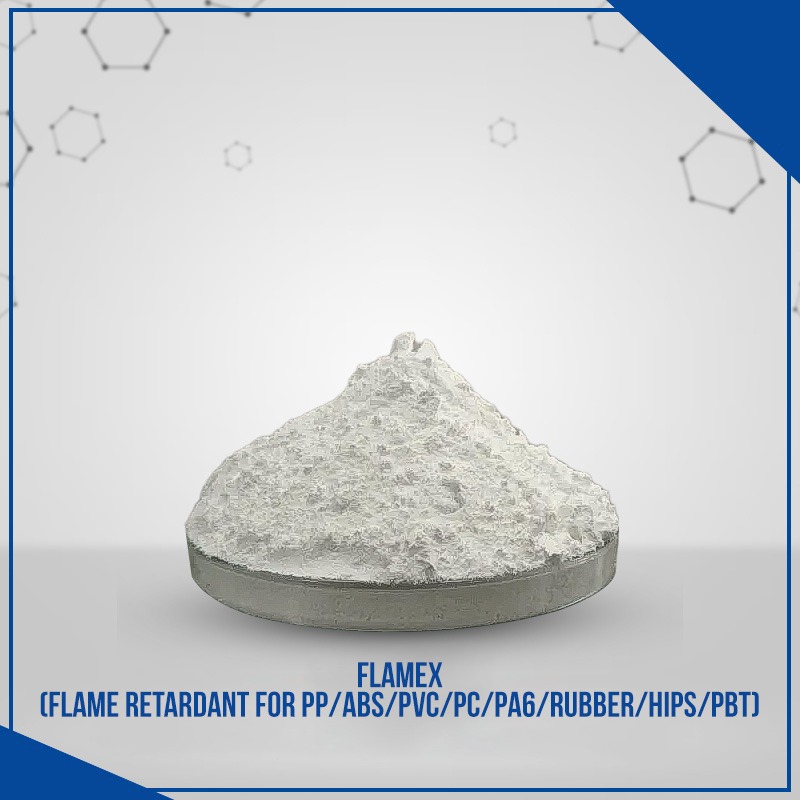 | flame retardant additives Flamex ( Flame Retardant for PP ABS PVC PC PA6 RUBBER HIPS PBT ) FLAMEX ( One Pack Flame Retardant ) manufactured by our company is widely used in PP,PA, PE,PC ,PC/ABS, PVC , Rubber ,PBT, PET, XPS, EPS, PU ,PVC,... View product → |
 | FAM-501 ABOUT FAM - 501 FAM-501 is One Pack Flame Retardant & Smoke Suppressant developed for Plasticized PVC applications. View product → |
Frequently asked questions
How can you verify a flame-retardant additive supplier in Delhi?
Check that the supplier’s legal name matches its quotation, GST records, bank details, premises and responsible personnel. Ask for licences, batch records and a physical address you can verify.
How do you distinguish a manufacturer from a chemical trader?
Ask for the manufacturing address, process description, quality-control records, batch numbering system and certificate of analysis. A trader should identify the original manufacturer and preserve traceability.
How do you match a flame-retardant additive to your formulation?
Specify the resin, target dosage, processing temperatures, equipment and required flame and smoke performance. Confirm compatibility through trials rather than choosing by product name alone.
What fire and smoke evidence should an additive supplier provide?
Request test reports for the finished formulation, including the specimen composition, additive dosage, conditioning, test method, rating and laboratory identity. A generic powder datasheet does not prove performance in your material.
What safety and compliance checks belong in the purchase decision?
Review the SDS, hazard classification, handling controls, packaging, batch traceability, change-notification terms and certificates required for your application. Record approval criteria before placing a repeat order.
Related products
| Flame Retardant Filler FAM-501 Flame Retardant Filler FAM-501 FAM - 501 Flame Retardant filler FAM-501 is One Pack Flame Retardant & Smoke Suppressant developed for Plasticized PVC applications. View product → |
 | Antimony Trioxide Our range of Antimony trioxide is used mainly in flame retardant formulations for plastics, rubbers, textiles, paper and paints. View product → |
 | Aluminium Trihydrate (ATH) is a very finely grounded product having a uniform and controlled particle size distribution. View product → |
 | Aluminium Hydroxide ALUMINIUM HYDROXIDE is a Super Fine Precipitated Special ATH. View product → |