
The right flame-retardant package depends on the polymer, processing temperature, part geometry, fire test and customer restrictions—not simply on the additive’s name or price. By the end, you will be able to narrow the choices, set a defensible starting formulation and request evidence that matches your Chennai plant’s processing and humidity conditions.
Key takeaways
- Screen ATH first below 180–220 °C, then check flow, impact and part weight.
- Set loading windows with molded-part testing, not additive performance data alone.
- Compare halogenated, mineral and intumescent systems at your actual processing temperature.
- Specify the fire test, conditioning method and pass criterion before requesting samples.
Match the additive family to the polymer and processing temperature
For a polymer processed below 180–220 °C, screen aluminium trihydrate first. ATH, also sold as an aluminium hydroxide flame retardant, releases water endothermically, cooling the melt and diluting flame gases; the penalty is high loading, lower melt flow, poorer impact strength and a heavier, rougher part.
Above that range, screen magnesium hydroxide (MDH), which decomposes near 300–350 °C.
| Polymer, process and end use | Screen first | Main decision |
|---|---|---|
| PVC cable extrusion | One-pack flame retardant or ATH | Check smoke, flexibility, electrical tracking and die temperature; excess mineral loading harms elongation. |
| PP injection moulding | MDH or a qualified one-pack system | MDH tolerates hotter processing, but high loading can reduce flow and weld-line strength; dripping may require an anti-drip or char strategy. |
| ABS and PC/ABS housings | Halogenated system with antimony trioxide | Lower loading can protect thin sections, but compare smoke, acidic combustion products and restricted-substance rules. |
| PA6 and PBT engineering parts | MDH or a polymer-specific phosphorus one-pack | Confirm melt-temperature stability, drying and impact retention; do not extrapolate from a plaque. |
| Rubber profiles and cable compounds | ATH below its dehydration range; MDH for hotter processing | Compare tear strength, compression set, smoke and compound viscosity. |
Treat zinc borate as a smoke-suppression or char-supporting co-additive, not an automatic primary solution. Ask for drying temperature, moisture limit, melt-temperature ceiling, residence-time limit and regrind allowance: wet feedstock, screw shear or long residence can decompose reactive packages, generate gas and cause erratic UL 94 results.
Qualify after humid conditioning and thermal aging, not only dry-as-molded.
Set a loading window without sacrificing part performance
Start with a loading window, not a pass-or-fail plaque. For PP, a useful PP flame retardant dosage screen is 20–30 phr for an intumescent or halogenated package, while ATH often begins at 40–60 phr; 20 phr equals 16.7% weight percentage when phr is based on 100 parts polymer.
High ATH loading can reduce impact, tensile strength, melt flow and surface finish.
- Check the additive’s TGA onset against the actual melt temperature, not just the barrel setting. ATH suits compounds kept below roughly 180–220 °C; magnesium hydroxide needs a hotter processing window.
- Run a dry-blend and compounded sample at low, middle and high flame retardant loading. Record torque, pressure, screw amperage, die build-up, plate-out and colour change.
- Measure melt-flow rate, tensile strength, elongation, notched impact and weld-line strength. A thin plaque can pass while a thick rib cracks or a large part warps.
- Inspect dispersion by microscopy and check moisture before feeding. Wet additive or excessive residence time can create gas, molecular-weight loss and erratic burning.
- Test the intended wall thickness and gate design. Confirm that the package does not block thin-section filling or create flaming drips.
| Polymer | Starting screen | Main compatibility check |
|---|---|---|
| PP | 20–30 phr; 40–60 phr for ATH | Impact, weld lines and flow |
| ABS | 12–20 wt% | Gloss, impact and colour |
| PC/ABS | 12–20 wt% | Melt stability and stress cracking |
| PA6 | 15–25 wt% | Moisture, impact and viscosity |
| PBT | 15–25 wt% | Hydrolysis, warpage and flow |
| PVC | 5–15 wt% | Plasticiser interaction and smoke |
| Rubber | 20–40 phr | Elongation and cure behaviour |
Compare halogenated, mineral and intumescent systems under real processing conditions
Choose by the temperature the compound sees, then price the complete package rather than the additive kilogram. A low-loading halogenated system can preserve melt flow, while a high-loading mineral system raises density and viscosity.
| System | Processing and melt-flow effect | Smoke, corrosion and market effect |
|---|---|---|
| Halogenated plus antimony trioxide | High efficiency at lower loading; usually the smallest melt-flow penalty. Confirm the polymer’s melt-temperature and residence-time limit. | More smoke and acidic, corrosive combustion products can damage equipment and create exposure controls. RoHS restricts PBB and PBDE to 0.1% in homogeneous materials; a customer may still demand halogen-free material. |
| Mineral: ATH or magnesium hydroxide (MDH) | ATH dehydrates around 180–220 °C, so it suits cooler processing. MDH decomposes around 300–350 °C and suits PP, PA6 and some engineering thermoplastics. Both often need high loading, reducing melt flow, tensile strength, impact and surface finish. | Water release dilutes flame gases and limits heat, with lower corrosivity. The loading increases part density; surface treatment controls viscosity and dispersion. Zinc borate can improve char and smoke performance in selected formulations. |
| Intumescent | APP-based packages expand into a protective char, but excessive shear, residence time or moisture can cause gas, die build-up and unstable results. | Smoke reduction depends on the polymer and test conditions, not the label. Request ASTM E662 specific optical density under flaming and nonflaming conditions. |
Ask for the customer’s restricted-substance list before selecting chemistry. Record melt temperature, drying conditions, screw shear, residence time and regrind allowance; a package that passes UL 94 in a laboratory can fail after wet or overheated production.
Specify the fire test, conditioning and pass criteria before buying
Treat a formulation as qualified only against a named end-use test, stated specimen thickness, conditioning schedule and numerical pass limit—not a supplier’s “flame-retardant” claim.
1. Write the method into the purchase specification.
For small plastic specimens, require UL 94 vertical testing to IEC 60695-11-10, with the target rating identified: UL 94 V-0 requires each flame application to produce no more than 10 seconds of afterflame, no flaming drips and no burn-through; UL 94 V-1 permits longer afterflame and has different limits.
Do not accept “passes UL 94” without the rating and thickness.
2. Define conditioning before testing. Require results as molded and after moisture conditioning at a specified temperature, relative humidity and duration, plus thermal aging at a specified temperature and time. State whether specimens are tested before or after aging. This matters in Chennai humidity, especially for hygroscopic polymers and APP-containing systems.
3. Match the larger-scale test to the product. For building or panel applications, request ASTM E84 results with flame-spread and smoke-developed values against the project’s stated limit. For electrical parts exposed to a hot wire, require the applicable IEC 60695-2 glow-wire test and product-standard grade; UL 94 V-0 does not prove glow-wire performance.
4. Demand a signed laboratory report naming the formulation, additive loading, polymer grade, colour, specimen thickness, processing conditions, conditioning, individual observations and pass/fail result. Request ASTM E662 specific optical density under flaming and nonflaming conditions when smoke matters. LOI can screen formulations, but it cannot replace the end-use test.
Turn a supplier sample into a Chennai production qualification
A supplier plaque is only a screening result. Request the technical data sheet, safety data sheet, processing-temperature limits, recommended loading, restricted-substance declaration, and a lot-specific batch test report before scheduling a plant trial. Ask Niknam Chemicals Pvt. Ltd for the same traceability documents for the exact grade and batch you plan to compound.
Run the additive through your actual Chennai line, using production equipment, target residence time, screw speed, die temperature and cooling conditions. Compound enough material for plaques and finished parts; a small plaque can pass while the larger moulding develops weld-line cracking, warpage, poor impact strength or thin-section flow failure.
Close the qualification file only when it contains:
- The supplier batch number linked to incoming inspection, weighed addition and finished-compound lots.
- Trial records for at least the lower and upper proposed loadings, including melt flow, torque, dispersion, surface finish, density and colour.
- Finished-part results against the customer’s named fire standard, not a generic “flame-retardant” claim.
- IEC 60695-2 glow-wire results where ignition from a hot wire or glowing component matters; select the required grade from the product standard.
- ASTM E662 smoke density results under flaming and nonflaming conditions when smoke is specified.
- EN 45545-2 evidence tied to the required hazard level, product category and test method.
- Retained samples of additive, compound and moulded parts for retest after a failed result.
Treat LOI and UL 94 V-0 as screening evidence, not approval. A V-0 result does not establish smoke performance, enclosure behaviour or glow-wire compliance.
Related products
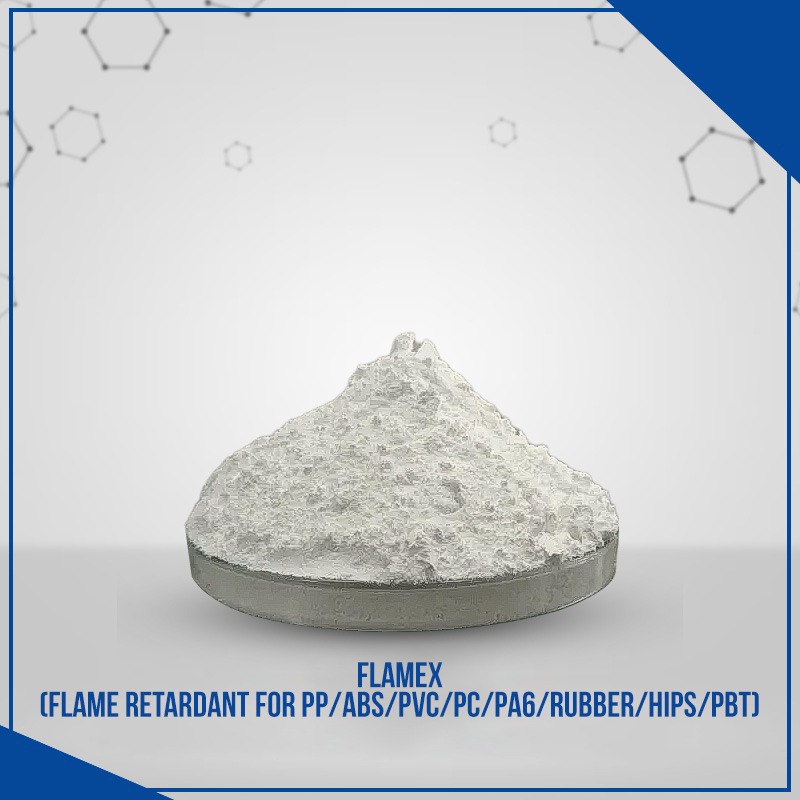 | flame retardant additives Flamex ( Flame Retardant for PP ABS PVC PC PA6 RUBBER HIPS PBT ) FLAMEX ( One Pack Flame Retardant ) manufactured by our company is widely used in PP,PA, PE,PC ,PC/ABS, PVC , Rubber ,PBT, PET, XPS, EPS, PU ,PVC,... View product → |
 | Flame Retardant Filler FAM-501 Flame Retardant Filler FAM-501 FAM - 501 Flame Retardant filler FAM-501 is One Pack Flame Retardant & Smoke Suppressant developed for Plasticized PVC applications. View product → |
Frequently asked questions
Which flame-retardant additive should you screen first for polymers processed below 180–220 °C?
Screen aluminium trihydrate (ATH), also called aluminium hydroxide. It releases water endothermically, but high loading can reduce melt flow and impact strength.
How do you set a flame-retardant loading window without damaging part performance?
Test a low, middle and high loading in the target polymer, then compare fire performance with melt flow, impact strength, surface finish, density and mechanical results.
How do halogenated, mineral and intumescent systems differ under production conditions?
Halogenated systems can deliver strong flame inhibition at lower loading; mineral systems absorb heat but often require higher loading; intumescents form a protective char and need compatible formulation and processing conditions.
What must you specify before buying a flame-retardant additive?
Name the fire test, specimen thickness, conditioning time and temperature, test direction, number of specimens and exact pass criterion before comparing supplier results.
How do you qualify a supplier sample for Chennai production?
Process the sample on your production equipment using the intended polymer, temperature profile, screw speed, mold and drying procedure, then test molded parts against your defined fire and performance criteria.
Related products
| FAM-501 ABOUT FAM - 501 FAM-501 is One Pack Flame Retardant & Smoke Suppressant developed for Plasticized PVC applications. View product → |
 | Antimony Trioxide Our range of Antimony trioxide is used mainly in flame retardant formulations for plastics, rubbers, textiles, paper and paints. View product → |
 | Aluminium Trihydrate (ATH) is a very finely grounded product having a uniform and controlled particle size distribution. View product → |
 | Aluminium Hydroxide ALUMINIUM HYDROXIDE is a Super Fine Precipitated Special ATH. View product → |