
A polypropylene component does not receive a universal flame-retardant grade: its result depends on wall thickness, geometry, resin type, additive loading, processing history and the test demanded by the customer. By the end, you will be able to define the required fire test, design a practical screening plan, challenge supplier data and set purchasing conditions for production in Chennai.
Key takeaways
- Specify UL 94 class, specimen thickness and geometry before selecting an additive.
- Set loading against PP grade, end use and flame-retardant chemistry.
- Verify dispersion, processing stability and fire performance on production-shaped parts.
- Trial additives under Chennai’s heat, humidity and manufacturing constraints.
Define the fire test before choosing a polypropylene additive
The required result is the customer’s end-use fire specification, written as UL 94 V-0, UL 94 V-1 or UL 94 V-2 at a named specimen thickness and geometry. UL 94 is thickness-specific: a compound rated V-0 on a thick bar can fail at the component’s thinner wall.
| Rating | Acceptance result | Dripping |
|---|---|---|
| V-0 | Each application: no more than 10 seconds afterflame; five specimens: no more than 50 seconds total | No flaming drips |
| V-1 | Five specimens: no more than 250 seconds total afterflame | No flaming drips |
| V-2 | Same time limits as V-1 | Flaming drips permitted |
Write the requirement with minimum wall section, ribs, holes, clips, inserts, weld lines and production mould conditions. State whether the specified method is IEC 60695-11-10 or ASTM D3801; these are not interchangeable labels. A plaque result does not qualify a shaped industrial component.
For electrical parts, add the hazard-specific glow-wire method from IEC 60695-2-10 through -13, needle-flame under IEC 60695-11-5, and comparative tracking under IEC 60112 after humidity conditioning. Do not treat V-0 as proof against an overheated wire or glowing element.
Use ASTM D2863 limiting oxygen index (LOI) to compare formulations, not to replace end-use testing: LOI does not measure dripping, ignition time or geometry. Specify smoke separately, such as optical density under ASTM E662, and address flame spread, smoke and combustion corrosivity as separate acceptance targets.
Set loading by PP grade, application and fire-retardant chemistry
A recommended FLAMEX loading cannot be set as one universal weight percent phr value. Establish a starting range separately for injection moulding, extrusion, fibre spinning and sheet, then adjust it against the required rating at the actual thickness.
| Application | Start the screen by checking | Main loading risk |
|---|---|---|
| Injection moulding | Flow, ribs, weld lines and mould filling | High loading raises torque and pressure |
| Extrusion | Die pressure, melt strength and surface finish | Poor dispersion causes streaks and die build-up |
| Fibre | Spinnability, elongation and filter pressure | Large particles break filaments |
| Sheet | Thickness, draw-down and smoke result | Additive migration can weaken surfaces |
Screen the same package in PP homopolymer, PP random copolymer and PP impact copolymer, including PPCP and PPHP grades. Comonomer content changes crystallinity, impact behaviour and fire response, so a result in one grade does not transfer automatically.
Record talc, glass fibre, calcium carbonate, pigment, recycled PP and every other mineral filler before choosing dosage. These ingredients can alter burning, dripping, dispersion and mechanical strength even when flame-retardant loading is unchanged.
ATH or aluminium hydroxide releases water at about 200–230 °C, making it a poor choice for PP processed near that range. Magnesium hydroxide decomposes around 330–350 °C but often needs tens of weight percent, sometimes 40–60 wt% for demanding ratings; flow, elongation and toughness then suffer.
Compare that route with a halogenated package, often using antimony oxide, and with a halogen-free intumescent system containing an acid source, carbon source and blowing source. A one-pack additive simplifies dosing, but establish its actual loading independently for each process and wall thickness.
Control addition, dispersion and processing during compounding
Choose the feeding route by dosing accuracy at the target throughput, not by convenience. Dry blending before extrusion suits small trials but can segregate; masterbatch dilution improves repeatability when the carrier matches the PP; direct feeding suits a calibrated gravimetric system and concentrated packages.
| Route | Strength | Main risk |
|---|---|---|
| Dry blending before extrusion | Simple, low setup cost | Segregation and uneven dispersion at high throughput |
| Masterbatch dilution | Accurate, clean dosing | Carrier incompatibility or dilution error |
| Direct feeding | Precise control of concentrated additive | Feeder bridging and unstable low-rate feed |
Record drying conditions, PP moisture, additive moisture, mixing time, melt temperature, residence time, screw speed, screw configuration and feed location. Capture torque, melt flow rate, die pressure, mould filling, cycle time, shrinkage, plate-out, odour, colour and surface appearance at every loading.
Do not raise temperature or shear to recover flow without checking degradation, volatiles and reduced intumescent efficiency. Confirm compatibility with antioxidants, UV stabilisers, nucleating agents, lubricants, pigments, glass fibre, talc and calcium carbonate; each can change fire performance.
Use dispersion checks on a microtomed or ashed sample to find agglomerates, then confirm distribution through ash content or additive-loading checks. Compare tensile strength, impact strength, elongation, heat-deflection temperature and weld-line performance with fire results. Short shots, streaks or weak knit lines disqualify a plaque-qualified formulation from production moulding.
Prove the compound on production-shaped parts and after conditioning
1. Use a practical screening method with low, middle and high loading levels agreed with the supplier. Mould plaques and production-equivalent parts, then condition specimens under the customer’s temperature and humidity protocol before repeating the specified fire test.
2. Make production component validation represent the weakest geometry: minimum wall thickness, ribs, sharp corners, holes, clips, inserts, weld lines and actual mould conditions. Do not qualify only a flat plaque; these features can change ignition, dripping and smoke behaviour. Record vertical burning, oxygen index, smoke and, where applicable, glow-wire, needle-flame and tracking results.
3. Include high-temperature humidity aging for Chennai service conditions, then define retention limits for flammability, impact strength and colour. Requalify after changing the resin grade, glass-fibre or talc percentage, pigment, recycled content, screw settings or wall thickness. A pass before aging does not prove compliance after additive migration, moisture exposure or impact loss.
4. Request the additive TDS, SDS and COA, plus lot traceability, moisture specification, particle size, thermal stability range and storage life. Verify production consistency through batch sampling, ash content, additive-loading checks, melt-flow testing and repeat fire tests.
Confirm that the evidence covers the actual halogenated or halogen-free chemistry, smoke and corrosivity target, humidity-conditioned performance and electrical properties.
Buy and trial the additive against Chennai production constraints
Before Chennai purchasing, request a sample quantity large enough for compounding, moulding and repeat testing. Confirm the minimum order, lead time, local delivery, technical support, trial-compounding support and documentation required by your quality system. Ask Niknam Chemicals Pvt. Ltd for comparable data, not a product promise.
- Check packaging integrity, moisture protection, storage temperature, shelf life and handling precautions. Keep moisture-sensitive packages sealed and dry them only to documented instructions.
- Record lot number, composition, processing guidance, humidity-aged results, thermal stability, moisture and particle-size data. Require a plan for production-part validation, not only laboratory plaques.
- Compare a one-pack additive with separate antimony trioxide, zinc borate, molybdenum trioxide, ATH or aluminium hydroxide. Do not assume any single material works in PP; verify loading, dispersion, flow, toughness, smoke and afterglow.
- Separate flame retardancy from smoke suppression. Check whether the chemistry is halogenated or halogen-free, whether combustion is corrosive, and whether it meets restricted-substance rules.
- Reject the option if evidence does not demonstrate the specified low-smoke, halogen-free, low-toxicity, electrical-tracking or automotive OEM standard after the required conditioning.
- Reject it if the supplier cannot provide lot data, processing guidance, humidity-aged results or production-part validation support.
| Option | Compare | Decision evidence |
|---|---|---|
| One-pack additive | Simpler dosing, but loading and compatibility remain unproven | Compound and mould at production settings |
| Multi-component package | More control, but more weighing and dispersion risk | Compare matched fire, smoke and mechanical results |
| ATH or aluminium hydroxide package | Check high loading, flow loss and toughness reduction | Reject when PP processing or part properties fail |
Related product
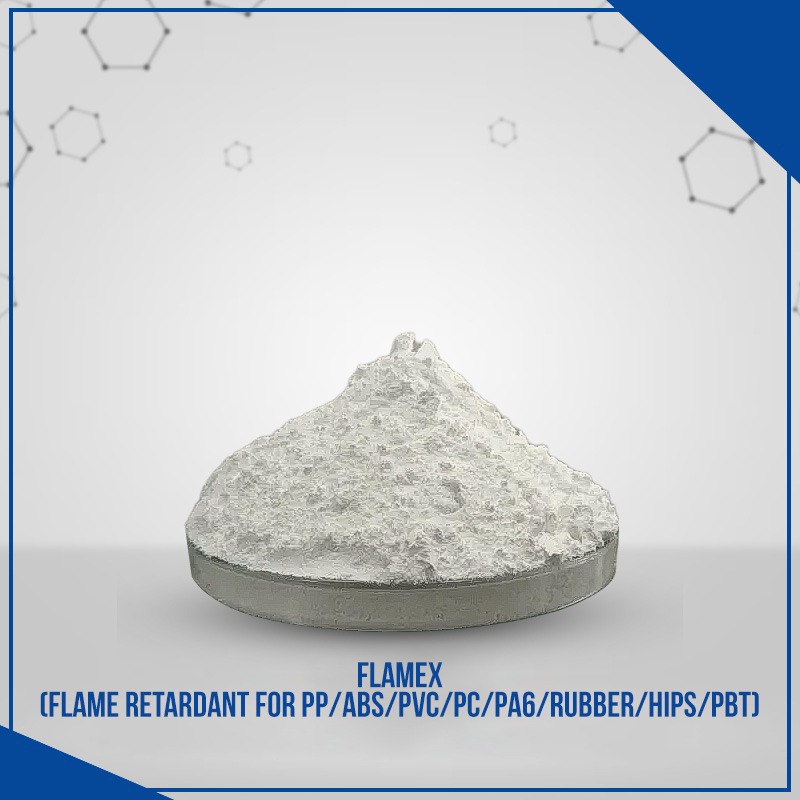 | flame retardant additives Flamex ( Flame Retardant for PP ABS PVC PC PA6 RUBBER HIPS PBT ) FLAMEX ( One Pack Flame Retardant ) manufactured by our company is widely used in PP,PA, PE,PC ,PC/ABS, PVC , Rubber ,PBT, PET, XPS, EPS, PU ,PVC,... View product → |
Frequently asked questions
Which fire test should you define before choosing a polypropylene additive?
Define the required UL 94 result—V-0, V-1 or V-2—along with the specimen thickness and geometry. A compound that passes on a thick bar can fail on a thinner component wall.
How do you set flame-retardant additive loading in polypropylene?
Set loading against the polypropylene grade, application requirements and flame-retardant chemistry, then confirm performance through compounding trials and fire testing.
What must you control during polypropylene compounding?
Control additive addition, dispersion and processing conditions so the formulation remains consistent without damaging the PP grade or reducing fire performance.
How should you validate a flame-retardant polypropylene compound?
Test production-shaped parts after the required conditioning period, rather than relying only on laboratory plaques or thick test bars.
What should you check when buying and trialling additives in Chennai?
Compare supply consistency, technical documentation, handling requirements and trial support against your compounder’s equipment, production schedule and local heat and humidity conditions.