

A flame-retardant additive that passes a supplier plaque can still fail in your ABS part after changes in wall thickness, colour, impact modification, moisture conditioning, or processing history. You will be able to define the required fire and smoke tests, compare additive systems, plan a controlled compounding trial, and qualify supply under Chennai storage and production conditions.
Key takeaways
- Define ABS grade, wall thickness, colour, and fire test first.
- Compare complete formulations, not additive packages in isolation.
- Check compounding and moulding conditions against the tested formulation.
- Request test reports, batch data, and production-part evidence before buying.
Choose the ABS grade and the fire rating before choosing an additive
Define the resin, wall thickness, colour, and fire test before selecting chemistry. A thin, unpigmented plaque can pass while the production part fails.
| Formulation | What changes | Initial question |
|---|---|---|
| ABS injection-moulding grade | Optimised for short flow and mould filling | Does it retain impact strength at the required wall thickness? |
| Extrusion ABS | Designed for sustained melt residence and die output | Will the additive remain stable during longer processing? |
| Impact-modified ABS | Rubber phase improves toughness but can reduce flame performance | What impact value must survive after additive loading? |
| Existing flame-retardant ABS | Already contains a balanced package | Can you modify it without upsetting its tested formulation? |
| PC/ABS blend flame retardant system | Raises heat performance but changes compatibility and processing | Is the blend, rather than neat ABS, the actual substrate? |
Specify UL 94 V-0 at specimen thickness matching the moulded part and test the production colour. V-0 requires no specimen afterflame above 10 seconds, no more than 50 seconds total for five specimens, and no flaming drips that ignite cotton. V-1 permits longer afterflame without igniting cotton; V-2 permits flaming drips.
None is a general fire-safety rating.
UL 94 does not measure smoke density, heat release, toxicity, assembly flame spread, glow-wire performance, CTI, or hot-wire ignition. Specify ASTM E662 smoke density, IEC 60695-2-11 glow-wire test for end products, IEC 60695-2-12 and IEC 60695-2-13 for material behaviour, and FMVSS 302 ABS or ISO 3795 for transport applications.
Compare flame-retardant packages as complete ABS formulations
Compare complete formulations, not isolated ingredients. A brominated ABS package normally needs antimony trioxide synergist; antimony trioxide is not a stand-alone flame retardant.
| Package | Main function | Formulation risk |
|---|---|---|
| Halogenated plus antimony trioxide | Efficient flame inhibition | Reducing antimony can reduce efficiency; excess raises density, impairs impact strength, changes colour, and creates agglomerates |
| Phosphorus-based flame retardant ABS | Flame inhibition or char formation | Liquid or low-molecular-weight phosphate esters can plasticise ABS, lower heat resistance, and migrate or bloom |
| Polymeric phosphate or phosphorus-nitrogen | Lower migration and durable char | May need higher loading or different processing conditions |
| Mineral flame retardant loading | Smoke suppression or char promotion | Metal hydroxides, molybdates, and selected metal oxides can increase viscosity, density, brittleness, colour, or electrical-property risk |
| Zinc borate ABS additive | Smoke suppression and char support | It is a synergist, not a universal replacement for the full package |
Do not replace one ingredient while holding the polymer grade, pigment, glass fibre, mineral reinforcement, impact modifier, lubricant, stabiliser, plasticiser, and recycled ABS content constant. Those materials alter dispersion, ignition, impact, colour, and electrical performance.
Require the supplier to state:
- ABS flame retardant dosage as an initial weight percentage
- masterbatch let-down ratio, active content, and carrier resin
- A trial matrix covering loading, processing temperature, wall thickness, colour, and recycled content
A supplier promising one universal dosage has not supplied a formulation basis. Compare moulded plaques, not additive prices, then measure UL 94, smoke, impact, flow, density, colour, and surface deposits.
Control compounding, moulding, and the properties the additive can change
Start with dried ABS and a measured addition method; do not scatter powder into a production hopper and assume uniform flame retardant dispersion. Compare the options before the trial:
| Option | Control point | Main risk |
|---|---|---|
| Direct compounding | Meter additive into a twin-screw extrusion ABS line | Agglomeration and uneven dosage |
| Dry blending | Preblend powder with ABS pellets | Segregation during feeding |
| Masterbatch dilution | Use a known let-down ratio | Carrier incompatibility or calculation error |
| Injection-moulding feedstock preparation | Add during pellet or feedstock preparation | Poor mixing and variable melt flow |
Run a defined screw configuration with conveying, kneading, and vacuum-vent sections. Set barrel and die temperatures inside both the ABS and additive thermal limits, then minimise ABS residence time. Record regrind percentage and the ABS drying requirements. Check moisture, melt-flow stability, particle dispersion, plate-out, volatilisation, and visible deposits.
High mineral loading raises ABS melt viscosity and density, restricting flow and changing mould filling. Measure tensile strength, ABS impact strength, elongation, heat-deflection temperature, colour, gloss, surface finish, weld-line strength, mould fouling flame retardant, and electrical performance. Record changes in recyclability.
A formulation trial must also capture flame retardant dispersion2026-09-22 and ABS residence time; excessive thermal history, contamination, moisture, or repeated regrind can invalidate a laboratory flame result. Compare results against the unmodified grade, including ABS melt viscosity2026-09-22.
Qualify the additive with evidence, not a resin-supplier claim
Approve an ABS additive only after its batch evidence survives a production-like trial. Ask for a certificate of analysis for the flame retardant showing batch number, test methods, active-content assay, moisture, bulk density, and the particle-size distribution ABS additive. Require thermal-stability data at your intended compounding temperature, plus lot-to-lot colour and dispersion results.
1. Identify the actual chemistry, not just a halogen-free declaration. Check the RoHS PBB PBDE limit: PBB and PBDE flame retardants are restricted to 0.1% in homogeneous material. Review REACH decaBDE restrictions separately; passing RoHS or UL 94 does not settle REACH compliance.
2. Compound representative ABS at the planned dosage, screw speed, residence time, barrel temperature, regrind content, and moulding conditions. Record feed stability, melt-flow change, agglomerates, plate-out, deposits, colour shift, and visible dispersion defects.
3. Mould plaques and finished parts at production wall thickness and colour. Condition them using a documented temperature and relative-humidity profile suitable for Chennai, then repeat fire, smoke, mechanical, electrical, and ageing tests. Unconditioned ABS can hide moisture defects, migration, hydrolytic damage, or lost impact strength.
4. Treat support from Niknam Chemicals Pvt. Ltd as part of the trial record: request representative samples, ABS formulation guidance, batch records, and test reports, but do not approve the additive from a product datasheet alone. Require independent confirmation on the final compounded and moulded formulation.
Related products
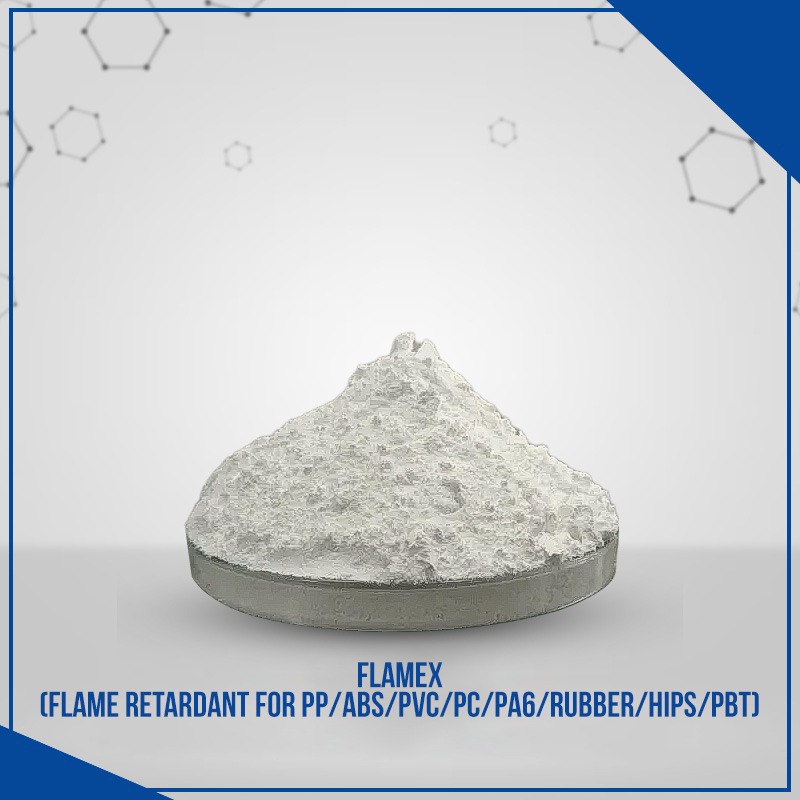 | flame retardant additives Flamex ( Flame Retardant for PP ABS PVC PC PA6 RUBBER HIPS PBT ) FLAMEX ( One Pack Flame Retardant ) manufactured by our company is widely used in PP,PA, PE,PC ,PC/ABS, PVC , Rubber ,PBT, PET, XPS, EPS, PU ,PVC,... View product → |
 | Antimony Trioxide Our range of Antimony trioxide is used mainly in flame retardant formulations for plastics, rubbers, textiles, paper and paints. View product → |
Make the Chennai purchase decision around storage, supply, and the application’s real limits
Approve an additive for Chennai only after it survives storage, production processing, and the finished part’s limits. ABS additive storage Chennai requires sealed, intact bags, a dry warehouse, stock rotation, and a moisture check after damaged or long-stored bags. This is essential for humid storage flame retardant chemicals.
Compare the purchase against the actual risk:
| Option | Accept when | Reject when |
|---|---|---|
| Supply | Trial stock, protected transport, clear flame retardant additive lead time | Quantity or delivery cannot support production trials |
| Performance | UL 94 thickness-specific rating2026-09-22 matches the finished wall | Rating depends on a thinner plaque than the part |
| Formulation | Mineral loading preserves impact and flow; phosphorus chemistry meets heat resistance | Either property falls below the specification |
| Smoke | Package demonstrates the halogen-free ABS smoke target2026-09-22 | A defined smoke limit is claimed without evidence |
Ask for:
- Sample quantities large enough for a representative compounding trial, minimum order quantity, lead time, and transport protection.
- Recommended storage temperature and humidity, packaging integrity limits, and local technical support for dispersion or mould deposits.
Reject the system if testing exposes unacceptable impact loss, flow reduction, or heat-resistance loss. Treat this as engineering plastic additive qualification: define the standard, screen chemistry, compound at production conditions, condition specimens, test independently, compare lot data, and approve only the formulation-plus-process combination.
Frequently asked questions
How do you choose a flame-retardant additive for ABS?
Set the ABS grade, production wall thickness, colour, and required fire test before comparing chemistries.
Why compare complete ABS formulations instead of additives alone?
The resin, additive loading, colourant, impact modifier, and processing conditions all affect fire performance and mechanical properties.
Which processing factors can change flame-retardant ABS performance?
Compounding temperature, residence time, dispersion, moisture control, moulding temperature, and part thickness can change the tested result.
What evidence should you request before qualifying an ABS flame retardant?
Request the exact formulation, fire-test report, specimen thickness, conditioning details, batch information, and production-part validation.
What should Chennai buyers check before ordering the additive?
Check storage conditions, packaging, batch traceability, local supply continuity, lead time, and whether the additive fits the application’s temperature and performance limits.
Related product
 | Zinc Borate ZINC BORATE is a highly effective multifunctional flame retardant synergist being used as a flame retardant and smoke suppressant in a wide range of... View product → |