
Polypropylene burns readily because its hydrocarbon structure produces little protective char, so a successful formulation depends on the resin grade, additive package, processing conditions and required fire test. By the end, you will be able to define a realistic PP flame-retardant specification, compare loading and performance trade-offs, and request evidence that applies to your finished part.
Key takeaways
- Use a coordinated package for flame resistance, smoke control and melt-drip management.
- Match additive chemistry to the PP grade, product geometry and required UL 94 rating.
- Set loading and processing temperatures through trials that protect impact strength and appearance.
- Test finished parts for UL 94 performance instead of relying on additive datasheets.
Why polypropylene needs a complete flame-retardant package
Polypropylene burns readily because its hydrocarbon backbone supplies fuel and lacks heteroatoms that promote char. A small conventional filler cannot reliably create the insulation, melt-drip control and gas-phase interruption needed for a demanding rating such as UL 94 V-0. PP fire resistance therefore depends on a coordinated package, not filler quantity alone.
- A phosphorus-based component promotes char or interferes with combustion reactions.
- A nitrogen synergist releases non-combustible gases or strengthens the protective layer.
- A mineral synergist improves barrier strength and can reduce dripping.
- A compatibilizer helps disperse polar additives through non-polar PP, limiting weak spots and mechanical loss.
- Processing aids, coated ammonium polyphosphate or reinforcement can recover flow, impact and surface quality lost at higher additive loading.
An intumescent flame retardant usually combines an acid source such as ammonium polyphosphate, a carbon source such as pentaerythritol or another polyol, and a blowing source such as melamine. The ratio and dispersion determine whether the package forms a continuous expanded char or leaves burning gaps.
A halogen-free flame retardant avoids the halogenated systems associated with higher smoke and corrosive-gas concerns, but it may require more additive and can affect strength, moisture uptake, resistivity and moulding behaviour. A burning pass alone does not prove the formulation works.
Match the additive system to the PP grade and product
A homopolymer PP enclosure, a flexible film and an impact-resistant automotive part need different flame-retardant systems. Compare the base resin, filler, product form and required rating before comparing dosage or price.
| Grade and product form | Chemistry to compare | Main trade-off |
|---|---|---|
| homopolymer PP, injection-moulded electrical enclosure | phosphorus plus nitrogen synergist, or intumescent ammonium polyphosphate system | Strong V-0 potential; check insulation, tracking and surface quality |
| random copolymer PP, thin sheet or film | low-bloom phosphorus system or halogenated system with antimony trioxide | Better clarity or flexibility; thin sections expose rating and migration limits |
| impact copolymer PP, automotive trim or housing | phosphorus-nitrogen package with compatibilizer, or halogenated package | Protect impact strength; high filler loading can embrittle the part |
| talc-filled polypropylene, moulded appliance or automotive part | mineral-compatible phosphorus package or intumescent system | Talc changes flow, stiffness and char structure; recheck dispersion |
| glass-fibre-reinforced or recycled PP, structural component | polymer-compatible package selected after fibre or contaminant analysis | Fibre, moisture and variable recycled content can destabilise burning results |
For injection moulding, check melt stability, mould deposits and pellet dispersion. For extrusion sheet, film, fibre, wire and cable, compare surface migration, drawability and dielectric retention instead.
Match the chemistry to the hazard. Halogenated systems can reach a rating at lower loading but demand smoke and corrosive-gas data; phosphorus systems can increase moisture uptake. Require UL 94 V-0, V-1 or HB data at your actual thickness, not a certificate showing V-0 at 3.2 mm for a 1.5 mm part.
Set loading and compounding conditions without damaging the part
Start with the finished part, not the additive drum. Define the PP grade, wall thickness, target UL 94 class, melt-flow requirement and impact specification before setting flame-retardant dosage. Screen at least three package levels around the supplier’s validated range, calculating active additive in the final compound rather than the percentage of PP masterbatch.
- Dry ammonium polyphosphate and hygroscopic co-additives in accordance with their technical data sheet, then keep them in sealed moisture-barrier packaging. Moisture creates bubbles, hydrolytic damage and inconsistent fire results, especially in Chennai’s coastal humidity.
- Choose a PP masterbatch whose carrier matches the resin: homopolymer, impact copolymer, talc-filled, glass-fibre-filled or recycled PP. Check the let-down calculation; pellet segregation can leave one moulding under-protected.
- Begin compounding polypropylene with a moderate screw speed, controlled feed rate and a distributive-mixing section before intensive kneading. Use the lowest melt temperature that gives stable melting, commonly near 190–220°C for PP, and avoid long residence times that degrade the package.
- Record torque, melt pressure, throughput and visible specks at every loading. A sharp torque rise or falling impact strength means the formulation needs a compatibilizer, finer or coated APP, lower loading, or a different screw profile.
- Confirm dispersion through a cut-section microscopy check or uniform ash measurement before mould trials. Then inspect gates, runners and cavities for abrasive wear; high mineral loading can demand hardened tooling, lower shear and a less restrictive gate design.
Test the finished formulation, not just the additive
Approve the formulation only after testing moulded specimens at the part’s thinnest and nominal thickness, using the actual colour, fillers and processing history. Fire evidence should include the required UL 94 V-0, UL 94 V-1 or UL 94 HB rating, plus ASTM D635 or IEC 60695-11-10 where specified.
A V-0 result at 3.2 mm does not prove a 1.5 mm enclosure will pass.
| Test | What it shows | Critical comparison |
|---|---|---|
| UL 94 vertical rating | Afterflame, dripping and ignition of cotton | Exact thickness, conditioning and PP grade |
| ASTM D2863 limiting oxygen index | Oxygen concentration needed to sustain burning | Useful ranking, not a substitute for vertical or heat-release testing |
| ASTM E662 or ISO 5659-2 | Smoke density during flaming and non-flaming exposure | Compare equal fire performance, including halogenated systems |
| Heat and humidity ageing | Retention after 85°C/85% RH or the product specification | Re-test fire, colour, mass and electrical properties |
Check mechanical retention with ASTM D638 tensile strength and elongation, ASTM D256 notched Izod impact, and ASTM D790 flexural properties. High-loading intumescent packages can weaken parts, increase brittleness and damage surface finish.
For electrical housings, measure ASTM D257 volume and surface resistivity, IEC 60112 comparative tracking index, and dielectric strength under the required conditioning sequence. Polar phosphorus additives or ionic residues can absorb moisture and cause failure after ageing even when burning tests pass.
Add smoke-toxicity or combustion-effluent data where people occupy the enclosure, vehicle or public space.
Build a Chennai supplier brief that can be verified
Give a flame-retardant additive supplier Chennai a one-page formulation brief, not just “PP, V-0.” State the exact resin, part geometry, processing route and evidence required for approval.
1. Identify the PP grade: homopolymer, random copolymer, impact copolymer, talc-filled, glass-fibre-reinforced or recycled PP. Add melt-flow rate, filler content, colour, moulded thickness, injection or extrusion conditions, and the part’s end use.
2. Specify the target result and method: UL 94 V-0, V-1 or HB at the actual thickness, IEC 60695-11-10, ASTM D635, glow-wire testing, or another named standard. Require the report to show specimen thickness, conditioning, laboratory and exact additive concentration.
3. Request a dosage ladder in weight percent or phr, with compounding temperature, screw speed, residence time, drying instructions, dispersion evidence, torque, mould-wear observations and effects on impact strength, tensile strength and melt flow.
4. For smoke-controlled products, request smoke density ISO 5659-2, cone calorimetry ISO 5660-1 and combustion-effluent data at equal fire performance. Do not treat a smoke suppressant’s lower optical density as proof of lower heat release.
5. Request COA, SDS, batch traceability, ageing and humidity results, volume and surface resistivity, tracking data, and halogen analysis. For halogen-free PP, state the applicable limit; a common electronics threshold is chlorine and bromine below 900 ppm each and 1,500 ppm combined.
Use the same evidence request with Niknam Chemicals Pvt. Ltd, including its proposed FLAMEX grade, rather than approving a catalogue description.
Related products
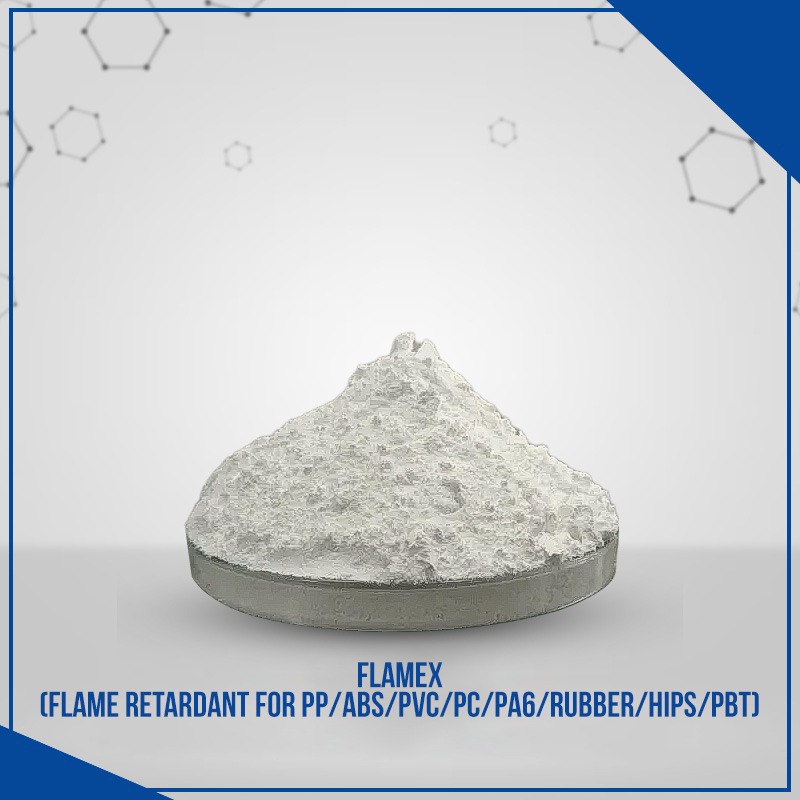 | flame retardant additives Flamex ( Flame Retardant for PP ABS PVC PC PA6 RUBBER HIPS PBT ) FLAMEX ( One Pack Flame Retardant ) manufactured by our company is widely used in PP,PA, PE,PC ,PC/ABS, PVC , Rubber ,PBT, PET, XPS, EPS, PU ,PVC,... View product → |
 | Antimony Trioxide Our range of Antimony trioxide is used mainly in flame retardant formulations for plastics, rubbers, textiles, paper and paints. View product → |
Frequently asked questions
Why does polypropylene need a complete flame-retardant package?
Polypropylene supplies fuel during burning, so demanding ratings such as UL 94 V-0 require coordinated flame resistance, insulation, melt-drip control and gas-phase interruption.
How do you match a flame-retardant system to a polypropylene product?
Compare the PP grade, product thickness, processing method, mechanical requirements, appearance limits and target fire rating before selecting the additive system.
How should you set additive loading and compounding conditions?
Use controlled trials to establish loading, dispersion, screw conditions and temperature limits without causing degradation, brittleness, warpage or surface defects.
Why test the finished polypropylene part instead of only the additive?
The final PP formulation and part geometry determine fire performance, so test finished specimens against the required method and rating.
What should you request from a Chennai flame-retardant supplier?
Request technical data, safety data, batch traceability, recommended loading, processing limits, test evidence and documents that let you verify each claim.
Related products
 | Zinc Borate ZINC BORATE is a highly effective multifunctional flame retardant synergist being used as a flame retardant and smoke suppressant in a wide range of... View product → |
 | Aluminium Trihydrate (ATH) is a very finely grounded product having a uniform and controlled particle size distribution. View product → |
 | Molybdenum Trioxide MOLYBDENUM TRIOXIDE is a high purity free flowing powder and is the most effective Smoke Suppressant used in a variety of applications. View product → |
 | Aluminium Hydroxide ALUMINIUM HYDROXIDE is a Super Fine Precipitated Special ATH. View product → |