
A flame-retardant additive must survive the chosen processing temperature, disperse through the polymer, and deliver the required fire and smoke result at the final part thickness. By the end, you will be able to match additive mechanisms to polymers, calculate a practical starting dosage, adjust the compounding process, and verify performance without treating one laboratory rating as a complete fire-safety guarantee.
Key takeaways
- Match additive chemistry to the polymer, processing temperature and required fire test.
- Calculate dosage against the total formulation, not only the base polymer weight.
- Use controlled feeding, mixing and sampling to preserve additive dispersion.
- Compare fire performance with mechanical strength, filler loading, smoke and processing stability.
How flame-retardant additives interrupt burning and suppress smoke
A flame-retardant additive changes what happens after a polymer is heated: it creates ignition delay, removes heat, interrupts flame chemistry, or forms a barrier between the polymer and the flame. The flame retardant mechanism depends on the additive and polymer, so one ingredient rarely satisfies every fire-test requirement.
Aluminium trihydrate provides heat absorption by releasing water endothermically at about 200–220°C. The water dilutes combustible gases, while the remaining alumina helps shield the surface; that decomposition range limits its use in higher-temperature polymers. Other chemistries promote char formation, producing an insulating layer that slows heat transfer and fuel release.
Halogenated additives interrupt gas-phase radicals, while antimony trioxide strengthens many halogen systems as a synergist rather than acting as a universal stand-alone retardant.
- A flame retardant delays ignition or stops sustained burning.
- A smoke suppressant reduces smoke-forming products in a defined polymer system; zinc borate, molybdates, metal hydroxides and mineral fillers can also alter colour, viscosity, electrical properties and residue.
- A filler adds volume or stiffness and may improve barrier action, but it is not automatically a flame retardant.
- A one-pack combines several functions, yet its performance still depends on dispersion, loading and processing moisture.
UL 94 V-0 does not predict room-scale heat release, smoke or flame spread. ASTM D2863 LOI measures candle-like downward burning under a defined oxygen concentration, not every real-fire condition.
Choosing the additive package for each polymer and process
Match the package to polymer polarity, processing temperature, melt flow and end-use test. A package that passes UL 94 in one grade can fail after a colour, glass fibre, thickness or moulding change.
| Polymer | Selection focus | Process check |
|---|---|---|
| PP | Use a compatible phosphorus, nitrogen or mineral system; nonpolar PP often needs surface-treated particles. | Check dispersion, impact strength and melt flow. |
| PE | Prefer a package that remains dispersed in this nonpolar resin without excessive viscosity. | Watch elongation, die pressure and high filler loading. |
| ABS | Select a system that preserves impact strength and avoids excessive colour change. | Confirm residence-time stability and plate-out. |
| HIPS | Use styrenic-compatible chemistry with controlled smoke and impact loss. | Test the actual rubber-modified grade. |
| PVC | Balance flame retardance with smoke suppression and plasticiser compatibility. | Check heat stability, corrosion and plasticiser migration. |
| PC | Choose a polymer-compatible phosphorus or synergist package. | Protect melt flow and avoid stress cracking. |
| PA6 | Use moisture-tolerant chemistry and dry both resin and hygroscopic additives. | Wet material can cause hydrolysis, brittleness and unstable flow. |
| PBT | Dry resin and concentrate carefully; select chemistry proven with glass fibre. | Verify molecular-weight retention and weld-line strength. |
| Rubber | Select mineral, phosphorus or synergist systems that suit the cure package. | Check cure time, tensile strength and compression set. |
| PU | Match the additive to the foam, elastomer or coating route. | Test density, cell structure and cure. |
| Textiles | Choose a finish or masterbatch compatible with the fibre and binder. | Check washing durability and hand feel. |
| Coatings | Match polarity and particle size to the resin, solvent or water system. | Check settling, viscosity, adhesion and recoatability. |
Use aluminium trihydrate around its 200–220°C decomposition range; magnesium hydroxide, decomposing around 330–350°C, suits hotter polyolefin processing. Validate the final compounded material at actual thickness, colour, reinforcement and moulding history.
Calculating dosage and introducing additives without losing dispersion
A target of 15 phr means 15 kg of additive for every 100 kg of polymer, not 15% of the finished batch. For 500 kg of resin, the loading calculation is 15/100 × 500 = 75 kg additive, producing 575 kg before other ingredients.
For 15 wt% in a 1,000 kg finished batch, use 150 kg additive and 850 kg resin.
1. Confirm whether the supplier’s dosage range is stated in phr, weight percent, or masterbatch let-down ratio. Convert all ingredients to the same basis before weighing.
2. Dry PET, PBT, PA6, and hygroscopic additives to the supplier’s specified moisture limit. Wet material can cause hydrolysis, lower molecular weight, brittle parts, unstable flow, and misleading flame-test results.
3. Calibrate each gravimetric feeder with the actual powder or pellet. High-loading mineral systems expose poor calibration quickly: viscosity rises, wet-out worsens, and screw or die wear increases.
4. Feed powders at a stable rate and use the screw’s distributive mixing sections for uniformity. Avoid excessive shear in intumescent systems; it can damage the acid, carbon, or blowing balance and produce a weak, discontinuous char.
5. Use extrusion compounding temperatures high enough to melt and wet the polymer, but below additive decomposition and polymer degradation limits. Check lubricant compatibility because an incompatible lubricant can reduce adhesion between the char and polymer.
6. Pelletise, sample across the run, and inspect ash, colour, melt flow, moisture, and additive distribution before moulding test specimens. Test the actual part thickness and processing history, not only the nominal formulation.
Balancing fire performance against polymer properties and filler loading
A higher mineral loading can deliver a better flame result while making the compound harder to process. Expect higher melt viscosity, poorer filler wet-out, greater screw and die wear, lower impact strength, and weaker weld lines. Surface treatment, particle-size distribution, feeder calibration, and screw design become as important as the stated percentage.
| Option | Fire-performance contribution | Main trade-off |
|---|---|---|
| Aluminium trihydrate (aluminium hydroxide) | Releases water near 200–220 °C, absorbs heat, dilutes combustible gases, and leaves alumina residue | High loading raises viscosity and limits use in higher-temperature polymers; excessive residence time can cause premature decomposition |
| Magnesium hydroxide | Releases water around 330–350 °C, making it more suitable for some higher-temperature polyolefin processes | The required loading can reduce impact strength, elongation, weld-line performance, and melt flow |
| Antimony trioxide | Acts mainly as a synergist, improving many halogen systems through gas-phase radical interruption | It is not a stand-alone replacement; the effective ratio depends on the halogen chemistry, polymer, thickness, and test method |
Mineral systems usually demand more filler, so they preserve halogen-free positioning at the cost of flow and toughness. Synergist packages can reach the target with less total additive, but they introduce compatibility, colour, smoke, and regulatory trade-offs. A V-0 result does not prove low smoke or low heat release.
Test the final grade, thickness, and formulation rather than comparing additive percentages alone.
Using Bhiwadi production trials to verify a supplier and final compound
Qualify the formulation by running a controlled Bhiwadi trial on the final compound, then testing specimens made with the intended polymer grade, colour, reinforcement, thickness and moulding history. Supplier data from another formulation is only a screening reference.
1. Define the approval target before compounding: the required UL 94 class at the actual part thickness, an ASTM D2863 LOI value, tensile and impact limits, melt-flow range, colour tolerance and any smoke criterion with its named test method.
2. Run a control batch and the candidate batch on the same extruder and moulding machine. Record drying, barrel temperatures, screw speed, residence time, moisture, recycled content and glass-fibre orientation; weld lines and thin sections can change the result.
3. Inspect dispersion in pellets and moulded parts, then test parts from different mould locations. Check for blooming, plate-out, residue, colour shift, viscosity loss and electrical-property changes, especially with zinc borate or molybdenum trioxide.
4. Request the supplier’s batch number, composition range, safety data sheet, certificate of analysis and recommended processing window. Keep retained samples of the additives, pellets and tested parts so a failed production lot can be traced.
Niknam Chemicals Pvt. Ltd can support a meaningful comparison only when its candidate package is trialled against your existing formulation in the same polymer and process.
Approve the compound only when repeated trial results meet the agreed limits. Treat UL 94 as a small-scale classification, not proof of room-scale fire safety; ASTM D2863 LOI measures candle-like downward burning, not performance under forced flame or radiant heat.
Related products
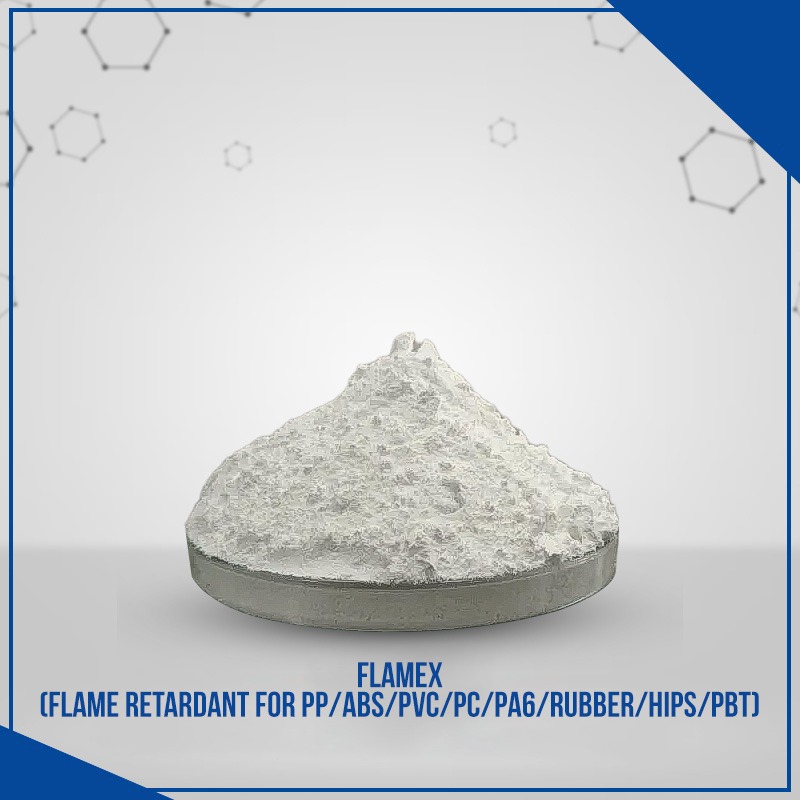 | flame retardant additives Flamex ( Flame Retardant for PP ABS PVC PC PA6 RUBBER HIPS PBT ) FLAMEX ( One Pack Flame Retardant ) manufactured by our company is widely used in PP,PA, PE,PC ,PC/ABS, PVC , Rubber ,PBT, PET, XPS, EPS, PU ,PVC,... View product → |
 | Flame Retardant Filler FAM-501 Flame Retardant Filler FAM-501 FAM - 501 Flame Retardant filler FAM-501 is One Pack Flame Retardant & Smoke Suppressant developed for Plasticized PVC applications. View product → |
Frequently asked questions
How do flame-retardant additives interrupt burning and suppress smoke?
They can delay ignition, absorb heat, release flame-inhibiting species, dilute combustible gases or form a protective char or barrier. Smoke suppression depends on the additive chemistry, polymer and combustion conditions.
How do you choose a flame-retardant package for a polymer process?
Check polymer compatibility, decomposition temperature, processing temperature, target fire test, smoke requirements, moisture sensitivity and interactions with fillers, pigments and stabilisers.
How should you calculate and introduce flame-retardant additives?
Define dosage as a percentage of the complete formulation, then control feeding order, melt temperature, residence time and mixing energy. Take samples from different points to check dispersion.
How can you balance fire performance against polymer properties and filler loading?
Compare the required fire rating with tensile strength, impact resistance, elongation, density, viscosity, surface appearance and smoke. Recheck the balance after changing additive or filler loading.
What should a Bhiwadi production trial verify before approving a supplier or compound?
Verify batch identity, certificate data, moisture, feeding behaviour, dispersion, process stability and test results from representative compound samples. Compare trial results with the agreed specification.
Related products
| FAM-501 ABOUT FAM - 501 FAM-501 is One Pack Flame Retardant & Smoke Suppressant developed for Plasticized PVC applications. View product → |
 | Antimony Trioxide Our range of Antimony trioxide is used mainly in flame retardant formulations for plastics, rubbers, textiles, paper and paints. View product → |
 | Zinc Borate ZINC BORATE is a highly effective multifunctional flame retardant synergist being used as a flame retardant and smoke suppressant in a wide range of... View product → |
 | Aluminium Trihydrate (ATH) is a very finely grounded product having a uniform and controlled particle size distribution. View product → |