
Polypropylene burns readily in ordinary air, so selecting a flame-retardant chemical is a balance between fire-test performance, melt processing, mechanical properties and cost per qualified part. By the end, you will be able to match a PP grade and additive package to the required test, processing window and purchasing evidence.
Key takeaways
- Match the additive package to PP grade, wall thickness, colour, and fire-test target.
- Compare halogenated, intumescent, and mineral systems against smoke, impact, cost, and processing needs.
- Check melt flow, dispersion, moisture, and impact retention during PP compounding.
- Approve the compound only after fire, smoke, and finished-part testing at target thickness.
Match the flame-retardant package to the polypropylene grade and fire test
Start with the part, not the additive: record the polypropylene grade, wall thickness, colour, processing temperature, impact requirement and fire-test target before choosing a polypropylene flame retardant. A package that reaches V-0 in a 1.5 mm plaque can fail at 0.8 mm, change melt flow, or reduce impact strength.
| Grade | Define before selection | Main formulation concern |
|---|---|---|
| PP homopolymer | Stiffness, weldability, thickness and UL 94 target | Efficient flame control without excessive brittleness |
| Random copolymer PP | Low-temperature impact and surface finish | Additive compatibility and loss of clarity or toughness |
| Impact copolymer PP | Notched impact strength and moulded-part toughness | Flame retardant loading can reduce impact performance |
| Talc-filled or glass-fibre-reinforced PP | Filler percentage, fibre orientation and flow path | Fillers alter dripping, dispersion, warpage and test results |
Specify the acceptance criteria in writing:
- UL 94 V-0, V-1 or V-2 at the actual part thickness; these ratings describe small vertical specimens, not full-fire behaviour.
- ASTM D635 for horizontal burning when required by the application, plus ASTM E662 or ISO 5659-2 for smoke density.
- IEC 60695-2-11 for glow-wire ignition of the finished part, or IEC 60695-2-12 and -13 for material flammability and ignition temperatures.
Define tensile strength, flexural modulus, impact strength, melt-flow rate, colour, surface finish and heat ageing limits beside the fire target. Compare trial formulations by cost per qualified part, not additive loading alone.
Compare halogenated, intumescent and mineral-based systems by trade-off
The lowest additive loading is not automatically the lowest-risk choice: each chemistry solves flame spread, smoke and dripping through a different compromise.
| System | Loading and processing | Smoke and dripping | Mechanical and regulatory trade-off |
|---|---|---|---|
| Halogenated flame retardant | High efficiency at comparatively low loading; antimony trioxide often acts as a synergist. | Controls flame spread and dripping effectively, but combustion can produce corrosive products and concerning smoke constituents. | Usually preserves tensile strength and impact performance better than high mineral loading. Identify the exact halogen chemistry, because regulatory status differs between substances. |
| Intumescent polypropylene | Often needs about 20–30 wt% total package. Ammonium polyphosphate supplies the acid source alongside a carbon and blowing source; dispersion and moisture resistance are critical. | Builds a protective char, reducing heat release and flaming drips with lower smoke potential than many halogen systems. Poor char integrity causes failure. | Can increase stiffness, density and colour change while reducing flow. Regulatory concern is usually lower, but additive compatibility and long-term char stability remain risks. |
| Mineral-based | Magnesium hydroxide decomposes around 300–340 °C, yet normally requires high loading; high torque, screw wear and melt viscosity follow. | Helps dilute fuel and suppress flame, but high filler content alone does not guarantee self-extinguishing PP or stop dripping. Zinc borate is chiefly a smoke-suppressing synergist. | Impact strength and toughness often fall. Regulatory risk is comparatively low, though density and recyclability increase. |
For a tight mechanical specification, start with halogenated chemistry; choose intumescent or magnesium hydroxide when smoke, dripping or regulatory constraints outweigh loading and processing penalties.
Protect processing performance during PP compounding
Keep the additive dry, within its processing window, and moving through the extruder quickly enough to avoid degradation. In PP compounding, control these variables at the feed throat and through the die:
- Store flame-retardant powder in sealed, moisture-barrier packaging and use a desiccant dryer when the supplier specifies drying. Check additive moisture by Karl Fischer titration or loss-on-drying; water can cause voids, foaming and poor char formation.
- Set the extrusion temperature profile below the additive’s decomposition range, then confirm the actual melt temperature rather than relying on barrel settings. Aluminium hydroxide can release water around 180–220 °C, while phosphorus and intumescent systems can lose performance after overheating.
- Choose a screw configuration with enough distributive mixing to wet and separate the additive without excessive kneading. A high mineral loading raises torque, melt viscosity and screw wear; monitor motor load, melt pressure and die pressure for sudden changes.
- Control feeder accuracy, screw speed and throughput together. A slow feed or low throughput increases residence time, allowing heat-sensitive packages to degrade in dead zones; purge the line during stops instead of leaving the compound stagnant.
Measure the incoming polypropylene and finished compound melt flow rate. A large shift indicates changed dispersion, degradation or excessive shear, not simply a normal batch difference.
Check ash or active content on additive lots, then repeat melt-flow, mechanical and fire testing after the actual molding cycle because residence time and molding heat can change the approved result.
Verify fire, smoke and part-level performance before approval
Approve the formulation only after testing plaques and molded parts at the minimum production wall thickness, not at a thicker laboratory section. Record resin grade, additive loading, colour, specimen orientation, conditioning and gate location; these variables can change the result.
| Test | Measurement | Approval use |
|---|---|---|
| UL 94 V-0 | Vertical burning, limited afterflame and no flaming drips | Highest target for the specified thickness |
| UL 94 V-1 | Vertical burning with longer permitted afterflame than V-0 | Accept only where the end-use specification allows it |
| UL 94 V-2 | Vertical burning where flaming drips are permitted | Reject it for parts requiring non-dripping behaviour |
| ASTM E662 smoke density | Optical smoke density under flaming and non-flaming conditions | Compare against the buyer’s smoke limit; it does not measure gas toxicity |
| IEC 60695-2-11 | Glow-wire ignition of the finished part | Use for assembled electrical or appliance components |
| IEC 60695-2-12 and -13 | Glow-wire flammability and ignition temperatures of materials | Screen the compound, not the completed assembly |
| ASTM D635 or FMVSS 302 | Horizontal burning rate | Use the specified method for automotive or other horizontal-burning applications |
Pair ASTM E662 results with combustion-gas analysis where enclosed equipment or worker exposure matters. Optical density can fall while hazardous gases remain.
Finally, compare the approved sample with unaged and heat-aged parts for melt-flow rate, tensile strength, notched impact, flexural modulus, colour, surface finish and dimensional stability. A passing plaque that causes brittle weld lines, slow filling or part-level glow-wire failure is not a qualified compound.
Turn a Bhiwadi chemical purchase into a qualified PP compound
A low advertised loading does not make a flame-retardant chemical in Bhiwadi economical. Compare the complete PP formulation at its required wall thickness, colour, impact strength, cycle time and fire-test acceptance, then calculate cost per qualified part rather than cost per kilogram of additive.
Ask every supplier for:
- Recommended dosage by PP grade: homopolymer, random copolymer, impact copolymer, talc-filled or glass-fibre-reinforced PP.
- Technical data sheet, safety data sheet, certificate of analysis, batch traceability, particle-size data and storage limits.
- Processing guidance covering drying, feed method, dispersion, melt-temperature limits and residence time.
- Test reports identifying specimen thickness, formulation, conditioning and method—not only a UL 94 headline.
- Evidence for the target application: FMVSS 302 for automotive interiors, or IEC 60695-2-11 for the finished electrical or appliance product.
Niknam Chemicals Pvt. Ltd can be included in the comparison when its supplier data identifies the PP grade, dosage and test configuration instead of treating a one-pack product as universally interchangeable.
Cost per qualified part should include additive, carrier resin, rejected parts, colour adjustment, moulding cycle time and retesting. A higher-loading mineral system can raise viscosity and reduce impact strength; a lower-loading system can cost more per kilogram but preserve throughput.
For electrical parts, request glow-wire data separately: IEC 60695-2-11 evaluates the finished product, not merely the compound.
Related product
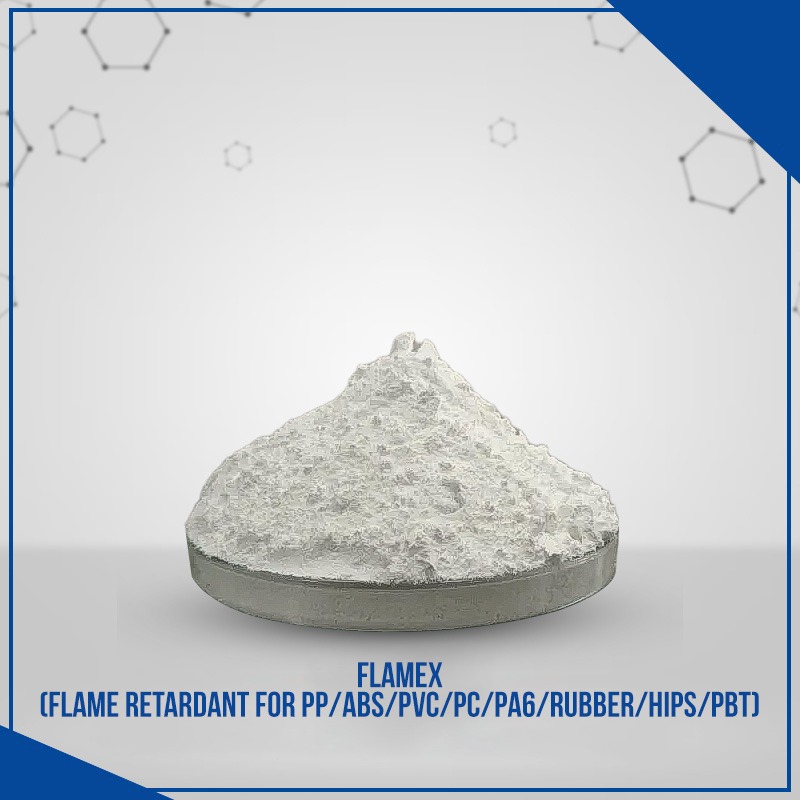 | flame retardant additives Flamex ( Flame Retardant for PP ABS PVC PC PA6 RUBBER HIPS PBT ) FLAMEX ( One Pack Flame Retardant ) manufactured by our company is widely used in PP,PA, PE,PC ,PC/ABS, PVC , Rubber ,PBT, PET, XPS, EPS, PU ,PVC,... View product → |
Frequently asked questions
How do you match a flame-retardant package to polypropylene?
Record the PP grade, wall thickness, colour, processing temperature, impact requirement, and target fire test before selecting the package. A system that reaches V-0 at 1.5 mm can fail at 0.8 mm.
What are the trade-offs between halogenated, intumescent, and mineral flame retardants?
Halogenated systems can deliver strong flame performance at efficient loading but require smoke and regulatory review. Intumescent systems form a protective char but depend on dispersion, dosage, and processing control. Mineral systems can improve fire performance and smoke suppression while increasing density and affecting flow or impact.
How can you protect polypropylene processing performance?
Control additive loading, drying, dispersion, residence time, shear, and melt temperature. Check melt flow, surface appearance, colour, impact strength, and plate-out after compounding.
What testing is required before approving a flame-retardant PP compound?
Test the actual compound in the target colour, wall thickness, and part geometry. Verify the specified fire test, smoke behaviour, mechanical properties, dimensional stability, and production consistency before approval.