
A PP instrument-panel substrate, battery tray and fuse box do not share one universal flame-retardant recipe: the required test, wall thickness, polymer grade and production process determine the formulation. By the end, you will know how to identify the PP compound, set up additive dosing, control injection-moulding risks and qualify a traceable material for Bhiwadi production.
Key takeaways
- Match the additive to the component’s required fire test.
- Confirm PP grade compatibility before selecting a flame-retardant route.
- Control dosing, dispersion and melt temperature during compounding.
- Test additive batches and moulded parts before production release.
Match the PP component to the fire test before choosing an additive
Flame-retardant treatment is not automatically required for every automotive polypropylene part. Apply it when the component sits in an interior, electrical, or heat-exposed location covered by a customer specification. The part’s location and required fire test, not the PP label alone, must control the formulation.
| Component or application | Test that should control approval | Why it matters |
|---|---|---|
| Instrument-panel substrates | FMVSS 302 or ISO 3795 | Interior trim is judged by horizontal burn rate and self-extinguishing behaviour. |
| Cable channels and air ducts | FMVSS 302, ISO 3795, or the OEM’s named test | Geometry, airflow and installation position can change flame spread. |
| Fuse boxes | UL 94 V-0 or V-1, plus the OEM electrical-housing test | Vertical burning and dripping performance matter around live circuits. |
| Battery trays | OEM battery-compartment or electrical-housing specification; UL 94 where named | Heat, electrical energy and enclosure design determine the required evidence. |
| Under-hood covers | OEM-specific heat-ageing and flammability test | Temperature, fluids and ageing can change performance after the initial burn test. |
Do not treat one pass as a universal approval: UL 94 V-0 does not prove FMVSS 302 compliance, and FMVSS 302 does not prove UL 94 performance. Ask for the exact test method, specimen thickness, conditioning state and pass criterion before selecting an additive.
Also separate smoke control from flame control; a smoke suppressant does not guarantee a flammability pass.
Identify the PP grade and choose a compatible flame-retardant route
Identify the exact PP grade before selecting the flame-retardant route; the same additive package will not behave identically in a neat resin, a rubber-modified grade, or a reinforced compound.
| PP grade | Additive-selection effect | Practical route |
|---|---|---|
| PP homopolymer | High stiffness and crystallinity, but limited impact strength | Halogenated plus antimony synergist for moderate loading; use nitrogen–phosphorus intumescent systems when halogen-free status is required |
| Random copolymer PP | Ethylene units improve clarity and impact but can alter melt strength and additive compatibility | Screen the package for transparency, flow and weld-line performance; do not transfer a homopolymer formulation unchanged |
| Impact copolymer PP | Rubber phase improves toughness but can dilute or disrupt the flame-retardant barrier | Prefer a package proven in the rubber-modified grade, then recheck impact retention and burning behaviour |
| Talc-filled PP | Talc raises stiffness, density and viscosity and can change char formation | Rebalance additive loading against existing talc; verify flow and weld-line burn performance |
| Glass-fibre-reinforced PP | Fibre and sizing affect dispersion, anisotropy and melt viscosity | Use a compatible concentrate or powder, and test fibre length retention, surface appearance and flame performance |
| Mineral-filled PP | Filler may reduce polymer content but does not automatically provide adequate flame resistance | Confirm filler identity and loading before adding a halogenated, intumescent or mineral-based route |
Halogenated systems with antimony trioxide often deliver efficiency at lower loading; antimony trioxide alone is not a practical PP flame retardant. Halogen-free systems based on intumescents, nitrogen–phosphorus chemistry or magnesium hydroxide require formulation trials because higher loading can reduce flow, strength and impact. Aluminium hydroxide is poorly suited to conventional PP melt temperatures.
Request the formulation declaration, including ready-to-mould or concentrate status, before compounding.
Dose and compound the additive without creating dispersion or heat damage
Use the additive’s stated active concentration, not its bag weight, to calculate the let-down ratio. Confirm whether the quoted grade is a ready-to-mould compound or a concentrate; confusing the two can produce an immediate flammability failure.
Dry a flame-retardant powder, pellet or flame-retardant masterbatch only when its technical data sheet specifies drying, then store it sealed to prevent moisture pickup.
- Feed PP pellets through the main hopper and introduce a powder after the polymer has formed a stable melt when the extruder and side feeder permit it. This reduces dust and improves incorporation.
- Meter powder with a loss-in-weight feeder fitted for fine solids; use agitation or a suitable screw to prevent bridging. Do not rely on volume-only dosing.
- Feed pellets or masterbatch through a gravimetric feeder. Preblend only after checking that pellet size and bulk density will not cause additive segregation.
- Use twin-screw extrusion with enough distributive mixing to eliminate visible specks, but avoid excessive kneading, torque and residence time. Local overheating can decompose the package, generate gas, cause plate-out and reduce fire performance.
- Set barrel temperatures, screw speed and throughput from the additive supplier’s processing window. Record melt pressure, torque and strand appearance during the trial.
Check the compounded pellet for moisture, dispersion, colour drift and melt-flow change before moulding. A burn result from one well-mixed sample does not validate a feeder that is bridging or a batch that is separating. Use the actual approved let-down ratio in every production record.
Control melt processing and measure the property trade-offs in the moulded part
Run the moulding trial at the approved melt temperature and record PP melt flow rate before and after compounding. A lower rate signals higher viscosity: filling slows, injection-fill pressure rises, screw torque increases and incomplete fills or sink marks appear. Do not correct this by raising temperature until additive stability has been checked.
High-loading halogen-free and intumescent packages usually impose a larger flow penalty than moderate-loading halogenated systems. The added solid content can lengthen filling and cooling, while increased pack pressure or mould temperature can extend cycle time. Excessive heat or residence time can decompose the package, generating gas, colour drift and deposits.
Measure the trade-offs on moulded plaques and the actual component:
- Tensile strength, elongation and notched impact, including low-temperature impact after heat ageing
- Weld-line strength, because flow fronts can create a weak split line
- Warpage, shrinkage, surface gloss, colour uniformity and stress whitening
- Fill pressure, peak screw torque, cooling time and total cycle time
- Deposit weight or visible mould fouling after a defined production run
Watch the tool after purging and during continuous production. Blooming, plate-out and corrosive residues can soil vents, alter texture and damage nearby metal.
If the package needs more pressure, gives poor weld-line strength or increases cleaning frequency, reduce loading only after repeating the required fire test; a clean-looking, easily moulded part is not evidence of compliance.
Qualify the formulation from additive batch to moulded component in Bhiwadi
A compliant part needs a controlled chain, not a supplier brochure. Request a formulation-level declaration covering chemistry, concentration range, halogen and antimony status, restricted-substance compliance, density, melt-flow range, colour limitations and processing window.
Confirm whether the grade is a ready-to-mould compound or concentrate, and match each delivery to its lot number, TDS, SDS and certificate of analysis.
Run dosage trials with the approved PP grade and fixed wall thickness, mould temperature, regrind percentage and residence time. Establish low, target and high points within the supplier’s stated range, record the PP flame-retardant loading, then mould plaques and production-shaped parts.
Test every condition against the specified FMVSS 302 or ISO 3795 requirement; one result does not prove the other.
Control the approved formulation in Bhiwadi with this production checklist:
- Verify additive and PP batch identity before feeding.
- Check the feeder calibration and recorded FLAMEX dosage at start-up and after a material refill.
- Retain first-off parts for flammability, dimensions, appearance and part mass checks.
- Record melt temperature, screw torque, pressure, cycle time, mould temperature and regrind percentage.
- Repeat flammability testing after a supplier, colourant, mould, wall-thickness or process-window change.
Niknam Chemicals Pvt. Ltd can provide the supplier-side information needed to define that approval record; the processor still has to prove repeatability on its own moulding line. Investigate plate-out, gas, colour drift or a failed burn result rather than correcting the batch with unrecorded additive.
Related product
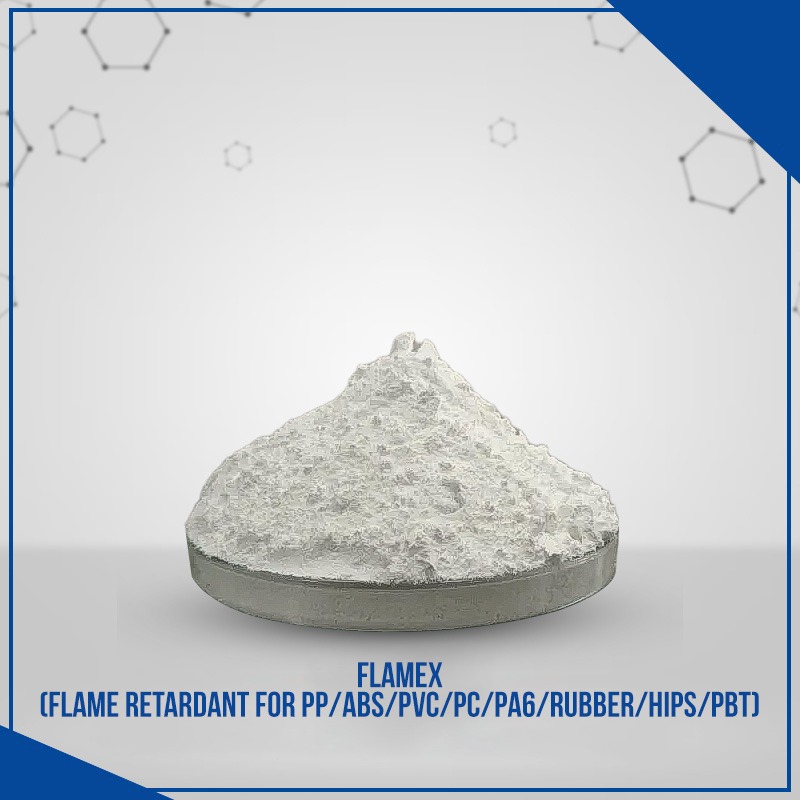 | flame retardant additives Flamex ( Flame Retardant for PP ABS PVC PC PA6 RUBBER HIPS PBT ) FLAMEX ( One Pack Flame Retardant ) manufactured by our company is widely used in PP,PA, PE,PC ,PC/ABS, PVC , Rubber ,PBT, PET, XPS, EPS, PU ,PVC,... View product → |
Frequently asked questions
When does an automotive polypropylene component need flame-retardant treatment?
Use flame retardants when the component’s interior, electrical or heat-exposed location falls under a customer fire specification. Choose the formulation from the required fire test, not from the PP label alone.
How do you choose a compatible flame-retardant route for polypropylene?
Identify the PP grade, including its melt-flow behaviour and filler or reinforcement package, then check compatibility with the selected additive system before compounding.
How can you prevent dispersion problems and heat damage during compounding?
Control additive dosing, feeding order, mixing intensity and melt temperature. Confirm that the additive disperses uniformly without exceeding the thermal limits of the PP formulation.
What must you measure after moulding a flame-retardant PP component?
Measure the specified fire performance alongside processing behaviour and part properties such as appearance, stiffness, impact resistance and dimensional stability. Qualify the formulation from additive batch through moulded component.