
ABS housings and covers must survive an ignition event without sacrificing impact strength, insulation, appearance or manufacturability. You will be able to match each Bhiwadi component with a target fire test, choose a compounding route, compare flame-retardant packages and request the evidence needed to qualify the finished part.
Key takeaways
- Rate ABS on the finished part, including thin walls, ribs, bosses and weld lines.
- Confirm the additive package works at the target loading without harming impact strength.
- Compare smoke, halogen status, test reports, batch consistency and technical support.
- Ask suppliers for geometry-specific test data, processing guidance and compliance documents.
Which ABS components need flame-retardant protection?
A thinner wall can fail even when the same ABS resin passes UL 94 V-0 in a thicker plaque. Select flame-retardant ABS for the finished geometry, wall thickness, ribs, bosses, apertures and weld lines—not for the pellet rating alone.
Relevant flame-retardant ABS applications in Bhiwadi include:
- Switchgear housings and a switchgear enclosure
- Circuit-breaker bodies and circuit-breaker body material
- Terminal blocks and connectors
- Cable-management parts
- Motor enclosures
- Control-panel parts
- Sensor housings
- Industrial guards
UL 94 classifications describe vertical-burning behaviour, not complete component safety.
| Rating | Afterflame and afterglow | Flaming drips |
|---|---|---|
| V-0 | Shortest permitted afterflame; afterglow must end within the specified limit | Drips cannot ignite the cotton indicator |
| V-1 | Longer permitted afterflame and afterglow than V-0 | Drips cannot ignite the cotton indicator |
| V-2 | Same broader time class as V-1 | Flaming drips may ignite the cotton indicator |
UL 94 does not measure smoke, dielectric strength, comparative tracking index or glow-wire resistance. A smoke suppressant therefore cannot prove smoke compliance.
Choose the test for the hazard and product:
- Use UL 94 or IEC 60695-11-10 for vertical burning.
- Use IEC 60695-2-11 for glow-wire flammability on the end product.
- Use IEC 60695-2-10 for the glow-wire apparatus, and IEC 60695-2-12 and -13 for material flammability and ignition temperatures.
IEC 62368-1 or a customer-specific electrical standard can impose safeguards beyond the resin rating. A component may need separate glow-wire, CTI, dielectric and smoke testing.
How is a flame-retardant package compounded into ABS?
Begin by selecting the ABS grade, target wall thickness and UL 94 rating, then record a supplier-validated screening range before compounding. Direct dry blending is simple, but density differences cause segregation, feeder inaccuracy and incomplete dispersion. A concentrated masterbatch improves dosing consistency when its carrier is compatible with ABS, although dilution errors still occur.
Use a gravimetric feeder for resin and additives, and a twin-screw extruder ABS flame retardant line with sufficient mixing length. Dry ABS to the resin supplier’s moisture specification before feeding; wet resin loses toughness and produces unstable flammability.
Introduce heat-sensitive additives through a controlled downstream port when the formulation requires it, rather than exposing them to the full upstream thermal history.
| Package | Supplier-validated screening range | Development purpose |
|---|---|---|
| Brominated organic flame retardant + antimony(III) oxide | Record weight-percent range from supplier | Conventional V-0 development |
| Halogen-free phosphorus system | Record weight-percent range from supplier | Halogen-free screening |
| Mineral or smoke-suppression package | Record each component’s weight-percent range | Smoke or char control |
Antimony(III) oxide is a synergist, not a stand-alone replacement for a halogen source. Assess zinc borate, molybdates, zinc stannate and zinc hydroxystannate as package components; their general additive descriptions do not predict performance in ABS.
Control the resin supplier’s melt window, avoid prolonged residence at its upper limit, and check torque, melt pressure and colour shift. A rising torque, pressure drift or colour change signals dispersion or degradation trouble before molded pellets reach production.
What does loading do to ABS performance?
Higher ABS flame-retardant loading usually improves burn resistance at the cost of toughness and processing latitude. Impact strength, especially low-temperature impact, can fall; tensile strength and elongation can also decline. High mineral loading raises density, reduces toughness and produces a rough, dull surface with greater colour change.
Organic or phosphorus packages can change melt viscosity, plasticization and melt-flow rate. A package that lowers viscosity may overfill or flash; one that raises viscosity may cause short shots, weak knit lines and poor filling around ribs, bosses and thin-wall sections. Both effects can reduce weld-line performance.
Halogen-free phosphorus systems are not automatic drop-in replacements for bromine/antimony formulations. They may require higher loading, alter shrinkage and mould filling, worsen surface appearance, and make V-0 difficult at thin sections.
A flat plaque can pass a burn test while a thin wall, knit line, rib, boss or weld line fails through cracking, warpage or ignition.
Control the process before comparing results:
- Dry ABS and additives to their specified moisture limits; moisture can reduce toughness and destabilise flammability.
- Limit residence time near the resin’s upper melt temperature and record torque, pressure and colour shift.
- Control screw shear so dispersion improves without degrading the polymer.
- Set and document the permitted regrind percentage, heat history and contamination limits.
Qualify CTI, hot-wire ignition, dielectric properties, impact strength and dimensional stability separately. UL 94 alone is not complete component qualification.
How should you compare products and suppliers in Bhiwadi?
Compare each offer through a document-and-sample file, not a product name. Require ABS compatibility data at your intended wall thickness and on your actual ABS grade; data limited to PVC, rubber, polyolefins or “general plastics” does not qualify. A flame-retardant chemicals supplier Bhiwadi can be useful only when its evidence matches the finished component.
| Evidence to compare | What to request | What failure indicates |
|---|---|---|
| Exact chemistry | Additive identity, CAS number flame retardant, halogen status and SDS | Generic “halogen compliant” wording |
| Processing fit | Recommended weight percent, melt-temperature range, residence-time limit, moisture specification, colour impact and density contribution | Uncontrolled loading, degradation or unsuitable appearance |
| Performance | UL 94 result for the relevant ABS grade and thickness; glow-wire, CTI, electrical and mechanical data where required | Plaque data cannot support component approval |
Treat FAM-501 ABS suitability as unproven until product-specific ABS results arrive. Its plasticized-PVC focus, inorganic complex or smoke-suppression description does not establish compatibility.
Ask each supplier for:
- A representative compounded sample and trial-compounding support.
- Test reports identifying specimen thickness, conditioning, formulation and regrind percentage.
- Lot documentation linking the sample to its certificate and SDS.
Niknam Chemicals Pvt. Ltd becomes practically valuable when it supplies an ABS-specific formulation discussion, trial support and lot records; the supplier name remains secondary to evidence that matches your molded part. Reject any offer that cannot connect its chemistry to your wall thickness and required standard.
Related product
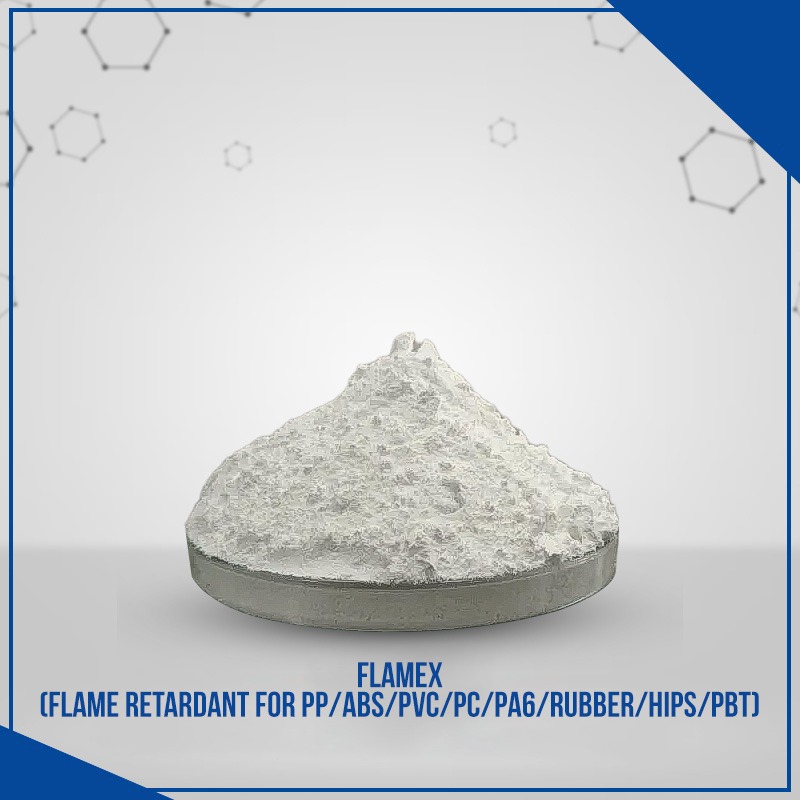 | flame retardant additives Flamex ( Flame Retardant for PP ABS PVC PC PA6 RUBBER HIPS PBT ) FLAMEX ( One Pack Flame Retardant ) manufactured by our company is widely used in PP,PA, PE,PC ,PC/ABS, PVC , Rubber ,PBT, PET, XPS, EPS, PU ,PVC,... View product → |
How do smoke, halogen status and compliance change the decision?
UL 94 measures burning behaviour, not smoke density, toxicity or corrosivity. A smoke suppressant ABS formulation therefore needs the required smoke test; UL 94 cannot replace it. Treat flame inhibition and smoke suppression as separate objectives.
| Option | Processing, smoke and gas | Electrical, colour and loading |
|---|---|---|
| Halogenated bromine/antimony | Efficient at moderate loading; smoke and corrosive-gas concerns require end-product testing | Strong V-0 route, but colour and insulation effects need verification |
| Halogen-free phosphorus | Higher processing sensitivity and loading can make thin-wall V-0 difficult; lower halogen-related gas concern | Check CTI, dielectric properties, colour and mould filling |
| Mineral packages | Aluminium hydroxide, aluminium trihydrate or magnesium hydroxide demand high loading, affecting density and flow | Lower smoke potential does not prove ABS performance; check toughness, surface and insulation |
Do not select mineral fillers from a general product description. Require ABS-specific evidence at the intended wall thickness, loading and moulding conditions. Molybdates, zinc stannate and zinc hydroxystannate also depend on the complete package.
Use this compliance checklist:
- Separate RoHS, REACH and the EU POPs Regulation; passing one does not prove the others.
- Record every restricted substance by chemical name and CAS number.
- Check decaBDE and other brominated substances separately; “halogen compliant” is insufficient.
Qualify virgin ABS and controlled-regrind ABS independently because recycled ABS flammability changes with heat history and contamination. Test moulded parts, apply customer-specific electrical standards, and sign a formulation record covering resin, regrind percentage, additive lot and processing conditions.
Frequently asked questions
Which ABS components need flame-retardant protection?
Electrical enclosures, connector bodies, terminal blocks, switchgear parts, cable-management components and industrial housings need protection when ignition, heat or arc exposure could spread fire. Evaluate the finished geometry, wall thickness, ribs, bosses, apertures and weld lines rather than relying only on the resin pellet rating.
How is a flame-retardant package compounded into ABS?
The package is blended into ABS during compounding, then processed into pellets for injection moulding or extrusion. Set the formulation and processing window through trials that check dispersion, residence time, mould temperature, melt temperature, screw speed and the finished part’s flame test performance.
What does loading do to ABS performance?
Higher additive loading can improve flame resistance while reducing impact strength, flow, weld-line strength, surface appearance or dimensional stability. Compare formulations at the same loading and test the actual part, not only a standard plaque.
How should you compare flame-retardant ABS suppliers in Bhiwadi?
Request the technical data sheet, safety data sheet, certificate of analysis, batch number, recommended dosage, processing range and test reports for the target grade. Compare dispersion, lot-to-lot consistency, delivery reliability, formulation support and evidence from parts with similar wall thickness.
How do smoke, halogen status and compliance change the decision?
Choose the package against the required smoke limit, halogen restriction and end-market rules. Ask for a named test method, result, report date and scope, then verify whether the evidence covers your ABS grade, additive loading, colour and finished geometry.