
Choosing a flame-retardant chemical depends on the plastic, processing temperature, end-use hazard and evidence required by the buyer. By the end, you will be able to compare mineral, phosphorus, halogenated and intumescent systems, define the right test plan, and qualify a formulation or supplier for electronics and industrial production.
Key takeaways
- Match the additive to the plastic, processing temperature, and end-use exposure.
- Set a UL 94 class and test thickness instead of accepting a generic V-0 claim.
- Check melt flow, impact strength, colour, smoke, and loading after compounding.
- Request TDS, SDS, COA, samples, batch numbers, and approval records from suppliers.
Match the flame-retardant chemistry to the plastic and end use
| PP | Use phosphorus-based intumescent systems or mineral hydroxides; confirm melt flow after the required loading. | Appliance parts, cable compounds and injection moulding plastic flame retardant chemicals where expansion or smoke limits matter. |
|---|---|---|
| ABS plastic flame retardant additives | Use brominated systems with a synergist for efficient V-0 performance, or phosphorus-based grades when smoke and restricted-substance requirements dominate. | Housings, connectors and cosmetic parts. |
| PVC | Start with the polymer’s inherent chlorine content, then assess plasticizer compatibility; use ATH, MDH or phosphorus systems for smoke and flame control. | Flexible cable insulation, conduit and industrial enclosures. |
| PC and PC ABS | Use oligomeric or reactive phosphorus chemistry; brominated systems can reduce loading but need smoke, corrosion and customer-restriction review. | Electronics housings, switchgear covers and connectors. |
| PA6 | Use phosphorus-nitrogen systems, mineral synergists or red phosphorus only after checking colour, moisture sensitivity and electrical performance. | Connectors, terminal blocks and structural parts. |
| Rubber | Choose ATH or MDH for low-smoke compounds, or halogenated chemistry when thin-section performance outweighs smoke concerns. | Gaskets, flexible cable insulation and industrial seals. |
Do not select flame retardant chemicals by polymer name alone. Check the specimen thickness and target in IEC 60695-11-10, IEC 60695-11-20, ASTM D635 or ASTM D2863; a V-0 result on a thin plaque does not qualify an industrial enclosure.
For electronics, test ionic residue and tracking separately: IEC 60112 and the finished product’s dielectric requirements can expose a formulation that passes flammability but fails in humidity. Obtain migration and extraction data for additive phosphorus grades, then retest after heat, humidity and cleaning-agent exposure.
Set a test target instead of accepting a generic V-0 claim
A V-0 claim is only a starting point, so set the required specimen thickness and test evidence before approving a formulation. UL 94 V-0, V-1 and V-2 describe vertical burning behaviour; HB plastic flammability classification describes horizontal burning. None proves smoke control, enclosure fire resistance or equipment safety.
| Test or evidence | What it proves | What to specify |
|---|---|---|
| UL 94 and IEC 60695-11-10 | Small-flame vertical or horizontal burning behaviour | V-0, V-1, V-2 or HB at the actual wall thickness |
| IEC 60695-11-20 | 500-watt flame resistance on a larger specimen | Use when the product standard calls for it |
| IEC 60695-2-11 | Glow-wire ignition of the finished product | Test the assembled housing, connector or barrier |
| IEC 60695-2-12 and IEC 60695-2-13 | Material glow-wire flammability index and ignition temperature | Compare the resin at the intended thickness |
| ASTM D635 and ASTM D2863 | Horizontal burning rate and limiting oxygen index | Use as supporting material data, not as a UL 94 substitute |
| ASTM E662 and ISO 5659-2 | Smoke density or specific optical density under defined exposure and specimen geometry | State radiant exposure, thickness and smoke result |
A formulation can pass UL 94 yet fail in humid equipment because ionic or conductive residues reduce insulation resistance or comparative tracking performance. Check IEC 60112 and the product’s dielectric requirements separately.
For equipment, connect the material data to IEC 62368-1: fire enclosure, fire barrier and ignition-source evaluations remain equipment-level decisions. A smoke-density result cannot replace a glow-wire result, and a raw-material certificate cannot approve the finished assembly.
Control loading and processing before the additive damages performance
A high flame retardant loading can win UL 94 performance while sacrificing tensile strength, impact resistance, elongation and melt flow. Mineral fillers such as aluminium trihydrate, aluminium hydroxide and magnesium hydroxide often require tens of weight percent; finer particles raise viscosity, while poor dispersion leaves weak points, rough finish and uneven density.
- Match decomposition temperature to the polymer: aluminium hydroxide is useful around 180–220 °C, whereas magnesium hydroxide suits processing closer to 300–340 °C. Do not use a filler that decomposes inside the melt.
- Compare particle-size distribution, surface treatment, moisture and bulk density before setting the flame retardant loading. These change dosing, mould wear, flow and electrical insulation.
- Dry hygroscopic ingredients before extrusion, injection moulding, calendaring or cable compounding. Moisture causes voids, splay, hydrolysis and lower dielectric strength.
- Record melt flow, tensile strength, impact resistance, elongation, density, surface finish and insulation resistance at the chosen loading and specimen thickness. Repeat after heat ageing and humidity exposure.
A phosphorus flame retardant or intumescent system can reduce mineral loading, while zinc borate may suppress smoke or strengthen char. A halogenated flame retardant with antimony trioxide can be efficient at low loading, but smoke, corrosive gases and customer restrictions require separate review.
Check IEC 60112 tracking performance; passing a flammability test does not prove electrical insulation.
Qualify a Bengaluru supplier with documents, samples and traceable batches
Approve a flame retardant supplier Bengaluru buyers can audit, not one that provides only a sales sheet. Start with a representative sample and insist that its label, test report and shipment carry the same batch number.
Request this qualification file:
- A certificate of analysis reporting active content, moisture, particle-size distribution, bulk density, decomposition profile and heavy-metal impurities.
- The SDS, handling instructions and storage limits; an SDS alone does not prove composition or regulatory compliance.
- For compounded grades, the polymer carrier, flame-retardant loading, glass or mineral reinforcement, and the exact UL 94 or glow-wire specimen thickness.
- Migration or extraction data for additive phosphorus grades, followed by flame testing after humidity, heat ageing and cleaning-agent exposure.
- A retained sample sealed against the batch number, so you can investigate a failed compound rather than debate a replacement lot.
For a Bengaluru manufacturer or blender, verify current Karnataka State Pollution Control Board consent and hazardous-waste authorization. Check that the permissions cover the actual process, quantities, air emissions, water discharge and waste streams; permissions for a different operation are not sufficient. Do not treat the SDS as evidence of either approval.
Ask Niknam Chemicals Pvt. Ltd for the same evidence if it is on your shortlist, then compare its sample against your approved formulation and processing window rather than accepting a catalogue match. Reject any lot whose certificate, seal or batch number cannot be reconciled.
Related products
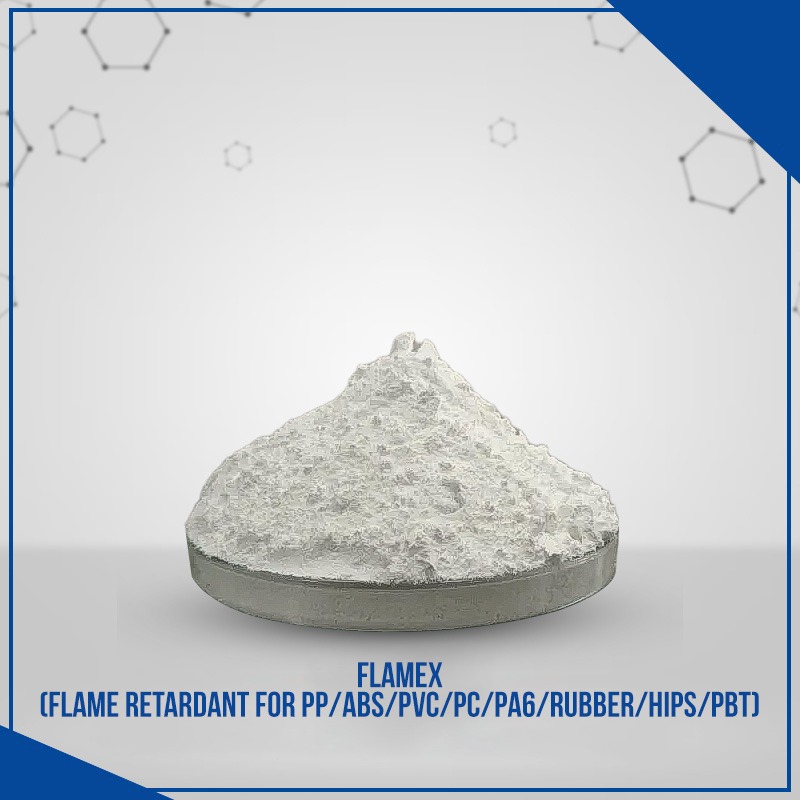 | flame retardant additives Flamex ( Flame Retardant for PP ABS PVC PC PA6 RUBBER HIPS PBT ) FLAMEX ( One Pack Flame Retardant ) manufactured by our company is widely used in PP,PA, PE,PC ,PC/ABS, PVC , Rubber ,PBT, PET, XPS, EPS, PU ,PVC,... View product → |
 | Flame Retardant Filler FAM-501 Flame Retardant Filler FAM-501 FAM - 501 Flame Retardant filler FAM-501 is One Pack Flame Retardant & Smoke Suppressant developed for Plasticized PVC applications. View product → |
Build an electronics or industrial approval file before production release
A release file must show more than a flame rating: it must trace the additive from its identity and laboratory report to the moulded part, equipment construction and service environment. Use one controlled file for each polymer grade, loading level and finished-part thickness.
1. Record the chemical identity, supplier batch, formulation percentage and test specimens. Check the declaration against RoHS under India’s E-Waste Management Rules, including the 0.1% homogeneous-material limits for PBB and PBDE, and document REACH status, including any SVHC disclosure.
2. Match the material evidence to the equipment assessment. A UL 746C recognition or UL 94 result does not replace IEC 62368-1 review of ignition sources, fire enclosure construction and fire barrier dimensions. Retain the exact thickness, colour, moulding process and conditioning used for every result.
3. Test electrical durability separately from flammability. Record comparative tracking index from IEC 60112 and insulation resistance after humidity, heat ageing and cleaning-agent exposure. A formulation that passes burning tests can still leave ionic or conductive residues that cause leakage or tracking.
4. Recreate the customer’s service conditions on finished parts, not just plaques: operating temperature, humidity, voltage, contamination, cleaning frequency and enclosure geometry. Release the part only when post-ageing flame performance, electrical results and dimensional integrity meet the IEC 62368-1 construction assessment.
Frequently asked questions
How do you choose a flame retardant for a plastic application?
Match the chemistry to the resin, processing temperature, required loading, end-use exposure, smoke limits, and restricted-substance requirements. ABS, PVC, polyolefins, engineering plastics, and cable compounds do not share one universal solution.
Why is a generic UL 94 V-0 claim insufficient?
UL 94 results depend on specimen thickness, resin grade, formulation, conditioning, and test configuration. Ask for the exact V-0 classification, test thickness, standard version, formulation basis, and laboratory report.
What should you check after adding a flame-retardant chemical?
Measure melt flow, impact strength, tensile properties, colour, surface appearance, density, smoke behaviour, and processing stability at the intended loading. Confirm that the additive has not damaged mould filling or part performance.
Which supplier documents should you request before purchasing?
Request the technical data sheet, safety data sheet, certificate of analysis, batch or lot number, sample specification, storage guidance, country-of-origin details, and any applicable restricted-substance declaration.
Related products
| FAM-501 ABOUT FAM - 501 FAM-501 is One Pack Flame Retardant & Smoke Suppressant developed for Plasticized PVC applications. View product → |
 | Zinc Borate ZINC BORATE is a highly effective multifunctional flame retardant synergist being used as a flame retardant and smoke suppressant in a wide range of... View product → |
 | Antimony Trioxide Our range of Antimony trioxide is used mainly in flame retardant formulations for plastics, rubbers, textiles, paper and paints. View product → |
 | Aluminium Trihydrate (ATH) is a very finely grounded product having a uniform and controlled particle size distribution. View product → |