
A polypropylene compound that passes UL 94 at one thickness can fail a glow-wire, automotive, or cable-flame test in its finished form. To choose intelligently, you need to identify the PP grade, define the governing test, compare additive chemistry and loading, then verify mechanical, processing, smoke, and ageing performance under the conditions your product will face.
Key takeaways
- Define the PP grade and failure mode before selecting an additive.
- Check additive loading against PP processing temperature and residence time.
- Compare flame rating with smoke, drips, impact strength and surface finish.
- Qualify molded parts under the required fire-test method, not only datasheets.
Start with the PP grade and the failure your application must prevent
Specify the resin and failure before you compare flame-retardant additives. Identify whether the part uses homopolymer PP, random copolymer, impact copolymer, filled PP variations, including talc-filled, glass-fibre-reinforced and mineral-filled PP, or recycled PP. Then define whether the failure to prevent is ignition, sustained afterflame, flaming drips, flame spread, or ignition of nearby material.
| PP grade | Typical decision point | Failure to prevent |
|---|---|---|
| Homopolymer PP | Stiffness and chemical resistance | Ignition, afterflame and dripping |
| Random copolymer | Better clarity and impact balance | Afterflame and loss of impact strength |
| Impact copolymer | Tough housings and molded parts | Flame spread without sacrificing impact |
| Filled PP variations | Talc, glass fibre or mineral loading | Dripping, weld-line ignition and inconsistent flow |
| Recycled PP | Lot-specific molecular weight and contamination | Variable afterflame, charring and ageing performance |
Set the application test before accepting a rating. For electrical enclosures, connectors and appliance parts, specify UL 94 V-0/V-1/V-2 at the actual specimen thickness, such as 0.8, 1.5 or 3.2 mm; a V-0 result at 3.2 mm does not qualify 0.8 mm. Add IEC 60695 glow-wire testing when a heated-wire ignition failure matters.
Cable products require the applicable IEC 60332 method on the complete cable or assembly, while automotive interiors may require FMVSS 302. Record colour, fibre or mineral content, gate thickness and molding cycle: a natural plaque cannot represent a black production part.
Match additive chemistry, loading and processing temperature
Choose chemistry by matching its decomposition window to the PP melt and its loading to the part’s mechanical limits. A mineral system suits applications that tolerate filler, while halogenated systems suit thin parts needing lower loading. Phosphorus-based systems and nitrogen-based systems are attractive where smoke, corrosion or recycling constraints rule out halogens.
| Option | Loading and role | Processing and application fit |
|---|---|---|
| Mineral | Aluminium trihydrate decomposition at 180–220 °C; magnesium hydroxide decomposition at 300–340 °C during melt processing. | ATH can decompose during PP processing; magnesium hydroxide tolerates higher temperatures but increases density and torque. |
| Synergist | Zinc borate or antimony trioxide supports another flame retardant rather than replacing it. | Use when the package needs improved char or flame efficiency; confirm smoke and residue effects. |
| Halogenated | Lower loading and good melt flow, with scrutiny of smoke and corrosive combustion products. | Suitable for thin injection moulding parts when recycling and end-use restrictions permit. |
| Phosphorus-based | Often paired with nitrogen-based chemistry as intumescent PP. Ammonium polyphosphate is a common acid source. | Screen a 20–30 wt% package and compare encapsulated APP in humid service. |
| Nitrogen-based | Blowing or char-support component, usually combined with phosphorus. | Useful in intumescent formulations, not as an assumed standalone solution. |
Set the starting percentage from supplier data, then record whether each dose is wt% based on total compound versus polymer weight. During compounding, extrusion, injection moulding or fibre spinning, check melt temperature, residence time and thermal decomposition; an additive that survives compounding can still alter viscosity, filtration or surface quality during a long cycle.
High intumescent loading can reduce impact strength and weld-line performance.
Measure the trade-off between flame rating, smoke and part performance
Compare the finished compound at the actual gate thickness, colour and moulding cycle—not on an unfilled natural plaque. A formulation that achieves UL 94 V-0 at 3.2 mm can fail at 1.5 or 0.8 mm, especially around weld lines and knit lines.
| Measure | Compare | Why it matters |
|---|---|---|
| Fire response | UL 94 rating, flaming drips, afterflame, afterglow and char behaviour at the specified thickness | Shows whether the part self-extinguishes without igniting material below it |
| Smoke and gases | ASTM E662 optical smoke density under flaming and non-flaming conditions, plus test data for toxic combustion products | Smoke density does not establish carbon monoxide, hydrogen halides, aldehydes or other gas concentrations |
| Part performance | Tensile strength, impact strength, elongation, flexural modulus, density, melt-flow rate, shrinkage, colour, surface appearance and electrical insulation | Reveals whether fire performance has made the part brittle, distorted, difficult to mould or electrically unsuitable |
- Repeat the comparison after adding production pigments, nucleating agents, glass fibre or talc. Each can change dripping, afterflame, flow and surface defects; residence time can alter degradation and char formation.
- Inspect moulded specimens at weld lines, knit lines and the actual gate thickness. Thin sections and poorly knit regions expose weaknesses that a flat laboratory plaque hides.
- For an intumescent package, check impact strength, elongation and surface appearance after the required loading; a 20–30 wt% package can reduce all three unless it is compatibilized for polypropylene.
- If the compound contains recycled PP, test each incoming lot for melt-flow rate, char behaviour, afterflame and mechanical retention after ageing. Virgin-resin data is not a substitute.
Choose between a one-pack system and a separate synergist package
A one-pack flame-retardant system reduces formulation risk when you need repeatable dosing across operators, shifts or contract compounders. The supplier has already balanced the active components, so premixing several powders is less likely to create a formulation error, poor dispersion or inconsistent feeder calibration.
| Option | Main advantage | When it applies |
|---|---|---|
| One-pack flame-retardant system | Simpler dosing and batch-to-batch consistency | Stable PP grade, fixed flame target and limited formulation resources |
| Separate synergist package | Independent control of loading and component ratio | Recycled PP, changing fillers, smoke targets or mechanical-property trade-offs |
Separate dosing is worth the extra control when you must adjust an acid source, carbon source, blowing source or synergist independently. It demands verified dosing accuracy, feeder calibration and dispersion checks; a small ratio error can increase afterflame, weaken impact strength or produce surface bloom.
Storage also decides the choice. Under Bengaluru monsoon conditions, use moisture conditioning before comparison, especially with APP-containing packages. Compare encapsulated APP or polymeric APP against untreated APP for additive migration, condensation resistance and electrical insulation, not only dry moulded flame results.
Condition specimens under ISO 291 at 23 ± 2 °C and 50 ± 10% relative humidity, then run the buyer’s humidity, immersion or heat-ageing protocol. That laboratory reference does not reproduce monsoon storage. Niknam Chemicals Pvt.
Ltd can be asked for lot-specific moisture data and mixing guidance before you lock a one-pack or separate synergist package.
Related products
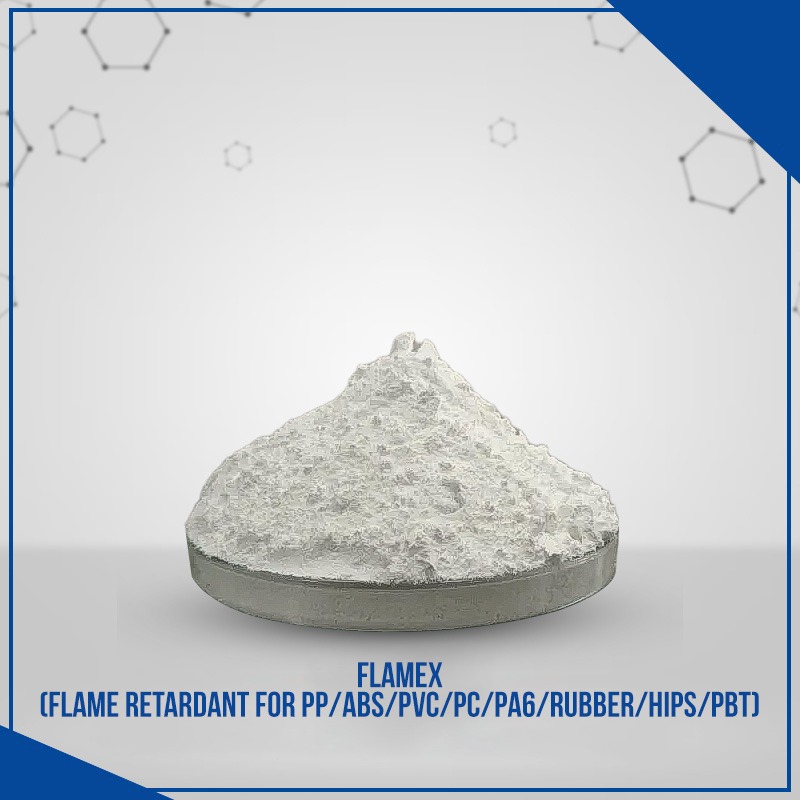 | flame retardant additives Flamex ( Flame Retardant for PP ABS PVC PC PA6 RUBBER HIPS PBT ) FLAMEX ( One Pack Flame Retardant ) manufactured by our company is widely used in PP,PA, PE,PC ,PC/ABS, PVC , Rubber ,PBT, PET, XPS, EPS, PU ,PVC,... View product → |
 | Zinc Borate ZINC BORATE is a highly effective multifunctional flame retardant synergist being used as a flame retardant and smoke suppressant in a wide range of... View product → |
Qualify the finished product, not just the additive datasheet
Approve the molded part, not the supplier’s plaque: make specimens from the production PP grade, colour, filler, gate thickness and molding cycle. A V-0 result at 3.2 mm does not qualify a 1.5 mm connector, and it says nothing about smoke-density testing or flame spread in a finished assembly.
1. For electrical enclosures, connectors and appliance parts, run UL 94 at production thickness, then test the actual part against the specified 650–960 °C glow-wire requirements under IEC 60695. Check ignition of the specimen and surrounding material; V-0 alone can miss this failure.
2. For automotive interior parts, use FMVSS 302 and verify the 102 mm/min burning-rate limit with its extinguishing provisions. Do not substitute a vertical UL 94 result without the vehicle maker’s approval.
3. For cable and conduit assemblies, test the complete cable or assembly using the applicable IEC 60332 method, including the installed bundle if specified. Use ASTM E84 only for its defined product format, never as evidence that loose pellets resist cable flame spread.
4. Repeat flammability, mechanical and electrical checks after heat ageing, water immersion and condensation. Add smoke-density testing when smoke control is part of the specification.
5. Require recycled PP lot qualification before approval. Measure molecular weight or a suitable melt-flow indicator, oxidation history, residual contamination and prior flame-retardant content, then compare afterflame time, char formation and mechanical retention across lots. Reject a formulation that passes only with one convenient regrind batch.
Frequently asked questions
Which polypropylene grade should you identify before choosing a flame retardant?
Record whether the material is homopolymer PP, random copolymer, impact copolymer, talc-filled PP, glass-fibre-reinforced PP, mineral-filled PP or recycled PP. These grades respond differently to additive loading, dispersion and mechanical-property loss.
How do you match a flame-retardant additive to polypropylene processing?
Compare the additive’s recommended loading and decomposition range with your extrusion or injection-molding temperature, residence time and shear history. Confirm that the package disperses without excessive plate-out, volatility or degradation.
What trade-offs must you measure besides the flame rating?
Measure smoke generation, flaming drips, afterflame time, flame spread, impact strength, tensile properties, elongation, colour, surface finish and processability. A higher flame rating does not automatically produce a usable PP part.
When should you choose a one-pack system instead of a separate synergist package?
Choose a one-pack system when consistent dosing and simpler production control matter most. Consider a separate synergist package when you need to tune loading, cost, smoke performance or compatibility for a specific PP formulation.
How should you qualify a flame-retardant polypropylene formulation?
Test molded production-grade specimens, not only additive samples. Use the fire-test method required for the application, record specimen thickness and conditioning, and verify mechanical, appearance and processing requirements after aging.
Related products
 | Antimony Trioxide Our range of Antimony trioxide is used mainly in flame retardant formulations for plastics, rubbers, textiles, paper and paints. View product → |
 | Aluminium Trihydrate (ATH) is a very finely grounded product having a uniform and controlled particle size distribution. View product → |
 | Aluminium Hydroxide ALUMINIUM HYDROXIDE is a Super Fine Precipitated Special ATH. View product → |
 | Magnesium Hydroxide MAGNESIUM HYDROXIDE is a very finely grounded product having an extremely uniform and narrow particle size distribution. View product → |