
A flame-retardant additive that works in PA6 can fail in PP, while a UL 94 V-0 result on a thin plaque does not guarantee safe performance in a finished cable, enclosure or sheet. By comparing chemistry, loading, processing conditions and test evidence, you can select a formulation that suits both your resin and your manufacturing process.
Key takeaways
- Match the additive to the resin grade, fillers, fibres, plasticisers and impact modifiers.
- Measure how additive loading changes melt flow, mechanical strength and smoke performance.
- Set processing temperatures below the additive’s decomposition limit before production trials.
- Use fire, smoke and electrical tests that match the finished plastic part’s application.
Match the Flame-Retardant Chemistry to the Resin
Choose by the resin’s decomposition behaviour, melt flow, processing temperature and end-use constraints—not by a compatibility list. Flame retardant selection by resin starts with the actual grade: fillers, glass fibre, impact modifiers and plasticisers can change the result.
| Resin | Chemistry to investigate first | Failure to check |
|---|---|---|
| PP | Intumescent phosphorus-nitrogen systems, or halogenated systems with antimony trioxide | Dripping, poor dispersion and loss of impact strength |
| ABS | Brominated systems with a suitable synergist, or phosphorus systems proven for the grade | Colour change, gloss loss, reduced impact and corrosive smoke |
| PVC | A PVC flame retardant additive matched to rigid or plasticised PVC; zinc borate can support smoke suppression | Plasticiser interaction, electrical-property change and dense smoke |
| PC/ABS | Phosphorus systems selected for both phases, with attention to melt stability | Reduced heat resistance, stress cracking and failed impact performance |
| PA6 | Phosphorus systems that promote condensed-phase char, often screened with nitrogen or mineral synergists | Moisture sensitivity, glass-fibre interaction and loss of tensile strength |
| PBT | Phosphorus or halogenated systems validated for polyester processing temperatures | Hydrolysis, corrosion, electrical tracking and mould deposits |
Run screening in the finished formulation at its intended fibre, pigment and glass-loading levels. A phosphorus percentage alone predicts little: phosphorus can form protective char in PA6 or PBT, yet perform weakly in PP.
Choose reactive chemistry when migration, extraction or permanence controls the decision; choose an additive when replacement and formulation adjustment matter more. Test flame spread, afterflame, smoke and corrosion separately, because a passing UL 94 result does not prove low smoke.
Understand What Each Additive Contributes—and What Loading Changes
The key distinction is whether the chemistry becomes part of the polymer or remains a separate phase. A reactive flame retardant bonds into the polymer structure, reducing migration and extraction but potentially changing molecular weight, glass-transition temperature, melt viscosity and recyclability.
A polymeric flame retardant is physically blended but has a high molecular weight, so it usually moves less than a small-molecule additive.
| Option | What it contributes | Main trade-off |
|---|---|---|
| Reactive flame retardant | Permanent chemical incorporation | Less replaceable; can alter processing and recycling |
| Polymeric flame retardant | Physically blended, lower-mobility flame-retardant phase | Requires dispersion; still is not chemically bound |
| Mineral flame-retardant filler | Dilution, barrier formation or heat absorption | Raises viscosity and density; can reduce impact and tensile strength |
| Flame-retardant synergist | Strengthens another chemistry, such as antimony trioxide with halogenated systems | Adds density, cost, opacity and compounding abrasion |
| One-pack blend | Pre-combined flame retardant, synergist and carrier for consistent dosing | Less formulation flexibility and possible compatibility limits |
Loading changes the plastic, not just its fire result. More aluminium trihydrate absorbs heat and releases water at roughly 180–220 °C, but that decomposition range can conflict with melt processing; high loading also increases viscosity. More additive can reduce strength, impact, flow or surface quality, while too little can leave incomplete char or gas-phase inhibition.
Treat each loading as a new grade. Mineral moisture, ionic impurities, interfacial voids and poor coating can reduce volume resistivity, dielectric strength or tracking resistance. Request electrical results from the compounded plastic after conditioning, not only the neat-resin datasheet, and test aged parts because extraction, hydrolysis and repeated reflow can redistribute non-reactive additives.
Set the Processing Window Before You Run a Production Trial
A production trial fails before molding if the additive’s thermal limit does not fit the resin’s melt window. Set the flame retardant processing temperature from the additive’s decomposition data, not from the polymer’s maximum barrel setting.
1. Keep ATH-based compounds below the ATH decomposition temperature, roughly 180–220 °C, unless the formulation is specifically designed around that release of water. Magnesium hydroxide decomposition occurs around 330–350 °C, making it more suitable for some high-temperature polyolefin and engineering-plastic processes.
2. Dry hygroscopic PA6, PBT, and moisture-sensitive masterbatches to the supplier’s specified moisture limit in a desiccant dryer. Moisture causes hydrolysis, bubbles, silver streaks, and lost impact strength. Seal dried material until feeding.
3. Use the lowest melt temperature that gives complete melting and dispersion. Limit residence time, purge dead zones, and avoid repeated reprocessing; excessive thermal history can darken ABS or PC/ABS and degrade the additive or polymer.
4. Select a screw with distributive mixing for mineral fillers and enough dispersive mixing to break agglomerates, but avoid excessive shear that raises melt temperature. Check ash distribution and molded-part surfaces rather than trusting pellet appearance.
5. Feed a flame-retardant masterbatch at its validated let-down ratio. Confirm carrier compatibility, then adjust feeder calibration for bulk density; a nominal percentage is not proof of uniform dosing.
6. Pelletise with stable strand cooling and controlled cutter speed. Dry or dewater pellets before injection moulding flame retardant trials, and record melt temperature, torque, pressure, residence time, moisture, and pellet appearance for every run.
Use the Right Fire, Smoke and Electrical Tests
A compounded plastic meets its intended fire-safety requirement only when the test matches the finished application. UL 94 and Limiting Oxygen Index are screening tools, not complete product approval.
| Test | What it shows | Evidence to retain |
|---|---|---|
| UL 94 V-0, V-1, V-2 | Vertical-burn afterflame, afterglow and flaming-drip behaviour | Exact specimen thickness, colour, moulding conditions and orientation |
| Limiting Oxygen Index | Minimum oxygen concentration supporting continued burning | Test procedure and specimen details; do not treat LOI as an end-use prediction |
| Cone calorimetry ISO 5660-1, ASTM E1354 | Time to ignition, heat-release rate, peak heat-release rate, total heat released and effective heat of combustion | External heat flux, thickness, orientation and flaming-ignition method |
| IEC 60332, IEC 60754 and IEC 61034 | Cable flame propagation, halogen-acid-gas release and smoke density | Test report for the complete cable construction, not only its insulation compound |
A UL 94 V-0 result can still accompany high heat release, unacceptable smoke or melt-drip behaviour in a larger fire. A high LOI can also fail under forced flaming, so request cone-calorimetry data when fire growth matters.
Keep evidence that connects the result to production: formulation and additive loading, resin grade, batch number, drying history, compounding conditions, specimen thickness and finished-part geometry. Repeat testing after heat aging, humidity exposure or colour changes when those conditions affect service.
For a cable, test the finished construction. Conductor size, insulation thickness, fillers, shields and jacket geometry can change the result even when the plastic compound itself passes a material-level test.
Qualify the Formulation for Bengaluru Production and End Use
Approve a formulation only after it survives the processing, conditioning and finished-part tests used in Bengaluru production. A plaque that passes UL 94 or shows a high LOI is not enough: molding history, humidity, geometry and additive distribution can change ignition, dripping, smoke and electrical performance.
1. Request the flame-retardant technical data sheet, SDS and batch traceability records. Check recommended loading, moisture limits, decomposition temperature, particle size, storage life, impurities, color effect and compliance declarations, including RoHS limits for PBB and PBDE in each homogeneous material.
2. Compound production-representative batches on the intended equipment. Record drying conditions, melt temperature, residence time, screw configuration, pellet moisture and molded-part settings, then compare dispersion, surface defects, warpage, impact strength and electrical properties with the unmodified resin.
3. Age molded parts before retesting them. Use the product’s real exposures: humidity and hydrolysis for PA6, UV and heat for outdoor parts, extraction or plasticizer migration for flexible PVC, and repeated reflow for electronics. Test after conditioning, not only as molded.
4. Test the finished geometry, including walls, ribs, weld lines, connectors and cable constructions. For cables, IEC 60332 covers flame propagation, IEC 60754 covers halogen-acid-gas evolution, acidity and conductivity, and IEC 61034 covers smoke density; material-level results do not prove finished-cable compliance.
Request actual compounded-grade dielectric strength, volume resistivity and tracking results after conditioning when mineral loading is high. Niknam Chemicals Pvt. Ltd can supply trial material for this comparison, but your approved batch, process window and finished-part evidence remain the qualification record.
Related products
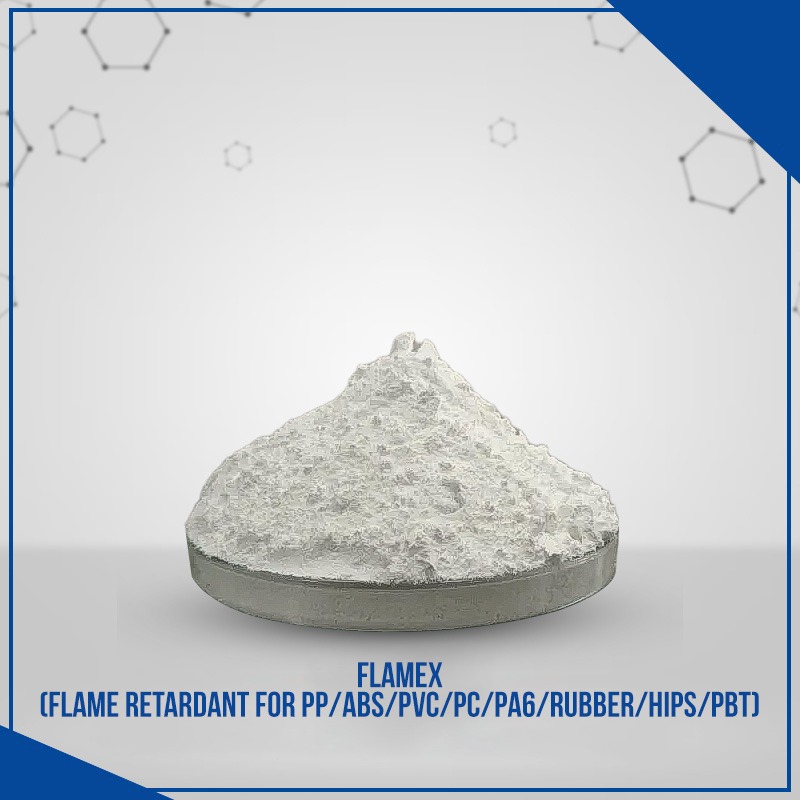 | flame retardant additives Flamex ( Flame Retardant for PP ABS PVC PC PA6 RUBBER HIPS PBT ) FLAMEX ( One Pack Flame Retardant ) manufactured by our company is widely used in PP,PA, PE,PC ,PC/ABS, PVC , Rubber ,PBT, PET, XPS, EPS, PU ,PVC,... View product → |
 | Flame Retardant Filler FAM-501 Flame Retardant Filler FAM-501 FAM - 501 Flame Retardant filler FAM-501 is One Pack Flame Retardant & Smoke Suppressant developed for Plasticized PVC applications. View product → |
Frequently asked questions
How do you match flame-retardant chemistry to a plastic resin?
Assess the resin’s decomposition behaviour, melt-flow requirements, processing temperature and end-use constraints, then account for fillers, glass fibre, impact modifiers and plasticisers.
What changes when you increase flame-retardant loading?
Higher loading can alter melt flow, mechanical properties, appearance, smoke generation and processing behaviour, so evaluate the complete formulation rather than the additive alone.
How do you set a safe processing window for a flame-retardant plastic?
Compare the additive’s thermal stability with the resin’s melt-processing temperature, then confirm the limits through a controlled production trial.
Which tests should you use for flame-retardant plastic formulations?
Select fire, smoke and electrical tests according to the finished part’s application, material construction and required performance classification.
Related products
| FAM-501 ABOUT FAM - 501 FAM-501 is One Pack Flame Retardant & Smoke Suppressant developed for Plasticized PVC applications. View product → |
 | Zinc Borate ZINC BORATE is a highly effective multifunctional flame retardant synergist being used as a flame retardant and smoke suppressant in a wide range of... View product → |
 | Aluminium Hydroxide ALUMINIUM HYDROXIDE is a Super Fine Precipitated Special ATH. View product → |
 | Aluminium Trihydrate (ATH) is a very finely grounded product having a uniform and controlled particle size distribution. View product → |