
Flame-retardant ABS succeeds only when the additive package, resin grade, wall thickness and processing history are qualified together. By the end, you will be able to set a test target, compare halogenated and halogen-free options, plan compounding trials and write a procurement specification that Bengaluru moulders and component buyers can verify.
Key takeaways
- Define the test standard, thickness, colour and conditioning state before selecting an additive.
- Match additive chemistry to the ABS grade, end use and required mechanical performance.
- Measure loading, drying and processing effects on both pellets and moulded parts.
- Use a Bengaluru qualification matrix to compare batches and maintain repeatable supply.
Set the fire-performance target before choosing an ABS additive
Choose the pass/fail result from the end use, not from an additive brochure. Specify the test standard, specimen thickness, colour, conditioning state and production-part location; “flame-retardant ABS” alone leaves the critical variables open.
| Target | Specify | What it proves |
|---|---|---|
| UL 94 V-0 | UL 94 V-0 at specimen thickness of 1.5 mm, 2.0 mm or the part’s minimum wall | Each flame application produces no more than 10 seconds of afterflame, with no flaming drips that ignite cotton and no burn-through |
| UL 94 V-1 | UL 94 V-1 at specimen thickness, with the exact thickness recorded | A lower vertical-burn performance than V-0; do not treat it as an equivalent substitute |
| UL 94 V-2 | UL 94 V-2 at specimen thickness, with the exact thickness recorded | Flaming drips are permitted, so it may be unsuitable above sensitive electronics or ignition sources |
| Glow-wire | IEC 60695-2-11 at the specified wire temperature on the finished part or material | Resistance to ignition from a heated wire; it does not follow from passing a UL 94 test |
| Vehicle interior | FMVSS 302, with a burning rate of 102 mm/min or less where the rule applies | Horizontal-burning compliance; a V-rating cannot replace this automotive requirement |
Validate the selected class on moulded parts using the intended wall thickness, colour, mould, lot and regrind policy. A formulation that achieves UL 94 V-0 on a laboratory plaque can fail after moisture, pigment, contamination, thermal history or a thinner production section changes the result.
Include smoke testing when the equipment or enclosure specification demands it.
Match the flame-retardant chemistry to the ABS grade and end use
The same flame-retardant package will not deliver the same engineering result across ABS grades. Resin flow, rubber content, reinforcement and colour affect burning behaviour, impact strength, surface appearance and mould filling, so qualify the chemistry with the finished part.
| Grade or construction | Engineering trade-off | Evidence to compare |
|---|---|---|
| injection-moulding ABS | Good flow can fall as additive loading rises, while impact and elongation decline | Spiral-flow, impact and weld-line results at the specified wall thickness |
| extrusion ABS | Long residence time can increase plate-out, degradation and colour shift | Melt stability, die deposits and colour after the production residence time |
| impact-modified ABS | Higher rubber content supports toughness but can make the UL 94 target harder to achieve | Notched impact and vertical-burn results on the actual grade |
| PC/ABS grades | Better heat performance can come with different viscosity, compatibility and additive response | Mould-flow, heat-deflection and flame results after drying and conditioning |
A halogenated system with antimony trioxide can reduce total additive loading, but it increases density and can raise smoke, corrosive-gas, colour and regulatory concerns. Confirm the actual chemistry: RoHS restricts PBBs and PBDEs at 0.1% by weight each, not every brominated flame retardant.
Halogen-free phosphorus systems are not drop-in replacements. They can alter viscosity, hydrolysis sensitivity, plate-out, colour and impact retention, so test the resin, additive level and processing history together.
Glass fibre can reduce dripping and improve dimensional stability, yet fibre-rich burn surfaces can change ignition and afterflame. Never transfer unfilled ABS data to a filled enclosure or connector body.
Qualify loading, mechanical retention and additive compatibility
Approve a loading window, not a single dosage. Demand the recommended loading range in ABS for the exact resin grade, colour and fire target, with additive dosage by weight stated as a percentage of the finished compound and separated into resin, flame retardant and synergist. Require test data at the low, nominal and high points.
1. Test the actual formulation at each loading for UL 94 at the specified wall thickness, melt flow, tensile strength, notched impact strength, elongation and heat-deflection temperature. Request weld-line and mould-flow results where the part has thin sections, ribs or flow fronts; the base ABS datasheet does not prove retention after modification.
2. Confirm additive compatibility with the ABS and every other ingredient. Review dispersion micrographs or equivalent evidence, colour shift, surface migration, plate-out, mould fouling, pellet stability and performance after drying and heat ageing. For glass-filled, mineral-filled, impact-modified or PC/ABS grades, insist on separate data rather than extrapolation from unfilled ABS.
3. Require the supplier to identify the flame-retardant chemistry and synergist, including the antimony trioxide level where used, plus restricted-substance and applicable RoHS declarations. For halogen-free phosphorus systems, check hydrolysis sensitivity, viscosity change and recycling effects; they are not drop-in replacements for brominated systems.
Reject a formulation that meets the flame test only at a loading that causes unacceptable impact, flow or colour. Record the approved dosage tolerance, regrind limit and conditioning protocol in the material specification, then verify them on production lots.
Control drying and twin-screw processing from pellets to moulded parts
Keep compounded ABS below 0.05% moisture at the feed throat unless the resin and additive supplier specify a different limit. Use ABS drying conditions of 80–85°C for 3–4 hours, confirm moisture with Karl Fischer testing, and transfer pellets into sealed hoppers.
Moisture causes splay, bubbles and unstable additive dispersion; phosphorus systems can also lose performance after excessive thermal or hydrolytic exposure.
Use this sequence before moulding:
- Dry resin, flame retardant and compatible processing aid according to their individual technical data sheets; do not assume one temperature suits every component.
- Premixing: weigh each component by loss-in-weight feeder or verified batch record, then blend long enough to prevent additive-rich and additive-poor slugs.
- Set the twin-screw temperature profile from feed zone to die so the additive melts and disperses without unnecessarily overheating ABS. Record melt temperature, screw speed, torque and twin-screw temperature profile and residence time for each validated formulation.
- Avoid dead zones and long stoppages. Purge before restarting, and control regrind percentage, pigment, lubricant and contamination as specification variables.
- Validate pellets and moulded parts at the intended wall thickness, colour, mould and cycle; a laboratory plaque can pass while production parts fail.
| Control | Release target | Failure if missed |
|---|---|---|
| Moisture | ≤0.05% unless validated otherwise | Splay, voids or variable flame results |
| Melt temperature | Within the approved formulation window | Degradation, colour shift or lost performance |
| Residence time | Within the validated range | Uneven dispersion or additive degradation |
| Regrind | Fixed percentage and approved source | Lot-to-lot flammability variation |
Build a Bengaluru qualification matrix for repeatable supply
A Bengaluru buyer should lock the formulation and finished-part variables into one controlled specification. “Flame-retardant ABS” is not enough: record the resin grade, colour, minimum wall thickness, glass fibre and mineral fillers, additive package, and permitted regrind percentage.
Validate each supplier against the same matrix:
- Require UL 94 classification at the specified thickness, not a result from a thinner specimen.
- Add glow-wire IEC 60695-2-11 for electrical parts; a UL 94 V-0 result does not prove ignition resistance under a heated wire.
- Specify ASTM E662 smoke testing when smoke performance matters. It reports optical density under flaming and non-flaming exposure; UL 94 does not measure smoke.
- For vehicle interiors, use FMVSS 302 and its 102 mm/min maximum burning rate instead of substituting a UL 94 rating.
- Demand impact, tensile, heat-deflection, mould-flow and weld-line results after the agreed conditioning cycle.
- Require RoHS PBB and PBDE screening, a signed restricted-substance declaration, batch number, certificate of analysis and retained sample.
- Set lot-to-lot limits for additive loading, colour, moisture, pellet appearance and regrind content.
Niknam Chemicals Pvt. Ltd can be assessed against this matrix by requesting formulation-specific data rather than accepting a generic additive datasheet.
Approve a Bengaluru source only after trial mouldings from multiple lots meet the same fire, smoke, mechanical and documentation limits. Requalify after any resin, additive, colour, filler, tooling or processing change.
Related product
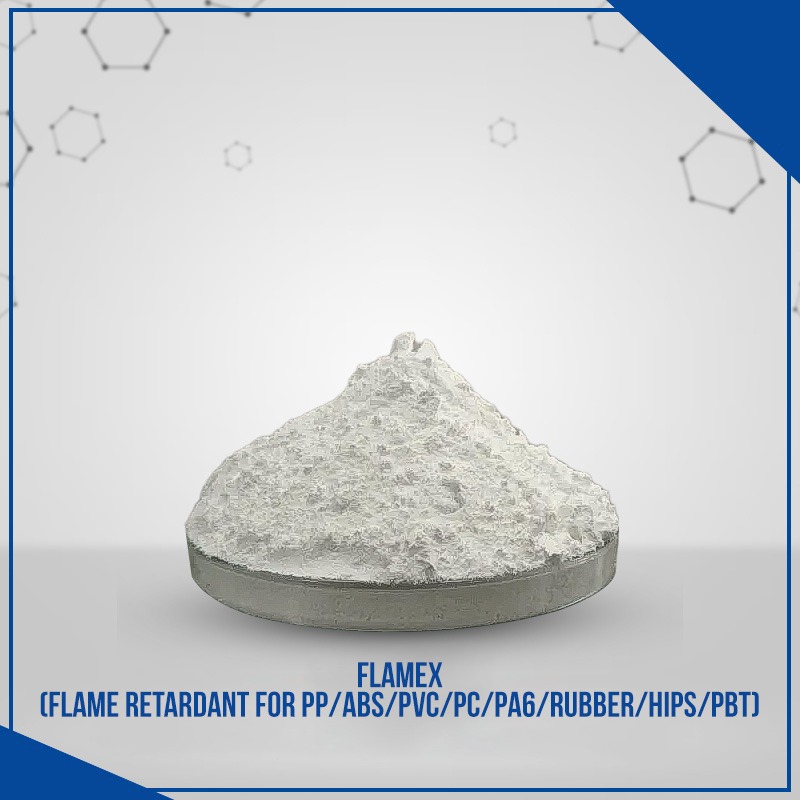 | flame retardant additives Flamex ( Flame Retardant for PP ABS PVC PC PA6 RUBBER HIPS PBT ) FLAMEX ( One Pack Flame Retardant ) manufactured by our company is widely used in PP,PA, PE,PC ,PC/ABS, PVC , Rubber ,PBT, PET, XPS, EPS, PU ,PVC,... View product → |
Frequently asked questions
What should you define before choosing a flame retardant for ABS?
Specify the pass/fail fire test, specimen thickness, colour, conditioning state and location of the production part.
How do you match flame-retardant chemistry to an ABS application?
Check the ABS grade, end-use temperature, required fire performance, mechanical properties and additive compatibility before selecting the chemistry.
What must you qualify besides flame performance?
Qualify additive loading, impact and tensile retention, colour, surface appearance, thermal stability and compatibility with the ABS formulation.
How should ABS flame-retardant compounds be processed?
Control pellet drying, feed consistency, twin-screw temperature, residence time and moulding conditions, then test the finished parts.
What belongs in a Bengaluru ABS supply qualification matrix?
Record supplier batch details, additive loading, test results, processing conditions, part location and repeat-test performance across incoming lots.