
An ABS electrical housing must pass the right flammability and electrical-safety tests at its thinnest production wall, not merely carry a generic V-0 claim. You will be able to define the target standard, compare flame-retardant chemistries, set a supplier trial brief and qualify the final moulded enclosure under Bengaluru production conditions.
Key takeaways
- Specify UL 94 and the complete enclosure standard before selecting additives.
- Check additive loading against ABS grade, wall thickness, impact and flow targets.
- Validate drying, compounding and moulding conditions with finished-part testing.
- Request batch data, compliance documents and process support from Bengaluru suppliers.
Choose the housing standard before choosing the flame-retardant package
Choose the ABS electrical housing standard before selecting a flame-retardant package. UL 94 V-0 ABS is a material classification, not proof that a complete enclosure meets IEC 60670 for boxes and enclosures for electrical accessories or IEC 60601-1 for medical electrical equipment.
| Test or classification | What it measures | What it does not prove |
|---|---|---|
| UL 94 V-0, V-1 or V-2 | Material response to a small flame | Finished-housing compliance |
| IEC 60695-11-10 | 50 W horizontal and vertical small-flame procedures for materials; the IEC 60695-11-10 ABS plastic test | Glow-wire or end-product performance |
| IEC 60695-11-20 | 500 W vertical flame test for materials | Smoke density, toxicity or fire endurance |
For UL 94 V-0, each afterflame must be no more than 10 seconds, the five-specimen total afterflame time after both flame applications must be no more than 50 seconds, and flaming drips must not ignite the cotton indicator.
UL 94 V-1 V-2 classifications use different acceptance limits, so do not treat them as equivalent to V-0.
UL 94 does not rate smoke density, smoke toxicity, room flame spread, heat release or fire endurance. Request ASTM E662 or ISO 5659-2 smoke data with orientation and heat flux stated.
Specify these details in the test request:
- Exact standard, specimen thickness, production colour and conditioning route
- Afterflame and afterglow recording, including cotton-indicator ignition and dripping
- End-product test required by IEC 60670 or IEC 60601-1
- Glow-wire testing under IEC 60695-2-11, or material screening under IEC 60695-2-12 or IEC 60695-2-13
Glow-wire results are separate evidence, not substitutes for UL 94. Test the actual minimum wall, because a formulation passing at 3.2 mm can fail at 1.5 mm or 0.8 mm.
Match the chemistry and loading to the ABS grade and wall thickness
A 3.2 mm plaque can pass UL 94 V-0 while the same ABS formulation fails at 1.5 mm or 0.8 mm. Specify the named resin grade, production colour and actual minimum wall thickness before selecting the flame-retardant dosage for ABS.
| Chemistry | Strength | Trade-off |
|---|---|---|
| Brominated flame retardant plus antimony trioxide | Efficient loading; established route for many ABS grades | More smoke and corrosive combustion products; antimony trioxide is a synergist, not a standalone replacement |
| Phosphorus- or nitrogen-based | Halogen-free ABS flame retardant option | Check viscosity, impact, colour, hydrolytic stability and CTI |
| Mineral-based | Can suppress smoke in a selected combustion regime | Higher density and stiffness, lower impact, greater viscosity and poorer thin-wall filling |
For a brominated flame retardant antimony trioxide ABS system, changing the bromine-to-antimony balance can alter afterflame, dripping, smoke and colour. “Halogen-free” does not automatically mean low-smoke or electrically superior. For EU RoHS markets, confirm PBB and PBDE below 0.1% by weight in each homogeneous material; that restriction does not ban every brominated flame retardant.
Put these items in the supplier brief:
- Starting dosage in phr and weight percent, recommended range, and loading that achieved the stated UL 94 result in the named grade.
- Results at 3.2 mm, 1.5 mm or 0.8 mm where those walls exist, using production colour and geometry.
- Separate results for general-purpose, high-heat, impact-modified, ABS/PC and recycled ABS grades.
- Resin composition, melt temperature and regrind percentage used in testing, since each changes flame response.
- Exact flame-retardant identity, PBB/PBDE declaration and any broader halogen-content claim.
Protect impact, flow and electrical insulation while adding flame resistance
A V-0 result is not useful if the enclosure cracks, warps, fails electrical insulation or will not fill its mould. Treat flame retardant ABS compatibility as a finished-compound qualification, not an additive claim.
1. Screen the ABS resin, pigments, plasticisers, stabilisers, glass fibre, mineral fillers and processing aids together. Check dispersion, plate-out, mould deposits, gas generation, corrosion risk and contact with copper terminals or electronic components.
2. Measure the trade-offs on moulded specimens: Izod impact for ABS housing impact strength, tensile strength, heat-deflection temperature, flow length, weld-line strength, surface gloss, colourability, density and melt viscosity. A high mineral loading can reduce smoke in a selected combustion regime while increasing stiffness, density and viscosity, reducing thin-wall filling and lowering impact strength.
3. Verify ABS CTI IEC 60112 at the specified voltage and conditioning state. A flame-retardant package, pigment or surface deposit can lower comparative tracking index even when UL 94 improves; inspect the actual housing surface, not only a resin plaque.
4. Treat smoke suppression as a separate claim. Request ASTM E662 smoke testing ABS data or ISO 5659-2 results with specimen orientation and heat-flux condition stated, then compare those results with UL 94, impact, flow and CTI data.
Approve the formulation only when it survives repeated moulding at production melt temperature, residence time and drying history. “Halogen-free” does not prove low smoke or superior electrical insulation.
Qualify drying, compounding and moulding instead of relying on a datasheet
A repeatable part requires a qualified process window, not a datasheet decomposition temperature. Ask the supplier for ABS drying before compounding: temperature, time and pellet moisture limit. Wet pellets can cause splay, bubbles and lower mechanical performance even though ABS absorbs less water than many engineering plastics.
- Define masterbatch preparation and twin-screw extrusion flame retardant ABS conditions, including screw-element selection, feed and kneading zones, residence time, melt temperature and purge practice. Record every setting.
- Establish ABS injection moulding flame retardant conditions: injection temperature, mould temperature, back pressure, screw speed and residence time. Keep the upper limit below the package’s thermal-decomposition limit, then confirm it through repeated moulding and long residence-time exposure.
- Inspect for colour shift, plate-out, mould deposits and gas generation. Retest impact retention after thermal exposure; a flame-retardant package that passes UL 94 but embrittles the housing is not qualified.
- Mould the production colour and complete geometry, including minimum walls, ribs, bosses, weld lines and gate locations. A thin-wall ABS electrical enclosure can behave differently from a flat plaque, especially at 0.8, 1.5 or 3.2 mm.
Run trials at the regrind percentage used in production and record regrind proportion, drying history, pellet packaging and storage. Repeat testing under Bengaluru humid-season storage and production conditions. Keep material UL 94 evidence separate from finished-part glow-wire testing under IEC 60695-2-11 and end-product evidence.
Build a supplier qualification brief for Bengaluru production
Your purchase specification should define the exact ABS compound, test configuration and production limits before you request prices. Use this qualification checklist:
- Named ABS grade, including general-purpose, high-heat, impact-modified, ABS/PC or recycled ABS
- Permitted flame-retardant chemistry family and any halogen, phosphorus, nitrogen or mineral restriction
- Starting dosage in phr or weight percent, recommended range and dosage that achieved the claimed result
- Production colour, minimum wall thickness and resin/regrind percentage
- Drying temperature, time and moisture limit
- Injection and mould-temperature range, residence-time limit, back pressure and purge practice
- CTI result to IEC 60112 at the specified voltage and conditioning
- Smoke method and result, such as ASTM E662 optical density or ISO 5659-2 with heat flux and orientation
- Glow-wire requirement to IEC 60695-2-11, including temperature and pass criterion
- UL 94 classification and a UL 94 test report ABS compound
The record must state specimen dimensions and thickness, conditioning, laboratory, formulation or recognition number, and limitations on colour, regrind and processing. Request moulded plaques plus production-like housings with ribs, bosses, weld lines and gates; “UL 94 compatible” proves nothing by itself.
Ask your ABS flame retardant supplier Bengaluru shortlist to support a flame retardant chemical trial for ABS. Niknam Chemicals Pvt. Ltd can discuss an ABS-specific trial brief, but its additive name is not compliance evidence. Compare ABS grades, colour and minimum wall thickness, then approve only when flame, smoke, mechanical, electrical and processing results agree.
Related products
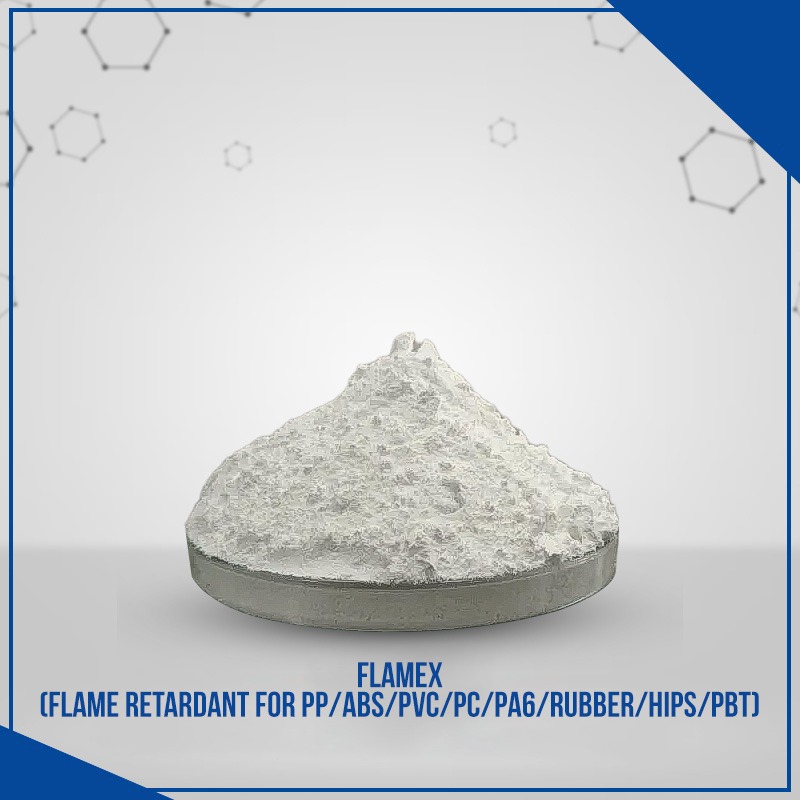 | flame retardant additives Flamex ( Flame Retardant for PP ABS PVC PC PA6 RUBBER HIPS PBT ) FLAMEX ( One Pack Flame Retardant ) manufactured by our company is widely used in PP,PA, PE,PC ,PC/ABS, PVC , Rubber ,PBT, PET, XPS, EPS, PU ,PVC,... View product → |
 | Antimony Trioxide Our range of Antimony trioxide is used mainly in flame retardant formulations for plastics, rubbers, textiles, paper and paints. View product → |
Frequently asked questions
Which standard should you choose before selecting a flame-retardant package for ABS housings?
Define the required material classification, such as UL 94 V-0, and the complete housing standard. UL 94 V-0 alone does not prove compliance with IEC 60670 or IEC 60601-1.
How do ABS grade and wall thickness affect flame-retardant selection?
They affect the additive chemistry and loading needed to reach the target classification. Compare results at the housing’s actual wall thickness, not only at a thicker laboratory specimen.
What properties must you protect when adding flame resistance to ABS?
Check impact strength, melt flow, mould filling, weld-line performance, colour, dimensional stability and electrical insulation after adding the flame-retardant package.
Why must drying, compounding and moulding be qualified?
Moisture, dispersion, residence time, screw settings, melt temperature, mould temperature and injection speed can change flame performance and part quality. Confirm the process with finished-part tests.
What should a Bengaluru supplier qualification brief include?
Include the ABS grade, colour, wall thickness, UL 94 target, electrical requirements, additive loading, processing window, test reports, safety data sheet, batch traceability and technical support contacts.