
ABS parts used in electrical housings, vehicle components and appliances must balance fire performance with impact strength, appearance, processability and compliance evidence. By the end, you will be able to compare additive packages, calculate trial loadings, choose a process-appropriate formulation and specify tests that reflect the finished part rather than the additive alone.
Key takeaways
- Start with ABS grade, rubber content, melt flow and wall thickness.
- Match additive loading and chemistry to your compounding and molding process.
- Check melt flow, toughness and part quality after flame retardant addition.
- Treat UL 94 results as evidence, not a complete fire-safety claim.
Start with the ABS grade, not a general compatibility list
ABS grade sets the starting point for ABS flame retardant selection. Acrylonitrile-butadiene-styrene grades differ in rubber content, melt flow, pigment level and heat resistance; each changes the balance between fire performance and toughness. Confirm the impact modifier, plasticizer content, pigment and intended wall thickness before choosing an additive.
For a brominated system, pair the halogen donor with antimony trioxide (ATO) rather than treating ATO as a complete flame retardant. ATO promotes the donor’s condensed- and gas-phase action, but the useful ratio and total loading are formulation-specific.
Treat any published FLAMEX or individual-synergist range as a screening starting point, then verify it in the actual resin.
- Record the ABS grade, target UL 94 class and test thickness.
- Set the processing window: ABS melt temperatures commonly sit around 220–260 °C, and the package must survive compounding, residence time and moulding.
- Compare impact strength, tensile properties, elongation, weld-line strength, gloss and colour after ageing.
- Express trials in phr, meaning grams of additive per 100 grams of resin. Ten phr added to 100 parts resin equals 9.09% of that resin-plus-additive blend before other ingredients are counted.
Do not approve “V-0 ABS” as a sufficient specification: UL 94 V-0 belongs to a stated specimen thickness and test procedure, and a thinner wall can fail. Require formulation-specific plaques and processing data, then choose the lowest loading that meets fire, flow, appearance and toughness targets.
Match loading and chemistry to the manufacturing process
Start with the process temperature and residence time, then choose the additive package. ABS commonly melts at about 220–260 °C, so a flame retardant that decomposes early can cause gas, discoloration, die deposits or lost fire performance.
1. Calculate the target loading on the resin basis: phr = additive mass ÷ ABS resin mass × 100. For example, 10 phr means 10 kg additive per 100 kg ABS. For a total-compound figure, use weight percentage = additive mass ÷ total batch mass × 100; 10 phr equals 9.1 weight percentage.
2. Treat FLAMEX loading as grade-specific, not a universal recipe. Confirm the supplier’s validated range, then adjust for impact modifier, pigment, plasticizer and processing temperature. A brominated flame retardant with antimony trioxide is common for injection moulding ABS, but the ratio requires testing; antimony trioxide alone is not an effective practical solution.
3. Match the package to the process and part:
| Process | Suitable approach | Main control |
|---|---|---|
| Injection moulding ABS | Thermally stable FLAMEX or brominated/synergist package; fine dispersion | Check melt flow, residence time and surface defects |
| Extrusion and sheet | Stable package with low die-plate-out risk; consider smoke suppressant | Test continuous residence time and thickness effects |
| Electrical housings | Verify UL 94 plus IEC 60695-2-10/11/12/13 glow-wire performance | Test the actual wall geometry |
| Automotive parts | Preserve impact strength and low warpage | Check heat ageing, vibration and pigment interaction |
| 3D-printing filament | Use finely dispersed, thermally stable loading at extruder temperature | Confirm diameter consistency, brittleness and nozzle deposits |
Aluminum hydroxide releases water near ABS processing temperatures. Magnesium hydroxide tolerates more heat but often needs high mineral loading, reducing flow and toughness.η
Protect melt flow, toughness and part quality during compounding
Flame retardants change ABS processing because they dilute the rubber-rich matrix and alter melt viscosity. Excessive loading can lower ABS melt flow, impact strength, elongation and weld-line strength; a molded part may pass a fire test yet crack at an assembly clip or show poor surface gloss.
Keep the additive stable across the 220–260 °C melt-temperature range. Early decomposition can cause discoloration, gas generation, die deposits or reduced fire performance, so thermal-gravimetric data must be confirmed with a production-representative compounding and molding trial.
Control the shift with these checks:
- Dry the ABS according to the resin supplier’s time and temperature, then verify moisture before feeding. Do not assume a non-hygroscopic flame retardant prevents wet-resin defects.
- Feed powders through a controlled premix or gravimetric feeder and inspect additive distribution. Use dispersion testing to detect agglomerates that create weak spots and inconsistent fire performance.
- Measure melt flow before and after compounding. Adjust screw speed, residence time and additive loading when viscosity causes incomplete filling, excessive shear or poor weld lines.
- Compare molded plaques and finished parts for impact strength and tensile strength, not only initial appearance or a flammability result.
- Repeat property and appearance checks after heat exposure, dust contact and repeated cleaning. Low-molecular-weight additives face greater migration and blooming risk; polymeric or reactive systems reduce that risk but can alter viscosity and recyclability.
A small pilot batch exposes these trade-offs before they reach a full mold.
Read UL 94 results as evidence, not as a complete fire-safety claim
UL 94 V-0 proves that ABS specimens met defined limits for ignition, afterflame, afterglow and flaming drips in a vertical-burning procedure. It does not prove that a complete enclosure, appliance or Delhi installation is fire-safe. UL 94 also includes horizontal burning classifications, which are not interchangeable with V-0.
A result belongs to the tested formulation, colour and specimen thickness. The same ABS compound can pass at 3.2 mm and fail at 1.5 mm, so “V-0 ABS” is incomplete procurement language.
| Test or evidence | What it tells you | What it does not tell you |
|---|---|---|
| UL 94 vertical burning | Small-specimen flame response, afterflame and afterglow | Room fire growth, heat release or smoke toxicity |
| UL 94 horizontal burning | Burning rate or self-extinguishing behaviour in the horizontal test | Vertical performance or end-use enclosure safety |
| IEC 60695-2-10/11/12/13 glow-wire tests | Response to a heated ignition source on an electrical part | Compliance based only on a UL 94 certificate |
| Smoke and fire-effluent testing | Smoke generation and gases under specified conditions | A universal low-smoke result for every geometry |
Request these documents before approval:
- The UL 94 report or certificate showing test method, thickness, colour, formulation identity and classification.
- The full afterflame, afterglow and flaming-drip observations, not only the words “V-0”.
- Glow-wire data when the ABS part is electrical or electronic, plus Izod impact, tensile results, appearance and ageing data.
- Processing and moisture limits, because wet ABS can cause splay, bubbles and variable results.
If evaluating a package from Niknam Chemicals Pvt. Ltd, request a formulation-specific report rather than relying on a product name or general ABS suitability statement.
Related products
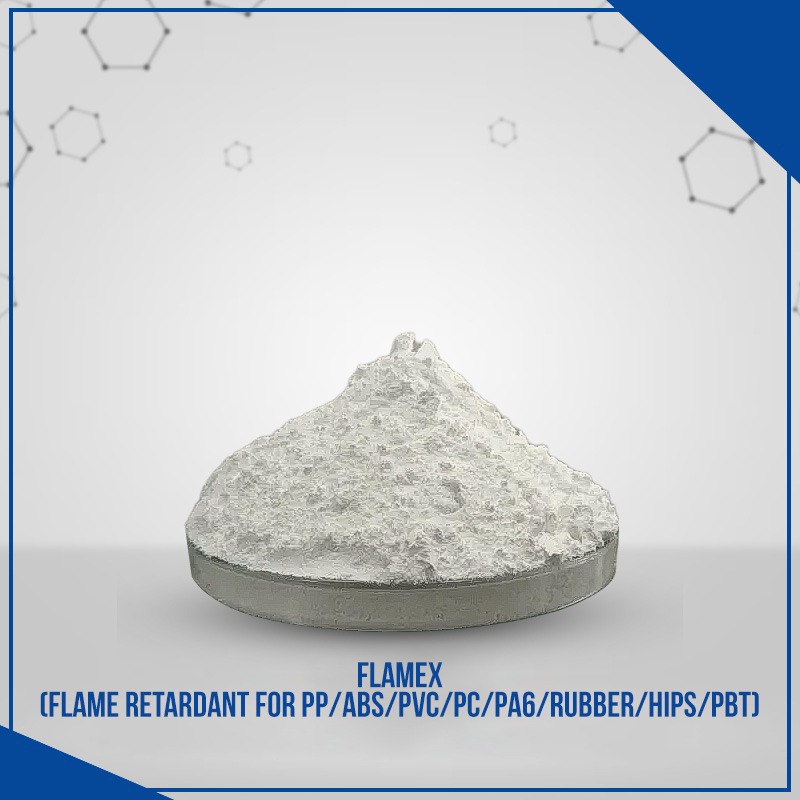 | flame retardant additives Flamex ( Flame Retardant for PP ABS PVC PC PA6 RUBBER HIPS PBT ) FLAMEX ( One Pack Flame Retardant ) manufactured by our company is widely used in PP,PA, PE,PC ,PC/ABS, PVC , Rubber ,PBT, PET, XPS, EPS, PU ,PVC,... View product → |
 | Antimony Trioxide Our range of Antimony trioxide is used mainly in flame retardant formulations for plastics, rubbers, textiles, paper and paints. View product → |
Choose halogenated or halogen-free chemistry for the actual Delhi application
Smoke and corrosive combustion products can outweigh a small processing advantage. A brominated flame retardant paired with antimony trioxide often delivers efficient ABS flame performance, but antimony trioxide is not an effective standalone package at practical loading. Establish the ratio by testing; do not copy a generic recipe.
| Option | Main decision | Check before approval |
|---|---|---|
| Halogenated ABS | Efficient flame performance with a brominated flame retardant and antimony trioxide | Smoke, acidic gases, enclosure corrosion and ventilation |
| Halogen-free ABS | Lower concern about halogenated combustion products | Heat release, required loading, melt viscosity and impact retention |
| RoHS ABS | Finished compound screened for PBB, PBDE, lead, mercury, cadmium and hexavalent chromium | Supplier declaration plus test evidence; “halogen-free” alone is not RoHS proof |
For electrical equipment in occupied rooms, assess smoke and corrosion alongside UL 94. For outdoor Delhi service, test heat exposure, dust deposition, repeated cleaning and accelerated ageing for migration, blooming, colour change and surface deposits. Reactive or polymeric additives reduce migration risk, yet they can alter viscosity, weld-line strength and recyclability.
Specify the end use precisely: a sealed enclosure, ventilated housing, automotive part and visible consumer component face different heat, ignition, dust and cleaning conditions. Compare aged Izod impact, tensile strength, elongation, weld-line performance, gloss and moisture-controlled processing—not initial plaques alone.
Frequently asked questions
Why must you start with the ABS grade when selecting a flame retardant?
ABS grades differ in rubber content, melt flow, pigment level and heat resistance. Confirm these factors, along with impact modifier, plasticizer content and wall thickness, before choosing an additive.
How do you match flame retardant loading and chemistry to manufacturing?
Match the additive to the compounding temperature, residence time, shear conditions and molding process. Then confirm the target loading through trials that measure fire performance and processing behaviour.
How can flame retardants affect ABS melt flow and toughness?
An additive can change viscosity, impact strength, surface appearance and dimensional consistency. Compare compounded samples with unmodified ABS using melt-flow, impact and part-quality checks.
What does a UL 94 result prove about flame-retardant ABS?
UL 94 classifies burning behaviour under a specified test method and specimen condition. It does not prove performance in every geometry, fire exposure, end use or regulatory application.
When should you choose halogenated or halogen-free flame retardant chemistry for ABS?
Choose based on the Delhi application’s smoke, toxicity, processing, electrical, environmental and customer requirements. Compare the complete formulation rather than selecting chemistry by label alone.
Related products
 | Zinc Borate ZINC BORATE is a highly effective multifunctional flame retardant synergist being used as a flame retardant and smoke suppressant in a wide range of... View product → |
 | Aluminium Trihydrate (ATH) is a very finely grounded product having a uniform and controlled particle size distribution. View product → |
 | Aluminium Hydroxide ALUMINIUM HYDROXIDE is a Super Fine Precipitated Special ATH. View product → |